


Each year, GreenStone’s team of expert appraisers evaluates the same benchmark properties across Michigan and northeastern Wisconsin to track changes in land values over time. A variety of factors influence these values, including commodity prices, economic conditions, government policies, tourism activity, and weather patterns. GreenStone’s benchmarking system is designed to measure the combined impact of these factors and provide a consistent assessment of how land values have changed over the previous year.
This year, land values pointed to an overall trend of stabilization in the market. Land values showed a steep increase following the pandemic. This year’s land benchmark results suggest a more moderate and sustainable pace of growth than the dramatic gains seen in the years following 2020.
What Stands out About Land Values in 2026
Alongside the same fifteen plots of land that were evaluated in 2025, GreenStone appraised two additional recreational plots this year. The new recreational benchmarks are located in northeastern Wisconsin and southern Michigan and are designed to capture recreational land market trends more effectively.
Both agricultural and recreational land continued to appreciate the most across the benchmark regions, but growth slowed substantially compared to the sharp increases seen in prior years. While the run-up in values eased, there is no indication of a widespread decline in land values.
Dairy and Cash Crop Land Values
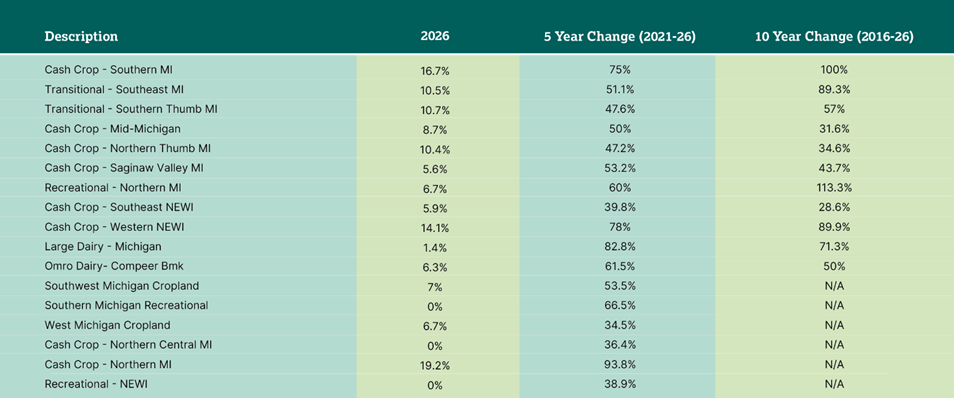
The strongest increase was seen in the cash crop land benchmarks found in northern and Thumb regions of Michigan. Most of these benchmarks increased between 5% – 19%. Cash crop land in northern Michigan experienced the largest increase of all land benchmarks at 19.2%, compared to a 14.5% increase in value of cash crop land in southwest Michigan last year. The increase in cash crop land values in northern Michigan reflects the region’s typical market dynamics, where land value trends have historically followed those observed in southern Michigan.
CAFO (concentrated animal feeding operation) sized dairy farms also grew in value but at a much lower rate than in years past. Large dairies in Michigan increased by just 1.4% compared to a 7.4% increase in 2025, again suggesting stabilization in the market after a period of demand and increase in milk prices following the pandemic.
Recreational and Transitional Land Values
With the addition of the two new recreational benchmarks, the total number of recreational land benchmarks appraised now comes to three, with the existing benchmark located in northern Michigan. Recreational land in northern Michigan did experience a 6.7% increase in value, only a slight drop from a 7.1% increase in 2025. This trend suggests that demand for recreational land remains strong, although competitive pressures appear to have moderated compared with previous years.
Transitional land is defined as agricultural land expected to be developed into another use, such as residential. Both of GreenStone’s transitional benchmarks have increased by more than 10% and have increased in value by more than 50% over the past five years. A strong residential housing market and growing interest in hobby farming and small acreage ownership can be attributed to the continued increase in value for transitional land.
Land Values Across the Region Continue to Stabilize
This year’s land value benchmark analysis points to a market that is continuing to grow, but at a more measured and sustainable pace in contrast with rapid increases seen in the years following the pandemic. While demand for farmland, recreational properties, and small-acreage ownership remains strong, the slower rate of growth across most benchmarks suggests the land market is stabilizing rather than accelerating, with no signs of widespread value declines across Michigan and northeast Wisconsin.
Whether you’re looking to invest in recreational property or considering expanding your farming operations through the purchase of additional farmland, GreenStone’s team of lending experts are here to help you find a solution that’s tailored to you. Click here to learn more about the financial solutions GreenStone provides when it comes to purchasing land.
This article was originally published in Michigan Farm News.
Calling all deer hunters in northeast Wisconsin and Michigan’s Upper Peninsula! Turn your trophy buck into cash this season with GreenStone’s annual Deer Challenge! Don’t miss this opportunity to show off your hunting skills and win dollars for your deer.
The contest is free to enter. Participants will compete for $1,000 in cash prizes. The challenge is open to all Wisconsin and U.P. residents who harvest a deer in GreenStone’s northeast Wisconsin territory or Michigan’s Upper Peninsula between September 12 and November 30, 2026.
The Big Buck class will include eligible participants 18 years and older. Hunters 17 years and younger are invited to compete in the Junior Buck class.
Big Buck Contest (Adults 18 years and older)
- First Place – $400
- Second Place – $200
- Third Place – $100
Junior Buck (17 years and younger)
- First Place – $200
- Second Place – $100
In addition to being eligible for a cash prize, junior hunters who harvest their first deer during the challenge will receive a trophy that can be picked up at their nearest GreenStone branch.
All participants who harvest a buck or doe with a legal gun, bow, muzzleloader, or crossbow and enter the contest will be entered in a drawing to win a game camera or a $25 gift card.
To enter, hunters must complete the form at GreenStoneFCS.com/DeerChallenge or drop off a completed entry form with witness signature and photos of the deer to GreenStone’s Clintonville, Coleman, Escanaba, Little Chute, Manitowoc, and Sturgeon Bay branches. All entry forms must be submitted by Dec. 4. For complete contest rules, contact your local Wisconsin or U.P. branch.
What location is right for us?
Determining the right location for your future home begins with an honest discussion about what’s important to you, your family, and the lifestyle you lead. Some questions to ask yourself include:
- Is the commute to work manageable?
- Is the nearby school district right for your family?
- What non-work activities (gym, hobbies, church, etc.) are important, and are they near this location?
- What’s the minimum number of acres needed for your family?
- Do you want a rural location or to be closer to town?
Before you begin your research, prioritize which of these are most important to you. It’s wise to choose an area that meets your needs now and in the future.
Will this home site work for the home we want to build?
Once you’ve chosen the area where you want to live, the next step is to identify the home site options that are best for you. Not every site will be ideal for building your dream home. Is the style of home you want to build more important to you than the home site? For example, if you want to build a home with a walkout basement, choosing a property that is mostly flat may not be ideal for the style of home you want. Your builder can help you with making sure the home you want is possible on the land you are considering building on.
Is our dream home affordable in this location?
There are many reasons why a particular location could make your dream home unaffordable by adding costs that would not be factors at another location. This is where you will need to do your homework with the local governing bodies. Questions to ask include:
- Are there zoning restrictions on the type, size, or style of home you want to build? Check with the township/sellers to determine if there could be potential issues.
- Are there access issues to the property or to where you are considering building a house on the property? The township can help provide an answer.
- Are there restrictions due to environmental concerns, such as water on the property, that may result in additional costs or restrictions?
- What site improvements will be needed to make the property suitable for construction of a home?
Does this home site have access to necessary utilities?
With the help of your real estate agent or builder, you will need to determine what needs to be done to bring utilities to the property.
Things to consider are:
- Does the property have access to electrical power? If not, what would it cost to get it connected?
- How do you plan to heat your home? Will you use natural gas, propane, electric, a heat pump, or another system? What costs are associated with getting these systems installed? Will you need to heat anything in addition to your home such as a pole barn or other structure?
- Wil you need to dig a well for water? Where is the water table in the area and what depth of well will be required?
- Will you have access to a local sewer system? If not, what type of septic system will you need? Does the property present any obstacles for installing a septic system where you plan to build your home?
Did you consider the homes/properties around you?
Many buyers spend a lot of time analyzing the property they are considering purchasing for a home site and too little time considering how the dynamics of the area could impact their experience. Just because the property you are considering purchasing is currently undeveloped doesn’t mean it won’t be in the future. If an adjacent property is a prime location for a new subdivision or apartment complex, would you still want to build there? Before purchasing, it is good to look at the property several times and at different times of the day or week to get a feel for the level of activity surrounding the home. If you can speak with residents in the area, that can help provide additional context as well.
Working with a lender who understands home site financing is important and will ensure the process of financing the site of your future home goes smoothly. GreenStone offers both home site financing and home construction loans, making it possible to build your dream home on your dream property! Contact your local GreenStone branch to learn more about the home financing options available to you.
Visit GreenStone’s Facebook page from September 8-21, 2026, for your chance to win two tickets to the 2026 TK Pro Rodeo!
Participation in the giveaway is simple: visit GreenStone’s Facebook page from September 8 to September 21, 2026, and comment your answer to the question on our designated post. A random drawing will be held at the end of the contest period to select the four (4) winners, and each winner will receive two (2) tickets to the 2026 TK Pro Rodeo on September 24, 2026.
Here’s what you need to know:
- The contest begins with a social media post on September 8, 2026, and will conclude on September 21, 2026, at 9 AM EDT.
- Two (2) tickets will be given away to the four (4) winners of the random drawing at the end of the contest period.
- Participants must follow our Facebook page to be eligible to win.
- Only one entry per person.
- Entry must be appropriate and reflect the spirit of the rodeo.
- Participants do not need to make any purchases to enter.
- Participants must be 18 years or older to participate.
- Participants must live in Michigan or Wisconsin to be eligible to win.
- To receive the prize, winners must contact GreenStone via Facebook private message by September 23, 2026, and provide their contact information.
[More details in the official rules below]
GreenStone Farm Credit Services is a proud sponsor of the TK Pro Rodeo. Learn more about the upcoming event: TK Pro Rodeo – The Wildest Show in the West
Join us on Facebook to enter!
_______________________________________________________________________________________________
Official GreenStone 2026 TK Pro Rodeo Sweepstake Rules:
NO PURCHASE IS NECESSARY TO ENTER OR WIN. A PURCHASE DOES NOT INCREASE THE CHANCES OF WINNING. The promotion is in no way sponsored, endorsed, administered by, or associated with Facebook.
- Eligibility: This Sweepstake is open only to those followers of the GreenStone Farm Credit Service’s Facebook page (GreenStoneFCS) who participate by commenting on the specific Sweepstake post during the specified time frame and who are 18 years of age or older as of the date of entry. The Sweepstake is only open to legal residents of Michigan and Wisconsin and is void where prohibited by law. Once a participant of a GreenStone contest has been selected as a winner, participants are prohibited from winning all future GreenStone contests. Employees of GreenStone Farm Credit Services, its affiliates, subsidiaries, advertising and promotion agencies, and suppliers, (collectively the “Employees”), and immediate family members and those living in the same household of Employees are not eligible to participate in the Sweepstake. The Sweepstake is subject to all applicable federal, state, and local laws and regulations. Void where prohibited.
- Agreement to Rules: By participating, the Sweepstake participant (“You”) agree to be fully and unconditionally bound by these Rules, and You represent and warrant that You meet the eligibility requirements. In addition, You agree to accept as final and binding the decisions made by GreenStone Farm Credit Services as it relates to the terms and conditions of this Sweepstake.
- Sweepstake Period: Entries will be accepted online starting with the Facebook Sweepstake post on September 8, 2026. Entries can be submitted until September 21, 2026, at 8:59 AM EDT. The four (4) randomly selected winners will be notified on September 21, 2026.
- How to Enter: The Sweepstake must be entered by commenting on the designated post as directed on the GreenStone Farm Credit Services Facebook page at https://www.facebook.com/GreenStoneFCS. Comments that are incomplete or do not adhere to the rules or specifications may be disqualified at the sole discretion of GreenStone Farm Credit Services. You must provide the information requested. You may enter one comment/entry per post per the life of the contest. Multiple comments will not increase your odds of winning, as GreenStone Farm Credit Services will base its selection on the first comment You made. If You use fraudulent methods or otherwise attempt to circumvent the rules, your submission may be removed from eligibility at the sole discretion of GreenStone Farm Credit Services.
- Prizes: Four (4) Winners will be randomly chosen. Winners will receive two (2) tickets to the 2026 TK Pro Rodeo. Actual/appraised value may differ at the time of prize award. Greenstone Farm Credit Services shall solely determine the specifics of the prize. No cash or other prize substitution shall be permitted except at GreenStone Farm Credit Services’ sole discretion. The prize is nontransferable. All prize-related expenses, including without limitation all federal, state, and/or local taxes, shall be the sole responsibility of Winner. No substitution of prize or transfer/assignment of prize to others or request for the cash equivalent by Winner is permitted. Acceptance of prize by Winner constitutes Winner’s permission granted to GreenStone Farm Credit Services to use Winner’s name, likeness, and entry for purposes of advertising and trade without further compensation, unless prohibited by law.
- Odds: The odds of winning depend on the number of eligible entries received.
- Winner Selection and Notification: Four (4) Winners from the Sweepstake post will be randomly chosen by GreenStone Farm Credit Services. Four (4) Winners will be notified in the comments of the Facebook post on September 21, 2026, at 9 AM EDT; Sweepstake comments will be eligible for the life of the contest. GreenStone Farm Credit Services shall have no liability for Winners’ failure to receive notices due to Facebook notifications, spam, junk email, or other security settings or for Winners’ provision of incorrect or otherwise non-functioning contact information. If the Winners cannot be contacted, are ineligible, or fail to claim the prize by September 23, 2026, the prize may be forfeited. The Winners must contact GreenStone Farm Credit Services via Facebook private message with their name, email, and phone number by September 23, 2026, to receive the details of redeeming their tickets. Receipt by Winners of the prizes offered in this Sweepstake is conditioned upon compliance with all federal, state, and local laws and regulations. ANY VIOLATION OF THESE OFFICIAL RULES BY A WINNER, AT GREENSTONE FARM CREDIT SERVICES’ SOLE DISCRETION, WILL RESULT IN WINNER’S DISQUALIFICATION AS WINNER OF THE SWEEPSTAKE, AND ALL PRIVILEGES AS WINNER WILL BE IMMEDIATELY TERMINATED.
- Rights Granted by You: By entering this Sweepstake, You understand and agree that GreenStone Farm Credit Services, anyone authorized to act on behalf of GreenStone Farm Credit Service, and GreenStone Farm Credit Services’ licensees, successors, agents, and assigns, shall have the right, where permitted by law, to print, publish, broadcast, distribute, and use in any media now known or hereafter developed, in perpetuity and throughout the world, without limitation, your entry, name, portrait, picture, voice, likeness, image, statements about the Sweepstake, and biographical information for news, publicity, information, trade, advertising, public relations, and promotional purposes, without any further compensation, notice, review, or consent.
- By entering this Sweepstake, You represent and warrant that your Facebook Sweepstake comment is your original comment and does not violate any third party’s proprietary or intellectual property rights. If your Facebook comment infringes upon the proprietary or intellectual property right of another, You will be disqualified at the sole discretion of GreenStone Farm Credit Services. If the content of your Facebook comment is claimed to constitute infringement of any proprietary or intellectual proprietary rights of any third party, You shall, at your sole expense, defend or settle against such claims. You shall indemnify, defend, and hold harmless GreenStone Farm Credit Services from and against any suit, proceeding, claims, liability, loss, damage, costs or expense, which GreenStone Farm Credit Services may incur, suffer, or be required to pay arising out of such infringement or suspected infringement of any third party’s right.
- Terms & Conditions: GreenStone Farm Credit Services reserves the right, in its sole discretion, to cancel, terminate, modify or suspend the Sweepstake should any virus, bug, non-authorized human intervention, fraud, or other source beyond GreenStone Farm Credit Services’ control, corrupt or affect the administration, security, fairness, or proper administration of the Sweepstake. In such case, GreenStone Farm Credit Services may select the Winner from all eligible Facebook comments received prior to and/or after (if appropriate) the action taken by GreenStone Farm Credit Services. GreenStone Farm Credit Services reserves the right, in its sole discretion, to disqualify any individual who tampers with or attempts to tamper with the entry process, administration or operation of the Sweepstake, or website, or violates these Terms and Conditions. GreenStone Farm Credit Services has the right, in its sole discretion, to maintain the integrity of the Sweepstake, to void Facebook comments for any reason, including, but not limited to: multiple Facebook comments on same post from the same user from different IP addresses; multiple Facebook comments from the same computer in excess of that allowed by Sweepstake rules; or the use of bots, macros, scripts, or other technical means for entering. Any attempt by an entrant to deliberately damage any website for the purpose of undermining the legitimate operation and administration of the Sweepstake may be in violation of criminal and civil laws. Should such attempt be made, GreenStone Farm Credit Services reserves the right to fully seek damages permitted by law.
- Limitation of Liability: By commenting on a Sweepstake post, You agree to release and hold harmless GreenStone Farm Credit Services and its subsidiaries, affiliates, advertising and promotion agencies, partners, representatives, agents, successors, assigns, employees, officers, and directors from any liability, illness, injury, death, loss, litigation, claim, or damage that may occur, directly or indirectly, whether caused by negligence or not, from: (i) such entrant’s participation in the Sweepstake and/or his/her acceptance, possession, use, or misuse of any prize or any portion thereof; (ii) technical failures of any kind, including but not limited to the malfunction of any computer, cable, network, server, hardware or software, Facebook page, or other mechanical equipment; (iii) the unavailability or inaccessibility of any transmissions, telephone, or Internet service; (iv) unauthorized human intervention in any part of the entry process or the Sweepstake; (v) electronic or human error in the administration of the Sweepstake or the processing of comments.
- Disputes: THIS SWEEPSTAKE IS GOVERNED BY THE LAWS OF THE UNITED STATES OF AMERICA AND THE STATE OF MICHIGAN, WITHOUT RESPECT TO CONFLICT OF LAW. AS A CONDITION OF PARTICIPATING IN THIS SWEEPSTAKE, PARTICIPANT AGREES THAT ALL DISPUTES THAT CANNOT BE RESOLVED BETWEEN THE PARTIES AND CAUSES OF ACTION ARISING OUT OF OR CONNECTED WITH THIS SWEEPSTAKE, SHALL BE RESOLVED INDIVIDUALLY, WITHOUT RESORT TO ANY FORM OF CLASS ACTION, EXCLUSIVELY BEFORE AN APPROPRIATE COURT HAVING JURISDICTION WITHIN THE STATE OF MICHIGAN. FURTHER, IN ANY SUCH DISPUTE, UNDER NO CIRCUMSTANCES SHALL PARTICIPANT BE PERMITTED TO OBTAIN AWARDS FOR, AND HEREBY WAIVES ALL RIGHTS TO, PUNITIVE, INCIDENTAL, OR CONSEQUENTIAL DAMAGES, INCLUDING ATTORNEY’S FEES, OTHER THAN PARTICIPANT’S ACTUAL, REASONABLE OUT-OF-POCKET EXPENSES (I.E. COSTS ASSOCIATED WITH ENTERING THIS SWEEPSTAKE). PARTICIPANT FURTHER WAIVES ALL RIGHTS TO HAVE DAMAGES MULTIPLIED OR INCREASED.
- Privacy Policy: Information submitted with an entry is subject to the Privacy Policy stated on the GreenStone Farm Credit Services website. View the Privacy Policy at https://www.greenstonefcs.com/resources/member-resources/security-privacy-center/
- Winners List: To obtain a copy of the Winners’ names or a copy of these Official Rules, mail your request along with a stamped, self-addressed envelope to: GreenStone Farm Credit Services, Attn: Marketing and Public Relations Department, 3515 West Road, East Lansing, Michigan 48823. Requests must be received no later than September 23, 2026. These Official Rules may not be available online after the expiration of this Sweepstake. Copies of these Official Rule may be requested as noted in this paragraph, subject to GreenStone Farm Credit Services document retention policy.
- Sponsor: The Sponsor of the Sweepstake is GreenStone Farm Credit Services, 3515 West Road, East Lansing, Michigan 48823, USA.
- Sweepstake hosted by GreenStone Farm Credit Services is in no way sponsored, endorsed, administered by, or associated with Facebook.
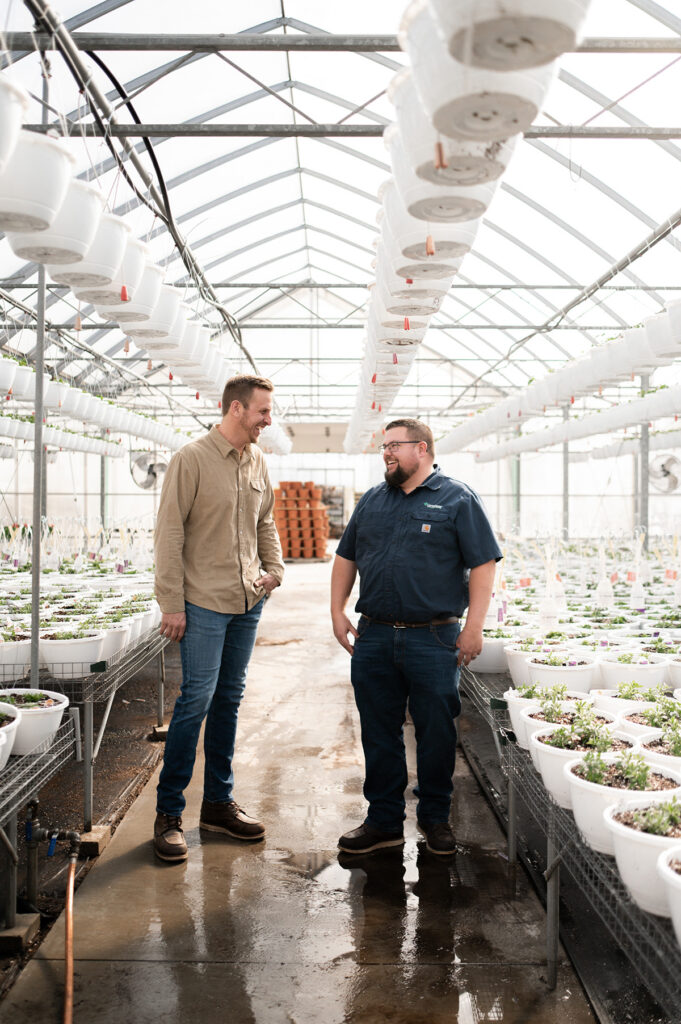
Growing up on a hobby farm, Chad Anderson had a connection to agriculture from a young age. He studied business in college and spent a couple years in the Peace Corps but felt the itch to return to the soil. He spent a season working for a vegetable farm before deciding he wanted to start something of his own. That’s when Green Wagon Farm was born.
Chad founded Green Wagon Farm in 2010. Shortly after, met his wife, Heather, who joined him as co-owner and farm and market manager. What began as a small operation on four leased acres has since grown into a year-round farm on 18 acres with a crew of about eight employees, which nearly doubles in size during the busy summer months. Chad made his first wholesale sale in his first year growing when a local buyer approached him directly. “We jumped right in and the relationship stuck,” Heather said. “We have a great relationship with them still, among other local restaurants.”
15 years later, after connecting with Forest Hills Foods, their wholesale market expanded quickly. Green Wagon’s ability to produce salad greens, microgreens, kale, and chard throughout the winter has made it a natural fit for grocers and restaurants who want fresh, local produce all year.
Vegetables have always been the focus of the farm, and over the years the Andersons have created many ways to connect with their customers. Their community supported agriculture (CSA) program has been a part of the business from the start – a year-round membership where customers pay monthly and pick their own produce weekly. They also sell at the Fulton Street Market year-round, and the Holland Farmers Market during the summer. Their largest channel now is by far wholesale, which makes up a little over 60% of their sales by supplying small grocers and restaurants with fresh produce throughout the Grand Rapids area.
The Andersons began their relationship with GreenStone a few years after they started the operation, but it wasn’t until Heather heard from her friends at Lakeview Hill Farm in Traverse City, Mich., that they learned about the CultivateGrowth program. That conversation was enough to convince Heather and Chad to apply for the CultivateGrowth grant, which provides young, beginning, and small farmers with financial support to offset the costs of continuing agricultural education.
The grant helped send them to the Organic Vegetable Production Conference, designed to educate vegetable growers at every stage of their operations. Even though the Andersons are more than a decade into the business, they are still looking to sharpen their business.
“We’ve been in operation for over ten years,” Heather said. “We’re not necessarily beginning farmers but still seeking to learn and improve our business.”
The conference offered crop-specific sessions, covering a handful of vegetable crops each year, alongside management-focused sessions on topics like crop storage, soil health, and no-till practices.
One session made a lasting impression: an approach called “habit farming,” a management style borrowed from lean manufacturing principles, and the same philosophy associated with Toyota’s production system. The strategy is to learn what the customer values most and then find the most efficient way to deliver it.
After the conference, Green Wagon’s team took part in a whole-farm review, walking through the property and gathering feedback from all team members on what had worked well over the season and what hadn’t. This review continued into the winter as they started to implement real changes, like a new lettuce-bagging process and new field signage marking bed numbers so the team can quickly identify the proper harvesting locations. Over this planting season, they have already seen the positive effects of the changes they made.
For Heather, the value of GreenStone’s CultivateGrowth grant goes beyond any one event. “It’s nice to be able to have an outlet to learn in so many different ways for people, because it’s not just one specific program, but we can use it to learn in so many different ways, both hands on and in community with other farmers.”
The Andersons have already applied for further CultivateGrowth support – one more step for farmers that even 15 years in, still aren’t done growing.
As long summer days begin to turn into chilly mornings and earlier sunsets, harvest season is right around the corner. You may have already started getting ready for the season through equipment inspections and maintenance, preparing your grain storage, or making labor and trucking arrangements. However, your farm’s financial preparation is just as important when it comes to this busy time of year. Here’s how to make sure your operation is financially ready for the season ahead.
Review Operating Lines of Credit
Harvest season expenses like fuel and supplies, seasonal labor, trucking and transportation, equipment and land payments, and other operational expenses can fluctuate and may be more than you were anticipating earlier in the season.
You should determine ahead of time whether you have enough cash flow available to cover these expenses, or if you should start a conversation with your lender about increasing your operating line of credit.
An operating loan with GreenStone can help you manage your cash flow through flexible terms, competitive interest rates, and a variety of repayment options. Your financial services officer can help you determine if increasing your operating line of credit is the right move for your operation this harvest season.
Revisit Your Marketing Plan
If the last time you reviewed your marketing strategy was at the beginning of the year, it’s time to revisit it again before harvest season ramps up. Updating financial projections before harvest allows you to determine whether marketing targets still align with current profitability goals.
Ask yourself the following questions:
- What fertilizer or input costs have increased throughout the year?
- Has my break-even price changed?
- Do I need to adjust my marketing targets?
- Am I still on budget?
If changes to expenses have raised your break-even costs, you may need to consider adjusting your marketing strategy. If it looks like you may encounter a loss this season, early communication with your lender is key.
Whether the issue involves lower-than-expected yields, delayed grain sales or reduced profitability, discussing concerns with lenders early provides more flexibility than waiting until payments become overdue. The earlier you communicate with your lender, the more solutions they will be able to offer you.
Don’t Wait Until December for Tax Planning
Don’t wait until the last month of the year to try to organize a year’s worth of financial records. Instead of creating unnecessary stress for yourself and limiting strategic tax planning opportunities, getting your financial records in order ahead of time will help you go into year-end with peace of mind.
Staying as current as possible on your bookkeeping will give you a better understanding of your tax position and will allow you more time to evaluate your options such as prepaid expenses, equipment purchases, and other tax management strategies. That’s where working with an experienced tax accountant comes in. GreenStone offers a dedicated team of tax and accounting specialists with full accounting services, tax planning and preparation, farm record keeping, and payroll management to help you minimize your liabilities and maximize your savings.
Improve Decision-Making by Planning Ahead
In addition to updating your bookwork for the current year, getting your projections ready for the next year will help you get a head start on the upcoming seasons. Now is the time to look ahead to what input costs will be in the spring, and if possible, purchasing those inputs ahead of time.
Are you planning on upgrading any of your equipment next year, or improving your facilities? If so, share your plans with your lender so they can work with you on a solution that will best fit your needs. If you’re not sure of your financial position or if you can afford to make a purchase such as land or equipment next year, your lender can work with you to see where you are at!
Work with a Lender Who Understands Your Operation
By preparing both operationally and financially ahead of harvest, producers can reduce risk, improve decision-making and position their businesses for a stronger finish to the year. When you work with a lender who speaks your language and understands the agriculture industry, you’re setting your operation up for success.
Contact your local team of lending experts at your nearest GreenStone branch to learn more.
This article was originally published in Michigan Farm News.
Buying your dream home is a huge decision. Deciding the right time to buy can be even more daunting. Add to that an ever-changing housing market and fluctuating interest rates, and the home buying process can feel overwhelming.
The good news is the perfect time for you to buy a home is when you are ready to make the leap toward your dream of home ownership. It is impossible to time the market perfectly, but there are things to consider making the most of your investment when you decide it’s time to take the leap.
Focus on the Monthly Payment
Rather than focusing on what current interest rates are, focus your attention on the purchase price and what your monthly payment will be for your new home. Don’t let an interest rate dictate whether it’s a good time to find your dream home. Interest rates are constantly changing, with no guarantee of knowing which direction they will go. The good news is, if you take out a home loan right now and the interest rate is not favorable, you can always refinance and take advantage of lower rates in the future. At GreenStone, you have an even better option. GreenStone members don’t have to refinance to take advantage of falling rates. With an interest rate conversion, GreenStone members can quickly and efficiently capture savings when interest rates drop without the need for a credit check, appraisal, or title fee.
How do you know what monthly payment you can afford for your new home? With GreenStone, the first step is submitting an online application to get prequalified for a purchase. You can also do some preliminary work on your own. GreenStone has a free loan payment calculator available here to help estimate this expense into your budget.
Consider Additional Home Expenses
It can be tempting to rush into making an offer when finding your dream home, but before you do, there are plenty of things to consider to make sure it’s right for you.
Outside of your monthly payment, you should also consider other costs you’ll incur to purchase your home. To start, your lender will require a down payment on your loan. We offer flexible down payment options personalized to meet your needs, which could be as little as 5% down with Private Mortgage Insurance (PMI) if your property qualifies. At GreenStone, interest rates for home mortgages vary based on credit score, down payment amount, and property type.
Another thing to consider when determining your overall “cash to close” costs are the fees or closing costs associated with your purchase and the loan. A good rule of thumb is to plan for 2-5% of the cost of your home to go towards closing costs, as it can vary depending on the loan amount, acreage involved, and documentation needed for your loan request.
Another often forgotten cost associated with a home purchase is the new estimated property taxes. To get an idea of what your estimated property taxes might be ahead of time in Michigan, click here. If you’re looking for a home in Wisconsin, view your estimated property taxes here.
One last often overlooked cost in every home purchase is the cost of moving. Whether hiring professionals or getting help from your friends or family, moving takes and can be pricey. After purchasing your home and closing on the loan, be sure to budget in the upcoming costs for the move, having utilities transferred to you from the previous owner, and any furniture or other items you’ll need.
Work with a Specialized Lender
Over the past few years, a demand in homes immediately following the pandemic has led to an increase in home prices, often resulting in accepted offers over the list price. This has changed as supply has slowly increased, interest rates are holding, and the overall market has become balanced, giving buyers a better chance of buying the property they have been working towards.
Buying a new home can feel overwhelming, but GreenStone’s dedicated team of lending experts are here to help you every step of the way. Call your local branch today to learn more about our specialized lending options for your unique needs.
GreenStone is committed to supporting agriculture and our rural communities. How we provide that support looks different for each of our members – because no two farms or families are the same! We provide tailored lending and financial solutions to a wide variety of members, all across Michigan and northeast Wisconsin.
No matter the size of your operation, our team of lending experts can work with you to find a solution for your unique needs. Whether you farm five or 5,000 acres, we have financing options to support you!
One of the ways we support the rural way of life is through our part-time financing options. No matter your goal, from raising livestock, selling produce from your garden, or are exploring hobby businesses such as beekeeping, GreenStone offers specialized lending to help you secure financing for pole barns, fencing, utility vehicles or equipment, or anything else needed for a thriving farm or rural business.
As a young, beginning, or small farmer, GreenStone’s CultivateGrowth program is designed to help you build a successful agricultural operation at whatever scale you’re dreaming of through grants, education, mentorship, and specialized financing. We provide support to individuals who meet one or more requirements:
- Between the ages of 18-35 years old
- 10 years or less of farming experience
- Earn less than $350,00 in annual gross income from production agriculture
GreenStone has been helping farmers and families build businesses, lives, and legacies for over a century. Our agriculture loan options can help cover operating costs, equipment, livestock, land, and building improvements.
We also provide agribusiness loans to those providing vital services to the agriculture industry, including vet services, customer harvesting, timber processing, food processing, storage and more.
For those looking to build their rural life, we help residents achieve their dreams through financing for country living, including country homes, home construction, home sites, and recreational land.
We understand no two members are the same. That’s why we offer a wide range of financial services tailored to your unique needs! To find a solution that’s right for you, pleasant don’t hesitate you reach out to your local GreenStone branch.
Owning every tractor and implement used to farm may have been the conventional approach to managing your equipment lineup in years past. However, in today’s market that approach is likely not the most economical and could have lasting impacts on your bottom line. As the cost of equipment, parts, labor, and repairs steadily increase, leasing or custom hiring work could be a more viable, cost-efficient alternative to ownership. All strategies have pros and cons – and which one works best for you depends on a few key variables.
Comparing Costs
In today’s market, farmers are looking for places to cut costs where available. While it may have once been economical to have two planters and two tractors running simultaneously during planting season, that may not be the case anymore for many producers. It is wise to evaluate whether the high cost of operating multiple pieces of equipment is worth the production value for your farm.
Performing a cost comparison is typically the first thing farmers calculate when determining whether to buy, lease, or custom hire. However, that comparison needs to account for more than just the sticker price and how much capital is required to get a certain piece of equipment. Hidden costs may not be apparent at first glance. Cash flow and trade-in value variables often play an important part in the consideration. These factors should all be accounted for when determining whether buying, leasing, or custom hiring is right for your farm’s financial health.
Additional Capital and Infrastructure
There’s a ripple effect: some equipment is dependent on other equipment, which may also require additional labor that must be factored into the equation. The owner of a manure tanker or dragline system, for example, cannot overlook the additional equipment required to set-up and support the manure application system. Can your existing tractor efficiently operate the manure application equipment? Are additional pumps or motors required? Likewise, if you are a dairy farmer, do you have the time and labor needed to get the job done and still manage the rest of your day-to-day farm duties? Additional capital and infrastructure are needed to handle your farm’s manure, which is why many dairy producers may choose to custom hire a manure handling service.
Custom work has been on the rise in recent years because of rising costs of owning certain pieces of equipment. It’s important to determine how much use a piece of machinery will get within your farm’s daily operations. Equipment you use every day or more time-critical machinery may be better to own versus custom-hiring. Having more control over that asset through customization is another reason purchasing may be the better option. GreenStone offers financing for both new and used equipment if purchasing is the best option for your operation.
Cash Flow Considerations
When looking for options to help keep your fixed costs flexible, leasing certain pieces of equipment may be the best solution for your farm. Leasing can help free up cash flow and allow your operation to more easily adapt to changing equipment needs. Instead of putting a down payment on an equipment loan, leasing can help your operation maintain more liquid resources.
GreenStone offers lease-to-own solutions for farm equipment and machinery through our partners at Farm Credit Leasing. With no down payment required, our leasing solutions help you control cash flow, reduce maintenance costs, and improve your balance sheet all while working towards owning the equipment.
Leasing can also provide significant tax advantages as lease payments are generally 100% tax deductible as operating expenses. However, it is still important to fully analyze if this benefit is the right choice for you. Working with GreenStone’s dedicated team of tax and accounting specialists can help you determine the best cost-savings strategy for your operation.
Determine the Right Solution for Your Unique Needs
When deciding whether to buy, lease or utilize custom hiring, it’s important to closely examine your machinery needs and costs associated with each before determining the right move is for your farm. Analyzing your unique operation and your equipment strategy will help you achieve the highest return on investment. If you have questions on what the right solution is for your farm, our team of lending experts are here to help.
Contact your local branch today to learn more!
This article was originally published in Michigan Farm News.
You already know the benefits of owning your own hunting land. The ability to be in control of your own hunting site, develop your property, and increase its value are all great reasons to invest in your own rural getaway.
If you’re already dreaming of time in the deer stand on your own land this year, now is the perfect time to start your search for the land where you will bag your dream buck! Here’s how to get started on your journey to purchase your own property.
1. Determine Your Financial Readiness
Before making a purchase, preparation, communication with your lender, and understanding your goals are all keys to success.
Bring your lender into the conversation as early as possible. Meeting with your lender before you begin searching for land will help you be prepared going into the land purchasing process. Your lender will discuss your financial information to understand what your lending needs are. This can include looking at your credit history, determining how much would be needed for a down payment, and verifying your income history before applying for a loan.
A great way to evaluate your financial readiness before even meeting with your lender is by looking at the Four Cs of Credit: Collateral, Capital, Credit, and Capacity.
- Collateral analyzes any assets or property you already own that can be used to secure the loan. When you work with GreenStone as your lender, equity from other real estate may be used in place of cash for a down payment on your land in some situations. We also offer competitive down payment options personalized to your unique needs.
- Capital analyzes your overall financial position; from the cash you have on hand to your savings and investments.
- Character looks at your borrowing history, such as your credit score and repayment history.
- Capacity measures your ability to repay a new debt, including your debt-to-income ratio.
Reviewing these financial readiness checkpoints will put you on the right track to getting approval for your loan!
2. Get Your Documents Ready
Having your documentation and information ready can also help streamline the loan approval process. When first meeting with your lender, they will often require the following documentation to complete your loan application:
- Driver’s license or photo I.D.
- Income verification
- Bank account statements
- Retirement account balances
If you’ve already scouted out the property you’re looking to purchase, any additional information you can provide up front to your lender can also speed up your approval process. Property info such as the address, parcel number, and purchase agreement (if you have one) are all useful during the approval stage.
3. Evaluate the Property
A property might look perfect at first- but does it suit your long-term needs? It’s important to evaluate the land for what you want to use it for now, and in the future. Maybe you will eventually like to build a cabin, or your permanent residence on the land. Would it be possible to connect utilities to the property to ensure access to water and electricity? When financing your land with GreenStone, there are no requirements to build on your property, giving you the freedom to truly enjoy your property how you want to!
Another thing to consider are zoning restrictions. Whether the land is zoned as agricultural, residential, or mixed use, could that prohibit you from using the land how you want to? Is there existing public access, or any easements that exist for the property? How about any existing leases that would inhibit your ability to lease the land to other hunters? Doing as much research as possible on the land before purchasing will ensure it remains the perfect property for years to come!
4. Work with a Lender Who Understands Hunting Land Loans
Working with a lender who specializes in recreational land loans is the key to success. GreenStone’s dedicated team of loan experts are here to help you through the loan process and fit the right loan and terms for your needs. To speak with one of GreenStone’s financial services officers about financing your dream property, visit a GreenStone branch near you.