


Falling leaves and cooling temperatures have many hunters once again dreaming about having their own land to harvest trophy bucks and build memories. Owning your own hunting land isn’t just about the thrill of the hunt; it’s about freedom, investment, and a place that can be passed down for generations. Here are five reasons to buy hunting land.
1. You Call the Shots
When you own land, you make the rules. From scouting to prepping the property out of season, you are free to curate your hunting experience. And come opening day, there is no competing for the best spot. You can make your own outdoor paradise customized for your needs.
You decide who hunts and when, ensuring a safer, more enjoyable experience. You also control how your land is managed. Intentional property management is to hunting land what fertilizer is to a crop field, it an environment that yields a better experience.
2. Land Holds Value
The universe isn’t making more land, so any acreage you buy is, in fact, an investment. Purchasing hunting land can be a strategy for building equity while retaining a practical use for a property.
Historically, land values steadily grow over time, as opposed to other investment vehicles like the stock market, which can be riskier due to additional volatility.
Buying your own land also means you can sell it down the road and make a profit, as opposed to leasing or renting hunting land. Any improvements you make to your property can be considered when it comes to evaluating the value of your property.
If a plot next to yours goes up for sale, it may be an opportunity for further investment. You can expand your acreage using one of the different loan options offered at GreenStone. Many of these options require less money down and have favorable loan terms.
You can also build on your land – whether you’re looking to retire in the country, have a rustic cabin getaway spot for your family, or have a place to crash during winter snowmobiling.
3. Make It Yours
If you’re a deer hunter, you know there are certain conditions that attract whitetails for the perfect hunting experience. When you own your own hunting land, you get to improve your habitat to create your ideal conditions for hunting, and for the health of the wildlife that calls your property home.
Land ownership means the opportunity to plant food plots and create water features for wildlife. You can also build a permanent deer blind in your favorite spot.
By owning your own land, you can also harvest timber on the land. This not only puts more money in your pocket, but it allows new undergrowth creating a thicker environment great for deer bedding, food, and leisure.
If you plan on spending days at a time hunting, you can take it a step further and build a cabin or cottage to sleep in or create a more permanent hookup for a camper. As mentioned above, these improvements to your property can also add to its value.
4. Supports the Future
Hunting and spending time in the great outdoors with your children and grandchildren, friends or significant other is a great way to build memories that last a lifetime. When you own your own hunting land, you can create a safe, enjoyable experience for all. It’s also a great opportunity to teach your children or grandchildren hunting, trapping and fishing while contributing to the health of our wildlife habitats.
Adding a cabin to your property can be a perfect opportunity to get away from the hustle and bustle of life and spend time unplugged with your family and close friends.
Having extra land also allows you to pass down property to future generations because, as mentioned, the supply of land is limited.
5. Earn Extra Cash
You may ask yourself “How can I make hunting land ownership more affordable?” Well, when you’re not enjoying your hunting land, other people can, and that can help your bottom line!
If you have a cabin or even a camper on your land, you can rent it out on sites like Airbnb and VRBO to earn extra income.
You can also lease part of your land to other hunters on an annual or seasonal basis. If your property includes ground suitable for farming, you can lease it to local farmers.
This extra land could also allow you to pick up some hobbies like beekeeping, selling fruits and vegetables or harvesting timber. These options can serve as great side hustles, also providing you with additional income.
Getting Started
GreenStone specializes in financing land and can help make obtaining a land loan convenient and easy. With long-term fixed rates, flexible financing options such as potentially using owned property as equity, and ability to offer group hunting loans for purchases with friends and family, we can help make recreational land affordable.
Use our loan calculator to see how affordable your piece of paradise could be!
Ready for next steps? Connect with a GreenStone rural land financing expert today.
Visit GreenStone’s Facebook page during the month of November for your chance to win a Revolver Pro 360 Cellular trail camera and $150 Jay’s Sporting Goods gift card!
Participation in the giveaway is simple: visit our Facebook page’s designated Capture the Wild contest post during the entry period to comment your best trail cam picture or photo of the great outdoors! After you comment on our Capture the Wild contest post, you will automatically be entered in a random drawing to win the trail camera and gift card! You can also fill out our quick survey HERE in addition to commenting your photo to receive 5 Bonus Entries!
Here’s what you need to know:
- The contest begins on November 3, 2025, and concludes on November 21, 2025
- One Revolver Pro 360 Cellular trail camera and $150 Jay’s Sporting Goods gift card will be given away to the first lucky, randomly drawn participant
- One Revolver Pro 360 Cellular trail camera and $100 Jay’s Sporting Goods gift card will be given away to the second lucky, randomly drawn participant
- A $50 Jay’s Sporting Goods gift card will be given away to the third lucky, randomly drawn participant
- Participants do not need to make any purchases to enter
- Participants must be 18 years or older to participate
- Participants must live in Michigan or Wisconsin to be eligible to win
- Winner must contact GreenStone via Facebook private message by December 2, 2025, to provide their contact information in order to receive the prize
[More details in the official rules below]
GreenStone Farm Credit Services looks forward to highlighting our recreational land financing options throughout the fall! To learn more about how GreenStone can help you capture the wild through recreational land financing, visit our site!
Join us on Facebook to Capture the Wild!
Official GreenStone Capture the Wild Rules:
NO PURCHASE IS NECESSARY TO ENTER OR WIN. A PURCHASE DOES NOT INCREASE THE CHANCES OF WINNING. The promotion is in no way sponsored, endorsed, administered by or associated with Facebook.
- Eligibility: This Sweepstake is open only to those who participate by commenting on the GreenStone Farm Credit Service’s Facebook page under the specific Sweepstake post during the specified time frame and who are 18 years of age or older as of the date of entry. The Sweepstake is only open to legal residents of Michigan and Wisconsin and is void where prohibited by law. Participants cannot win a prize more than once. Employees of GreenStone Farm Credit Services, its affiliates, subsidiaries, advertising and promotion agencies, and suppliers, (collectively the “Employees”), and immediate family members and those living in the same household of Employees are not eligible to participate in the Sweepstake. The Sweepstake is subject to all applicable federal, state, and local laws and regulations. Void where prohibited.
- Agreement to Rules: By participating, the Sweepstake participant (“You”) agree to be fully and unconditionally bound by these Rules, and You represent and warrant that You meet the eligibility requirements. In addition, You agree to accept as final and binding the decisions made by GreenStone Farm Credit Services as it relates to the content of this Sweepstake.
- Sweepstake Period: Entries will be accepted online starting with the Facebook Sweepstake post on November 3, 2025. Entries can be submitted until November 21, 2025 at 11:59 PM EST. The randomly selected winners will be drawn on November 24, 2025 and notified on November 25, 2025.
- How to Enter: The Sweepstake must be entered by commenting on the designated post as directed on the GreenStone FCS Facebook page at https://www.facebook.com/GreenStoneFCS. Comments that are incomplete or do not adhere to the rules or specifications may be disqualified at the sole discretion of GreenStone Farm Credit Services. You must provide the information requested. You may enter one comment/entry per post per the life of the contest. Multiple comments will not increase your odds of winning, as we will base selection on the first comment you made. If you use fraudulent methods or otherwise attempt to circumvent the rules, your submission may be removed from eligibility at the sole discretion of GreenStone Farm Credit Services.
- Additionally, you may elect to fill out and submit GreenStone’s survey via this Link or using the link provided in the designated post for an additional five bonus entries. These entries are subject to form completion, and having already commented an entry photo on the designated post. Filling out the form multiple times will not increase your entries or chances of winning. Only one survey per person may be completed for the life of this contest.
- Prizes: Three Winners will be chosen by random from the entries received and those Winners will receive one Revolver Pro 360 Cellular trail camera and $150 Jay’s Sporting Goods gift card if they’re the random first drawn participant, one Revolver Pro 360 Cellular trail camera and $100 Jay’s Sporting Goods gift card if they’re the random second drawn participant, and a $50 Jay’s Sporting Goods gift card if they’re the random third drawn participant. Actual/appraised value may differ at time of prize award. The specifics of the prize shall be solely determined by GreenStone Farm Credit Services. No cash or other prize substitution shall be permitted except at GreenStone Farm Credit Services’ discretion. The prize is nontransferable. Any and all prize-related expenses, including without limitation any and all federal, state, and/or local taxes, shall be the sole responsibility of Winner. No substitution of prize or transfer/assignment of prize to others or request for the cash equivalent by a Winner is permitted. Acceptance of a prize by a Winner constitutes Winner’s permission granted to GreenStone Farm Credit Services to use Winner’s name, likeness, and entry for purposes of advertising and trade without further compensation, unless prohibited by law.
- Odds: The odds of winning depend on the number of eligible entries received.
- Winner Selection and Notification: Three Winners from the Sweepstake entries will be chosen at random by GreenStone Farm Credit Services. The Winners will be announced on Facebook November 25, 2025; Sweepstake comments will be eligible for the life of the contest. GreenStone Farm Credit Services shall have no liability for a Winner’s failure to receive notices due to Facebook notifications, spam, junk email or other security settings or for a Winner’s provision of incorrect or otherwise non-functioning contact information. If a Winner cannot be contacted, is ineligible, or fails to claim the prize by December 2, 2025, the prize may be forfeited. The Winners must contact GreenStone FCS via Facebook private message with their mailing address by December 2, 2025 to receive their prize. Receipt by Winners of the prizes offered in this Sweepstake is conditioned upon compliance with any and all federal, state, and local laws and regulations. ANY VIOLATION OF THESE OFFICIAL RULES BY A WINNER, AT GREENSTONE FARM CREDIT SERVICES’ SOLE DISCRETION, WILL RESULT IN WINNER’S DISQUALIFICATION AS WINNER OF THE SWEEPSTAKE, AND ALL PRIVILEGES AS WINNER WILL BE IMMEDIATELY TERMINATED.
- Rights Granted by You: By entering this Sweepstake, You understand and agree that GreenStone Farm Credit Services, anyone authorized to act on behalf of GreenStone Farm Credit Service, and GreenStone Farm Credit Services’ licensees, successors, and assigns, shall have the right, where permitted by law, to print, publish, broadcast, distribute, and use in any media now known or hereafter developed, in perpetuity and throughout the World, without limitation, your entry, name, portrait, picture, voice, likeness, image, statements about the Sweepstake, and biographical information for news, publicity, information, trade, advertising, public relations, and promotional purposes, without any further compensation, notice, review, or consent.
- By entering this Sweepstake, You represent and warrant that your Facebook Sweepstake comment is your original comment and does not violate any third party’s proprietary or intellectual property rights. If your Facebook comment infringes upon the proprietary or intellectual property right of another, You will be disqualified at the sole discretion of GreenStone Farm Credit Services. If the content of your Facebook comment is claimed to constitute infringement of any proprietary or intellectual proprietary rights of any third party, you shall, at your sole expense, defend or settle against such claims. You shall indemnify, defend, and hold harmless GreenStone Farm Credit Services from and against any suit, proceeding, claims, liability, loss, damage, costs or expense, which GreenStone Farm Credit Services may incur, suffer, or be required to pay arising out of such infringement or suspected infringement of any third party’s right.
- Terms & Conditions: GreenStone Farm Credit Services reserves the right, in its sole discretion, to cancel, terminate, modify or suspend the Sweepstake should virus, bug, non-authorized human intervention, fraud, or other cause beyond GreenStone Farm Credit Services’ control corrupt or affect the administration, security, fairness, or proper conduct of the Sweepstake. In such case, GreenStone Farm Credit Services may select the Winner from all eligible Facebook comments received prior to and/or after (if appropriate) the action taken by GreenStone Farm Credit Services. GreenStone Farm Credit Services reserves the right, in its sole discretion, to disqualify any individual who tampers with or attempts to tamper with the entry process or the operation of the Sweepstake or website, or violates these Terms & Conditions. GreenStone Farm Credit Services has the right, in its sole discretion, to maintain the integrity of the Sweepstake, to void Facebook comments for any reason, including, but not limited to: multiple Facebook comments on same post from the same user from different IP addresses; multiple Facebook comments from the same computer in excess of that allowed by Sweepstake rules; or the use of bots, macros, scripts, or other technical means for entering. Any attempt by an entrant to deliberately damage any website or undermine the legitimate operation of the Sweepstake may be a violation of criminal and civil laws. Should such attempt be made, GreenStone Farm Credit Services reserves the right to seek damages to the fullest extent permitted by law.
- Limitation of Liability: By commenting on a Sweepstake post, You agree to release and hold harmless GreenStone Farm Credit Services and its subsidiaries, affiliates, advertising and promotion agencies, partners, representatives, agents, successors, assigns, employees, officers, and directors from any liability, illness, injury, death, loss, litigation, claim, or damage that may occur, directly or indirectly, whether caused by negligence or not, from: (i) such entrant’s participation in the Sweepstake and/or his/her acceptance, possession, use, or misuse of any prize or any portion thereof; (ii) technical failures of any kind, including but not limited to the malfunction of any computer, cable, network, server, hardware or software, Facebook page, or other mechanical equipment; (iii) the unavailability or inaccessibility of any transmissions, telephone, or Internet service; (iv) unauthorized human intervention in any part of the entry process or the Sweepstake; (v) electronic or human error in the administration of the Sweepstake or the processing of comments.
- Disputes: THIS SWEEPSTAKE IS GOVERNED BY THE LAWS OF the United States of America AND the state of Michigan, WITHOUT RESPECT TO CONFLICT OF LAW DOCTRINES. As a condition of participating in this Sweepstake, participant agrees that all disputes that cannot be resolved between the parties and causes of action arising out of or connected with this Sweepstake, shall be resolved individually, without resort to any form of class action, exclusively before a court located in Michigan having jurisdiction. Further, in any such dispute, under no circumstances shall participant be permitted to obtain awards for, and hereby waives all rights to, punitive, incidental, or consequential damages, including reasonable attorney’s fees, other than participant’s actual out-of-pocket expenses (i.e. costs associated with entering this Sweepstake). Participant further waives all rights to have damages multiplied or increased.
- Privacy Policy: Information submitted with an entry is subject to the Privacy Policy stated on the GreenStone Farm Credit Services website. View the Privacy Policy here.
- Winners List: To obtain a copy of the Winners’ names or a copy of these Official Rules, mail your request along with a stamped, self-addressed envelope to: GreenStone Farm Credit Services, Attn: Marketing and Public Relations Department, 3515 West Road, East Lansing, Michigan 48823. Requests must be received no later than December 8, 2025.
- Sponsor: The Sponsor of the Sweepstake is GreenStone Farm Credit Services, 3515 West Road, East Lansing, Michigan 48823, USA.
The Sweepstake hosted by GreenStone Farm Credit Services is in no way sponsored, endorsed, administered by, or associated with Facebook.
Anthony and Brandy Dixon had grandparents who farmed, and they both grew up with intentions of farming in their future goals. Staying true to themselves, this marks their fourth season in official operation and their first-year farming their 60 acre grain operation and their cut-flower farm in Monroe County. Anthony said “At our flower farm, From The Ground Up, we sell pre-made bouquets my wife makes, a self-serve you-pick set up, and separate from that we grow various grains.”
Feeling a need for some guidance, the Dixons joined GreenStone’s mentorship program. “We were hoping to get someone to come alongside us so we could ask and bounce the questions off of,” Anthony noted.
GreenStone’s CultivateGrowth Mentorship is an 18-month program that pairs young, beginning, and small farmers with a more experienced mentor to gain hands-on experiences and knowledge. The program begins with a day of training to help equip everyone for the year as mentor and mentee. It also includes several coordinated conversations and site visits to both mentor and mentee farms throughout the year. Some key areas of focus include creating an effective business plan, managing risk, utilizing resources, and overseeing day-to-day operations.
The Dixons were placed with an operation that is multi-generational and focuses on agritourism like they do. Mentors and mentees are placed together based on operation scope and size, but also ensuring they are located in different areas of the state. The distance allows for open conversation, idea-sharing, and mutual encouragement.
“The program is going well,” Brandy shared. “It has been beneficial, especially when we dealt with the set-back, a wrong spray mix being applied to our crops which killed them. Our mentor helped walk us through how to handle the situation effectively.”
Whether it is assistance in dealing with setbacks, a celebration when harvest is over, or simply having an ear to listen, the Dixons were able to get placed with a mentor they can rely on.
As the Dixons expand their operation they continue to learn with their mentor. Anthony concluded, “We are excited to continue to get a feel for the basics; it’s going to be a learning curve each year.”
Anthony and Brandy are embracing that learning curve head on, working to strengthen their operation and refine their skills. Through their mentorship, the couple has gained many valuable insights and inspiration for future growth. They have learned more about sustainable practices, such as no-till, cover cropping, and the realities of farming full-time. Anthony and Brandy are eager to continue building on that knowledge.
Like many young, beginning, and small farmers, there will always be a learning curve when trying out new techniques or equipment, but with guidance and support, that curve becomes a path towards growth and success.
GreenStone is proud to have a mentorship program that encourages both mentors and mentees to expand their vision and assist one another as the need arises. For more information on our CultivateGrowth resources, click here.
Michigan and Wisconsin each sport around seven million acres of public land available for hunting. However, nearly 90% of the deer harvested in America’s Dairyland and The Great Lakes State each year are shot on private land, according to the National Deer Association. Public land can be crowded, and many hunters resort to an “anything brown is down” mentality due to increased competition. Additional traffic on public land not only drives off many deer, but it can create safety concerns when many hunters are attempting to hunt the same area. Public land also limits the amount of preparation hunters can do ahead of their hunts and eliminates the ability to invest in the land and perform habitat management. For hunters seeking to improve their hunting experience, leasing private land is an age-old solution. A common scenario is for a hunter – or group of hunters – to lease out of season farmland for use during a specified window of time during hunting season. Hunting leases offer multiple advantages to hunting on public land, including less pressure on the animal population because of controlled access to the area. However, leasing land has drawbacks as well. For hunters seeking the ultimate experience, offering the most autonomy to control their environment and improve it over time, and the most freedom to use the land outside of hunting season, land ownership can be the best solution. Here are five reasons why buying recreational land might be your best option for improving your hunting experience.
Autonomy & Hunting Experience
Public land and leased land both limit your autonomy. Owning recreational land for hunting allows you to fully curate your experience. Whether you want to invest in improving the land, or limit access to yourself or a select few friends and family, you control the variables. When you own the property, gone are the days of competing for the best spot on opening day.
Habitat Management
When you own recreational land, you can make long-term habitat improvements that can impact your hunting experience over time. Planting food plots, adding trees or clearing timber, encouraging growth of bedding areas, cutting trails, or adding water sources – the sky is the limit. Year after year, by observing your property you can see how your efforts have positively or negatively impacted your results during hunting season and decide what you’d like to do differently before the next season.
Year-Round Use
When you buy recreational land for hunting, you gain the added benefit of having access to your land 365 days a year. Outside of hunting season, and beyond prepping for next season, you can use your land for camping, ATVing or snowmobiling, hiking, fishing, a place to host gatherings or events, or anything else you’d like to do with it. Recreational land can even serve as a site for a future cabin or home. When you own the land, it’s yours to do what you like, and the possibilities are endless!
Traditions & Memories
Not only does owning your own land provide more opportunities to use and develop the land, owning your own recreational property also provides a place to build lasting memories and value that can be passed down for generations. From taking your child out on their first hunt to hosting your family’s annual get-together, your property can become a canvas on which you paint beautiful memories for years to come.
An Investment in Your Future
The saying, “land – they aren’t making any more of it,” begs the question, “is hunting land a good investment?” Beyond the benefits associated with the use of a property, purchasing land can be a good financial investment that grows in value over time. Unlike lease payments where you’re paying for the limited use of a property, when you own your own property, you are building equity with each mortgage payment you make. In addition to natural increases in value a piece of property may enjoy due to supply and demand and market factors, landowners can actively increase the value of their land as well. Much like how one may purchase a home as a fixer-upper and increase its value through investing in renovations, making improvements to your recreational land can also increase its value.
Why Own Recreational Land for Hunting?
Owning recreational land offers hunters unmatched freedom, control, and long-term value compared to hunting on public land or leasing land. Unlike public land, where overcrowding, unpredictable pressure, and limited management opportunities diminish your hunting experience, private ownership allows hunters to curate habitats, control access, and enjoy year-round recreation with family and friends. Unlike leasing, where investments in food plots or stand prep can be lost if access changes, ownership ensures improvements compound year after year while also building equity in an appreciating asset. Owning your own property can offer a better hunting experience by providing a recreational retreat, a place to make memories and build family traditions, and a lasting investment that pays dividends well beyond hunting season.
Family owned since its founding amid the American Civil War, Overhiser Orchards in South Haven, Mich., has been “providing fresh fruit since 1863.”
Allan Overhiser represents the fifth generation of his family to own and operate the farm.
Allan and his wife, Kim, welcomed their first son in 1996. Two years later they welcomed quadruplets. Alex Overhiser, one of the four, eventually joined his father as an owner of the operation – carrying the family legacy, and farm, into its sixth generation.
Situated about a mile from where the first South Haven peach – the predecessor of the lauded Red Haven variety – was discovered, Overhiser Orchards’ retail location features a barn-themed farm market stocked with fruit harvested on site and homemade apple cider donuts, as well as other produce and various locally sourced products. It also offers visitors the option to pick their own fruit, including a variety of sweet and sour cherries, peaches, pears, plums, and apples.
Agritourism makes up around half of Overhiser Orchards’ business today, according to Allan.
“We’re open from 10 a.m. to 5 p.m. every day – all holidays,” says Alex. “We try to have something for everyone. So, when they come out, they know there is something fresh for them to find.”
A commercial fruit operation makes up the other half of the orchard’s business.
“We have primarily one farm that’s dedicated to retail and U-pick. The rest of the acreage goes towards the normal commercial outlets,” Allan said. “We do a lot of what I call, ‘mom-and-pop wholesale.’ In other words, farm markets and different customers in Indiana for some of our peaches and plums and pears.”
Agriculture is notoriously unpredictable, and fruit is among its most unpredictable sectors. Sensitivity to subtle weather variables, high input costs, perishability, and price volatility are just a few of the factors that have made fruit farming a difficult business to sustain, let alone grow.
According to Allan, one key to Overhiser Orchards’ longevity has been its conscious effort to maintain diversity across the fruit it grows.
Not only does diversification expand the farm’s growing season and production capacity, spreading risk across multiple fruits helps to lower the impact of a bad crop on the operation.
However, crop diversification is a double-edged sword, Allan says. On one hand, growing many different crops allows the grower to lower the likelihood that their entire yield is impacted by a disaster. However, it also increases the likelihood that some of their crops will perform poorly year in and year out.
“Because we’re so diverse and have a lot of different crops, I always say, ‘We’re so diverse that we’re guaranteed a disaster in something every year,’” Allan quips.
Fruit crop insurance is the second key that Allan attributes to Overhiser Farms’ continued success.
“Crop insurance has been a real difference maker,” says Allan. “A lot of people would say, ‘Well, you’re so diverse, so you’re self-insured.’ But at the end of the day, the same types of disasters can affect all my crops in a single year every once in a while, and that’s tough.”
Recalling the decades that his family spent managing Overhiser Orchards before fruit crop insurance was available, Allan emphasized the night and day difference it has made.
“As a kid growing up in the 1960s and the 1970s, there were some really hard years in the fruit industry,” Allan recollects. “From overproduction to freezes, it was a tough go. A lot of farms went by the wayside.”
In addition to farming, both of Allan’s parents had other careers. His father, Albert, was a truck driver. His mother, June, was a schoolteacher. Without similar secondary employment, many of the elder Overhisers’ contemporaries during the mid-20th century saw their operations fail when inevitable bad years struck.
“Crop insurance is something they just didn’t have the option to purchase,” Allan laments. “I think life would have been a little easier for them if they could have had that.”
The Federal Crop Insurance Corporation was founded in 1938 in response to the Dust Bowl and the Great Depression, according to the U.S. Department of Agriculture.
In the 1980s the federal crop insurance program expanded coverage options to include more crops and larger swaths of the country. Over the next two decades, as a result of additional revisions to federal policies, the number of American farmers utilizing crop insurance had increased significantly. Overhiser Orchards was one of the many operations that began taking advantage of emerging crop insurance options in the 1990s.
According to Allan, crop insurance has not only provided more peace of mind in the face of the incredible year-to-year volatility of the fruit industry but allowed the operation the cushion and confidence required to expand its business rather than simply sustain it.
“Finding somebody that is invested in your operation as much as you can be difficult. Crop insurance can be a creative way to invest in other aspects of the farm as you grow,” says Jeffrey Sparks, the Overhiser’s GreenStone crop insurance specialist. “For the Overhisers, they used their commercial apples, peaches, and crop insurance to carry them as they slowly built out their direct markets. Having an agent that understands your operations and goals can help growers achieve their goals for future generations.”
A practical benefit of fruit crop insurance, on which Allan places tremendous value, is its ability to support keeping on key employees, even during years when costly disasters hit.
“It was always tough before crop insurance. If you freezed out, you would board up the windows, try to maintain the trees, and do what you could do,” says Allan. “But with crop insurance, you can better keep the key employees that you need to continue the farm instead of having to tell them, ‘Sorry, guys. I don’t have any work for you this year.’”
“This is something that is often overlooked,” says Jeffrey. “Crop insurance doesn’t just provide revenue from the crop you are missing. It helps operations keep employees and stability into the future.”
Growing up by his father’s side, working on the farm in various capacities since he was a child, and now an owner looking to one day take over the family business, Alex recognizes the role crop insurance has played in providing him the opportunity to think outside the box and be creative with expanding Overhiser Orchards’ offerings and attractions.
“It’s been a privilege to watch Alex grow into his role on his farm,” said Jeffrey. “The joy and satisfaction it brings to me as an agent to watch one generation transition to another gives me a sense of pride that I was able to help that transition take place, even if I wasn’t the main component to that success!”
Just this year, Alex led the farm to invest in a children’s play area called “The Barnyard,” that features large, farm-themed bounce houses, games, and a bucket train powered by an ATV “locomotive.”
Such benefits are why Allan and Alex place such a high value on crop insurance and intend to keep it as a standard part of their business strategy indefinitely.
“Crop insurance is not cheap. It’s certainly something that you have to think about. You have to choose the right product for the right scenarios and make some financial decisions about what you purchase,” Allan said.
“But at the end of the day, I don’t think we’re going to turn a wheel without crop insurance.”
To view the rest of the 2025 fall Partners articles please click here.
On July 4, 2025, The One Big Beautiful Bill (OBBB) was signed into law to extend, enhance and, in some cases, make permanent some of the Tax Cut Job Act’s tax law changes from 2018. It will bring back additional options for you come tax season filing time – and it may add difficulty in filing your return by March 1 this year as tax accountants and their software providers work through all of the OBBB changes.
Many farmers operate under the common misconception that all farm income tax returns are due by March 1 each year. While that is one of the deadlines, it does not have to be the case for all farmers. The IRS allows farmers and fisherman to avoid paying income tax estimates during the year if the following criteria are met:
- 66.67% of your gross income for the current tax year or the prior tax year is from farming
- You file your tax return and pay all the tax due by March 1
In addition, if no income tax is due, the farm return is not due until the normal April 15 individual filing deadline.
Due to the nuances and rules involved, many times farmers simply say they want to file by the March 1 farm deadline, but there are reasons to consider other options.
Why not March 1?
Meeting a March 1 due date is becoming harder and harder from a compliance standpoint. Many farmers receive 1099s from their cooperatives and other business activities such as rent, custom hire work, and other miscellaneous income, and are not receiving those until late in February.
Farmers who have outside pass-through entities with ownership for which they receive K-1s or have personal brokerage investments for which they receive a 1099 have the same challenges with not receiving the necessary documents until late February. The timing of receipt of this information creates a struggle to properly prepare farmers’ tax returns by March 1.
What other options do farmers have?
Rather than being forced into the March 1 time crunch, farmers can make an estimated tax payment on January 15 and then have until April 15 to complete the return and make a payment due for any remaining tax.
The January 15 payment plan comes with two options for the farmer. The IRS did farmers a favor by allowing them to pay by January 15 the lower of 100% of the prior year’s tax or 66.67% of the current year’s expected tax.
The options help accommodate the income volatility often experienced as a result of crop yields, commodity prices, and/or in recent years government aid. Paying at the lower of the prior or current year allows the farmer to hold onto more of their cash for as long as possible.
Below is an example of how this would work in two different scenarios:
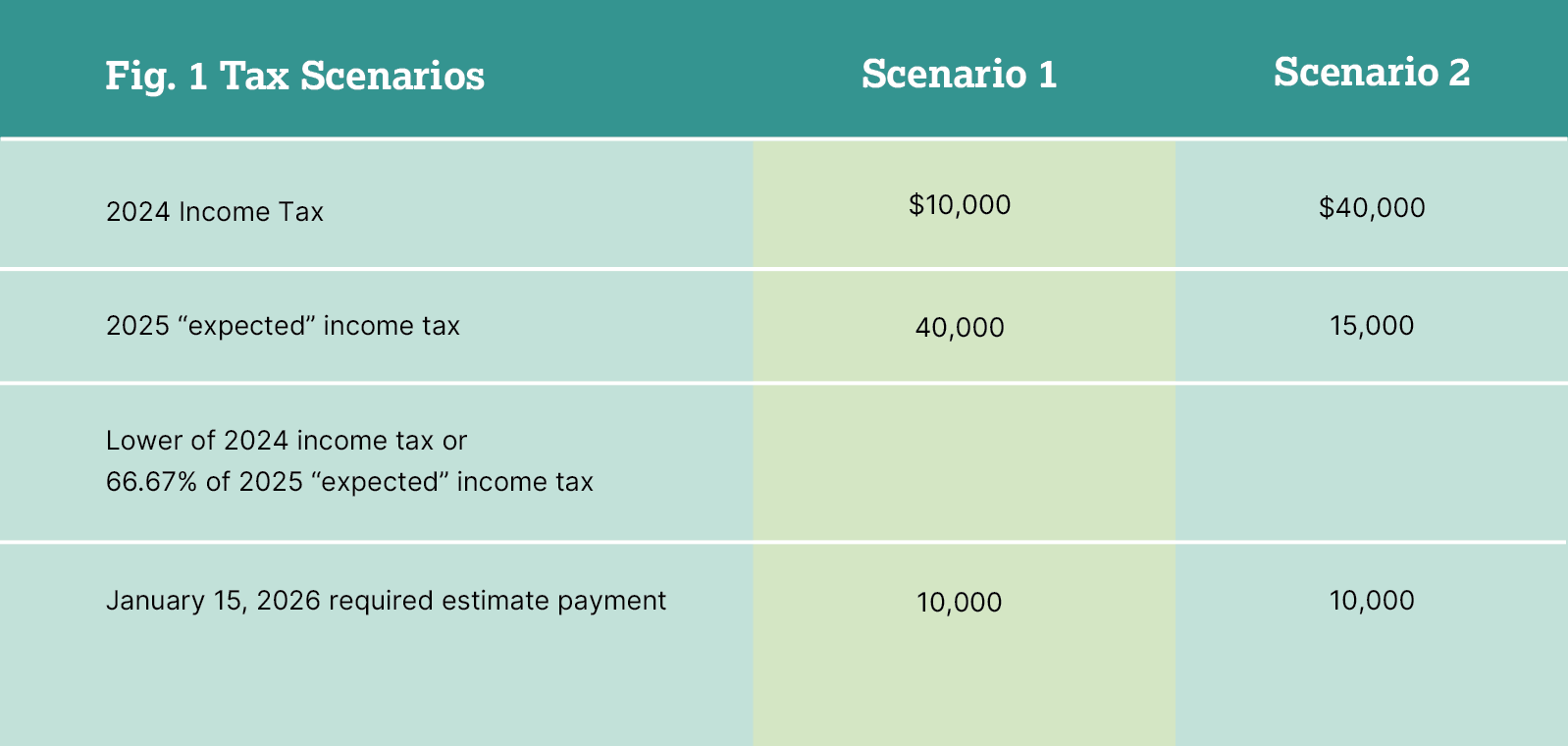
Balances due at the completion of the tax return would be offset by these January estimated payments made. For example, in scenario 2, if the tax return were finalized and the farmer had income tax of $15,000 per the tax return, the $5,000 balance would be owed as of the filing date — typically April 15.
Making the January 15 estimated income tax payment can be extremely useful for a farmer especially in years where your taxable income will be higher than the previous year. It provides more time, until April 15, to file a correct individual income tax return that maximizes tax deductions. You receive 45 more days to see how the current year is going as well – which can help with decisions on how aggressive you are in utilizing Section 179 and bonus depreciation methods.
Additionally, considering the cost of funds and timing of the payments made, it could result in a net benefit from an interest standpoint. Using scenario 1 from above, consider the following payment dates for a farmer that did or did not make an estimated income tax payment by January 15:
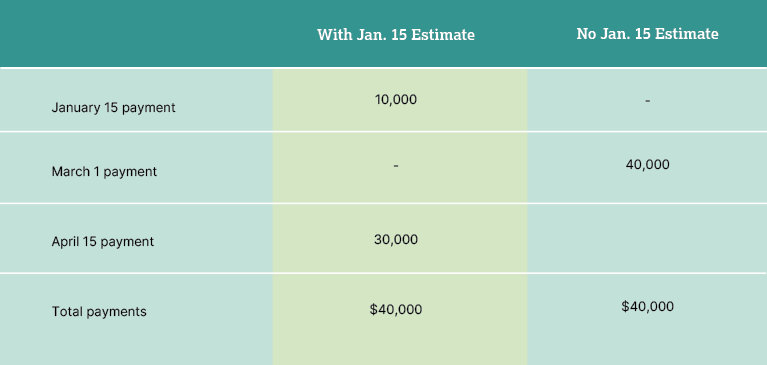
The same amount of tax was due regardless of whether an estimated payment was made — it simply moved the timing of the required payments. In this scenario, a $10,000 payment was made 45 days ahead of the March 1 date, but the remaining $30,000 was not due until April 15. At the current prime interest rates, this would save the farmer approximately $200 in interest costs when paying the income tax from an operating loan.
Whether for interest savings or documentation receipt timing and filing accuracy, adjusting your farm tax filing process may be a solution worth considering. Should you have any questions how this would work for your specific situation, consult with your CPA or your GreenStone income tax professional.
Sugar beet harvest is underway in Michigan, and beet tonnage and sugar content both look favorable for the state’s growers in upwards of 20 counties.
However, rising costs of producing and processing sugar beets into sugar have squeezed operating margins and weather challenges in various regions have affected production potential. Sugar beets have historically been a high-profit-per-acre crop but have become an average commodity due to low prices, disease pressures, and labor issues, according to Jake Moegle, VP of Lending at GreenStone Farm Credit Services.
“Sugar beets can be expensive to grow because of the many fungicide applications necessary to keep the plants healthy and producing,” he says. “So, it really needs to pay well for people to be excited about growing them.”
Founded in 1906, Michigan Sugar Company is headquartered in Bay City, Mich., and has sugar beet processing facilities in Bay City, Caro, Croswell and Sebewaing, Mich.
Drought impact
Planting conditions were generally favorable this year, Jake says, but drought conditions affected certain areas and delayed early-dig by a week.
“It wasn’t widespread, but there were significant pockets where it was dry,” he explains. “It’s hard on everything when you’re digging. Tips can break off the beets leaving part of the beet in the ground. It also takes a toll on digging wheels. Machines ride hard, and you wear things out in a hurry when we haven’t had rain in a long time.”
Jenna Maher, an agronomist with Michigan Sugar, says the weather has been sporadic this year.
“We have areas that haven’t received rain in two months and some areas with more than two inches of rain recently,” she says.
The regular sugar beet campaign – slated to start in mid-to-late October – requires beets to be piled at several locations around the state. “We really need some colder conditions for favorable storage,” Moegle says.
Permanent piling (full harvest) will continue through mid-November, according to Rob Clark, Michigan Sugar’s senior director of communications and community relations.
Favorable sugar content
Sugar content has been the highlight of harvest. At Michigan Sugar’s four factories, more than 630,000 tons of sugar beets have been sliced, and the sugar content is averaging 16.31%, according to Clark.
“We are seeing higher numbers now on a regular basis,” he says. “To date, we have produced more than 150 million pounds of sugar.” Weather mainly controls sugar content to finish the crop, and growers are paid on pounds of sugar per acre.
To date, Michigan Sugar’s grower-owners have harvested more than 600,000 tons of sugar beets, about 15% of the projected crop, according to Clark.
“While recoverable white sugar per ton (RWST) is tracking well above the five-year average of 270.1 pounds, yield is tracking below the five-year average of 31.95 tons per acre,” he adds. “We are seeing some pressure from leafspot and aphids across our growing region. We need more rain and are asking growers to continue to care for their crops over the coming weeks before permanent pile begins.”
Hiring seasonal workers to harvest the crop continues to be a challenge.
“Finding workers with a CDL who you trust to drive the semis and be loading on the go in the field is sometimes difficult,” Moegle says.
Current Production Status for 2025
- Planting Progress: According to Betaseed, Michigan Sugar reported 97.5% of the 2025 sugar beet crop was planted by May 5.
- Acreage: Michigan Sugar planted 139,000 acres of sugar beets in 2025, down from slightly more than 143,000 acres in 2024.
- Yield Projections: Early estimates suggest average sugar beet yields between 27-32 tons per acre for 2025.
- Harvest Timeline: Michigan Sugar’s 2025 early dig harvest started on Aug. 25, and slicing at its factories began in late August and early September.
- Michigan ranks as the third largest sugar beet producer in the United States.
Despite ongoing challenges, including lower prices and operational difficulties, industry representatives maintain cautious optimism. As Moegle notes, “The outlook is still positive. I think there’s a nice crop out there waiting for us.”
Lisa Cram has built a long career in the law enforcement industry, and as she is nearing retirement, she has big plans for how she is going to spend it!
Lisa comes from a deep-rooted agricultural family with generations of farming experiences. Growing up, she was one of four daughters who were raised in a vegetable and nursery operation. Lisa grew up hearing stories of her grandparent’s dairy and swine farms and as a little girl, always wanted animals. Being raised in rural Jackson County on an agricultural farm with an open-air market, her whole family was involved with different parts of the operation. Being raised with a soft spot for livestock, Lisa knew she wanted to get back into agriculture at some point but never knew when. She shared, “The plan all started about three years ago, at that time we lived at the lake and had hoped we could sell that and move.”
In between her dream land and her current home, she spent much of her time researching what her niche could be. While searching, she found a group called Cowgirl Confident. The group offers support for agriculturists anywhere in their journey. “It was very cool because I saw somebody like me that had very little knowledge in the industry and could ask any question and nobody was judging for it,” Lisa enthused!
When Lisa retires in 2026, she plans to officially kick off her agritourism operation. Lisa was also able to get a head start on her retirement plan with her land purchase and home mortgage through GreenStone. The plan is to welcome farm visitors with unique glamping spaces, livestock interactions, and other rural experiences focused on making memories and smiles as she officially launches. All pieces of the farm will be intentionally chosen, to keep the guest experience top priority. “It’s all about the experience,” Lisa stated as she explained her hopes for the land.
Over the years, the Cowgirl Confident group has grown larger and there have been various conferences and events hosted to connect their community.
Earlier this year, when she found GreenStone’s CultivateGrowth grant, she excitedly took advantage of one of the group’s events. “This year I said, that’s it. I’m a year away from kicking off and it’s time to really get serious and learn a whole lot more.” Using the grant, she was able to attend a Cowgirl Confident event in Oklahoma!
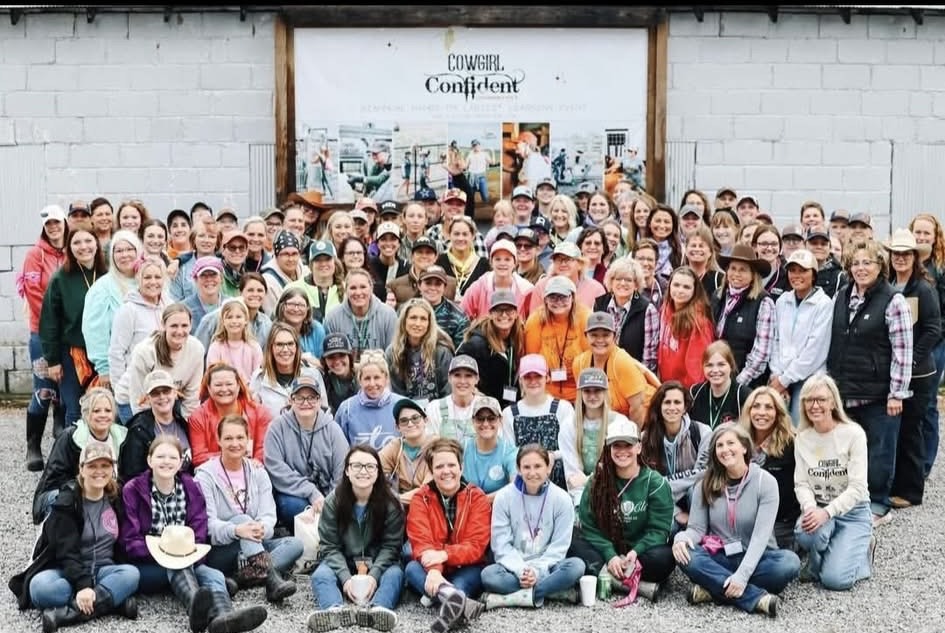
Lisa and the Cowgirl Confident Group!
The event was focused on bringing their community together and talking about the various types of cattle operation but had a variety of different sessions to choose from. The event ranged from business advice, to agritourism planning, bovine reproduction, and even the renowned Dr. Temple Grandin made an appearance as the keynote speaker for her work in animal husbandry. In addition, Lisa was able to network with other producers from around the country. “There was just so much valuable information to take away,” Lisa noted.
After the conference and with her community of Cowgirls, Lisa feels more set in her plans for retirement next year. She plans to keep being intentional and looking out for any furry additions as she prepares for the official launch of her agritourism operation.
GreenStone is proud to support up and coming farmers like Lisa as they reach for their dreams. To learn more about our CultivateGrowth program and grant for young, beginning, or small farmers, click here.
Determining Land Value Benchmarks
GreenStone’s team of expert appraisers evaluate land values annually throughout Michigan and northeast Wisconsin. These values are measured by re-evaluating the same plots of land every year, providing our customers and landowners with a picture of how the value of cropland, transitional land, recreational land, and dairy improvements have changed throughout the year.
Revaluating the same plots of land each year eliminates variances that could occur with other survey methods. This provides our team of appraisers with the most accurate representation of market value trends. There are many factors that influence the results of these appraisals, including changing commodity prices, governmental regulations, the economy, tourism, and weather.
Land Benchmark Results
In 2025, alongside the same thirteen plots of land that are evaluated each year, three additional plots located in northern Michigan, north central Michigan, and northeastern Wisconsin were also appraised to give a more complete picture of land value trends across our region. The results from these land benchmarks were clear – the value of land is holding steady. Across the board, the average value of land increased by 5%. Land value increases ranged from 5-15%, with only one benchmark experiencing a decrease in value.
While land values have continued to increase over the past five years, they remained steady in 2025, suggesting the market may finally be leveling off and finding a balance post pandemic. This is still good news for landowners, as a majority of the benchmarks appraised continued to either increase or hold their value. These results are also optimistic for those trying to acquire land, as demand seems to be steadying in an ultra-competitive market.
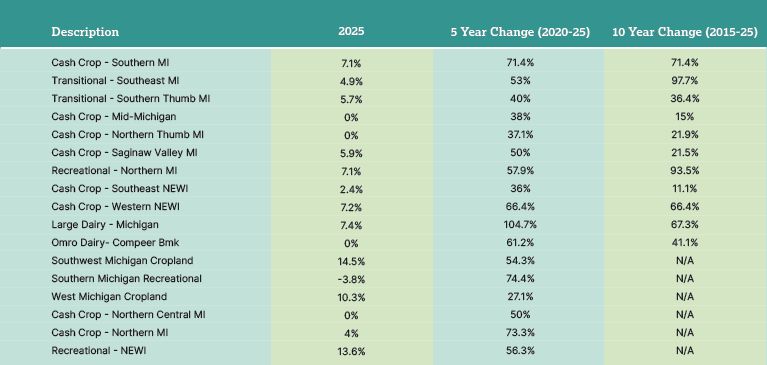
Dairy and Cash Crop Land Values
Most notably, concentrated animal feeding operation (CAFO) sized dairy farms have experienced more than a 100% increase in value over the past five years, effectively doubling in value since the pandemic. Increased construction costs, and a healthier dairy market with increased demand and steady supply over the past few years are both contributing factors to this increase. In 2025 alone, CAFO dairy operations increased in value by 7.5%. Many producers have even been able to expand their facilities in recent years because of an increase in profitability.
Out of the ten cash crop land benchmarks surveyed, seven of them experienced an increase in value, ranging from a 2.4% increase to a 14.5% increase. Michigan’s crop diversity is a contributing factor to the stabilization of these land values.
Western Wisconsin, and southwest and west Michigan showed the largest increases in value for cash crop land again this year due to continued competition for land. Three benchmarks maintained their value, after each experiencing a substantial increase in value in 2024.
Recreational and Transitional Land Values
Recreational and transitional land values also experienced an increase in value. Recreational land saw an increase of 5.7%, while transitional land – agricultural land expected to be developed for another use in the future – increased by 5.3%. Only one recreational benchmark, located in southern Michigan, experienced a decrease in value. This comes after a 17.8% increase in 2024, once again suggesting land values are finally steadying post pandemic.
Transitional land values continue to hold strong despite not experiencing the dramatic increase in value we’ve seen over the past five years. Increases in construction costs and shifting economic factors are both influences to transitional land values.
Land Remains a Strong Investment
Buying and owning land continues to be a strong investment in your future. For many landowners, it is very likely the value of your land has increased over the past few years. While we continue to see an increase in land values, the stabilization of land prices is also positive for those looking to acquire land.
GreenStone’s team of financial experts are here to help you find a solution that’s tailored to you, whether that’s securing vacant land or expanding your farming operation. Click here to learn more about the resources GreenStone provides when it comes to purchasing land.
This article was originally published in Michigan Farm News.
Regular firearm hunting season is rapidly approaching for both Michigan and Wisconsin hunters. Before the season begins, consider using this quiet time to evaluate your property and land improvement tactics to get your hunting land in tip-top shape.
There are four things to keep in mind with hunting land management to harvest the perfect buck: food source, water source, proper coverage, and keeping the correct ratio between does and bucks.
Providing Adequate Food and Water Sources
In order to maintain wildlife, just like you and I, they need to eat! Some land might not naturally provide the right mix of food options for the wildlife you want to attract. However, you can grow this food yourself on a food plot.
Adding different foods to your food plot will attract different types of animals. If you’re hunting deer, consider growing things like barley or rye.
These days, you don’t need any fancy tools or tractors – many manufacturers produce seeds you can throw down, and they’ll grow into a garden for your wildlife with little to no extra work needed from you.
If a pond or lake doesn’t already exist on your hunting property, you will need to create a source of water for wildlife.
Low-lying patches of land can be dug deeper to create an area for water to fill. You could also install a liner in these areas to make sure they remain puddles of water for your wildlife.
Creating Shelter for Your Wildlife
Animals need a place to hide and sleep. For their own protection, deer will not typically settle down in an open field space.
Evergreens and trees are good additions to provide more coverage on your land. If your land already has trees, you may even consider knocking some over, so the deer have more places to hide.
Another option for open spaces is to allow your fields to grow plenty of weeds and grass to act as coverage for wildlife.
Maintaining Your Buck to Doe Ratio
While the goal is to attract wildlife, having a population too big is equally problematic. For deer, you’ll want to try to keep the ratio of does and bucks close to 50/50, if possible. Too many deer mean a lower food supply, and the bucks won’t stay.
If one of your goals is to be rewarded with a trophy buck, you may want to consider deer management practices, such as only harvesting deer of a certain size to allow younger bucks to mature.
When sharing your hunting land with other people, talk with them ahead of time about your expectations for the land, and what wildlife should and should not be harvested.
Getting Started with Managing Your Land
How you will manage your hunting land should be considered early in the year, well before hunting season begins. This will ensure your property is ready and the animals are comfortable, so you can enjoy a successful hunting season. It is also important to reevaluate your practices each season to determine what worked and what didn’t work, to know what is best for the wildlife’s health and population on your land.
There are plenty of perks to owning your own hunting land. If you haven’t made the purchase, you might consider these benefits for future ownership. Learn about a few of the benefits of recreational land ownership in this resource here.
Our recreational land experts are here to walk you through the land buying process. Get started by checking out these frequently asked questions or contacting your nearest branch.