

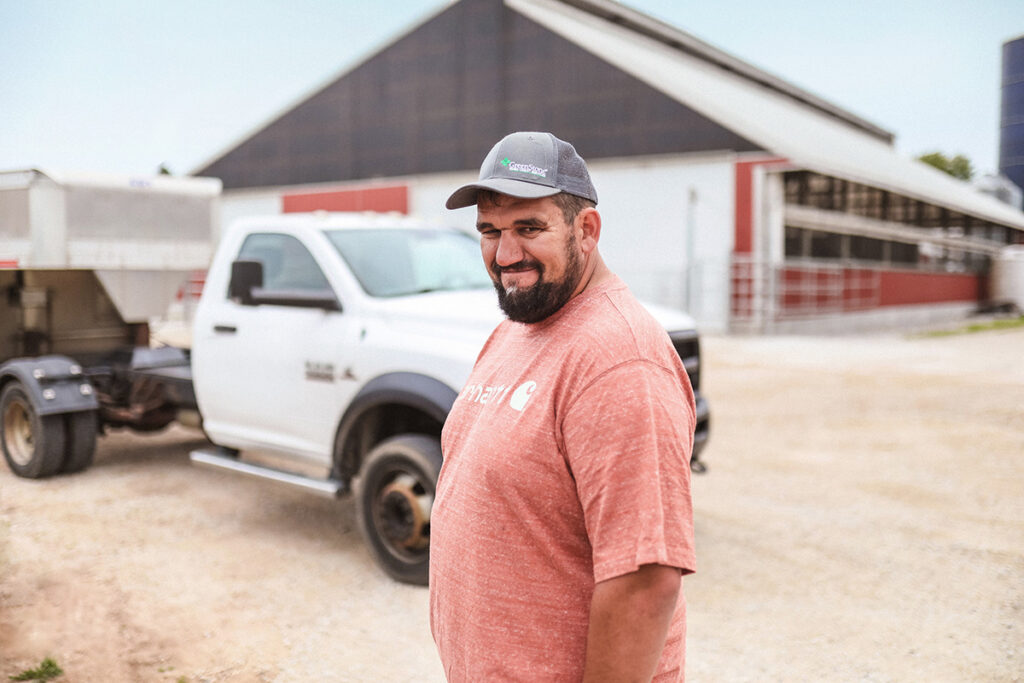
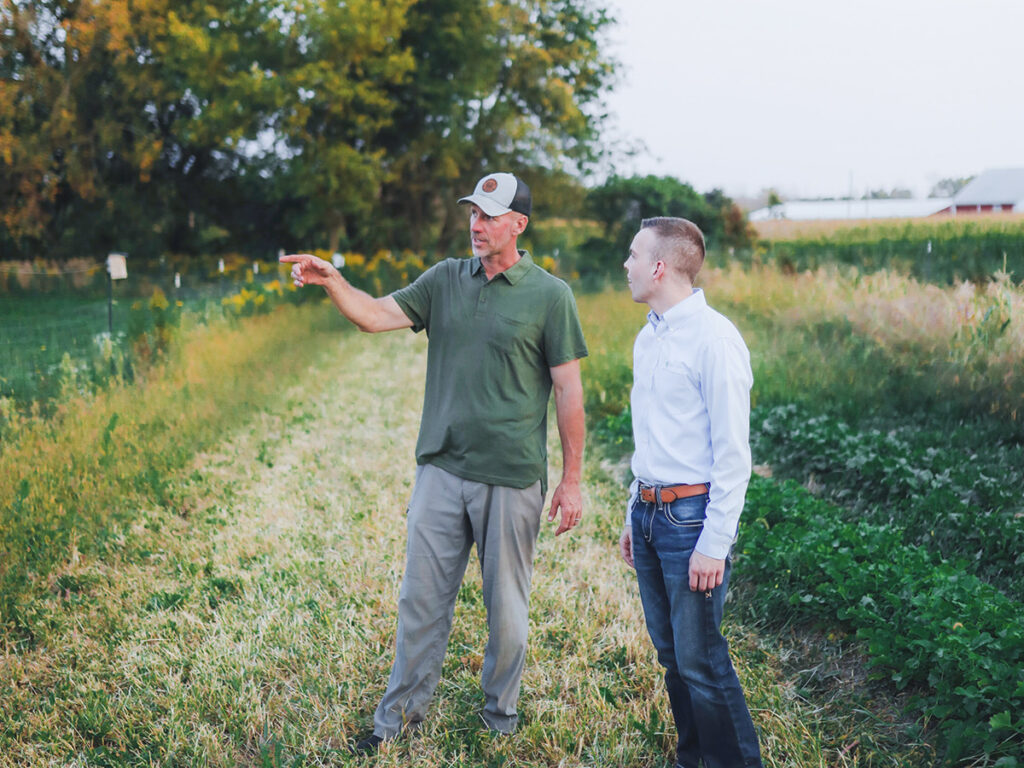
Mike Bagnall was 18 years old the first time he walked into a GreenStone branch. Born and raised on a dairy cow operation, Mike knew he belonged in a career in agriculture.
“I could never see myself working a 9-5 office job,” explained Mike. “I spent all my summers growing up out in a tractor. I was born to be out on the road and in the field.”
For Mike, his passion was found in hauling livestock for the producers who supply our country with the food we all enjoy.
“I was still in school when I applied for a loan with GreenStone to buy my first truck and trailer,” said Mike. “It seemed like all the stars aligned for me at the time because I was able to buy my truck from someone who was retiring from the business. I was really serious about making this my career, and with the support I received from GreenStone, I was able to make it a reality.”
A Business Based on Loyalty
Eighteen years later, Mike now owns and operates two trucks and trailers hauling livestock like beef and dairy cows, swine, and even sheep. With the help of his brother, Mike is able to run both trucks and trailers multiple times a week making pickups and deliveries, mostly to and from livestock auctions for over twenty farms across northeastern Wisconsin. Mike has even financed two custom-built trailers through GreenStone with moveable gates that can be adjusted for the type of livestock he is hauling.
“We continue to get busier and busier,” Mike says. “Some of my customers are the same people who I started hauling for back in 2007. I’ve continued to grow my customer base over the years, but something that is extremely important to me is loyalty.”
This kind of loyalty for Mike means when he gets a call from one of his customers, he’s on the road headed their way. “I’ve hardly missed a Monday hauling livestock in the last eighteen years,” laughed Mike. “When you’ve got 15-20 people regularly calling on you, you better be there for them. I know they’re relying on me, and I want to be the person they can depend on.”
The Value of a Dependable Lender
While Mike is focused on being there for his customers, having a dependable lender has been a tremendous help in continuing to grow and expand his business.
“I remember there was a time when I needed to buy a truck very quickly to keep normal operations running smoothly. I texted my loan officer at GreenStone and was able to pick up a check the same day and had purchased a new truck by that afternoon. You don’t get that anywhere else! I’ve applied for loans from other lenders and there were always too many hoops to jump through. With GreenStone it’s always been a simple process, and they want to see you be successful and continue to grow your business.”
A Team Effort
When Mike became a business owner at 18, there were a lot of things he had to learn quickly. One of those was how to manage his growing business’s taxes. After about a year of trucking, he quickly realized the value of tax and accounting services to support the growth of his trucking operation. Again, he turned to GreenStone for support.
“When you own your own business, you really need to know your stuff when it comes to taxes. I knew right away that I wanted my taxes done right the first time, so I could focus on other parts of my business.”
Mike has been a tax customer of GreenStone since the beginning of his business. Throughout the years, he’s gotten to know his GreenStone team well, especially his tax accountant, Megan LaPlant.
“Megan does an amazing job. I know when I turn over my paperwork to her it’s going to be done right, and I don’t have to worry about it,” says Mike.
Growing up in the same small town, Megan graduated with Mike’s brother who now works with Mike hauling livestock multiple times a week.
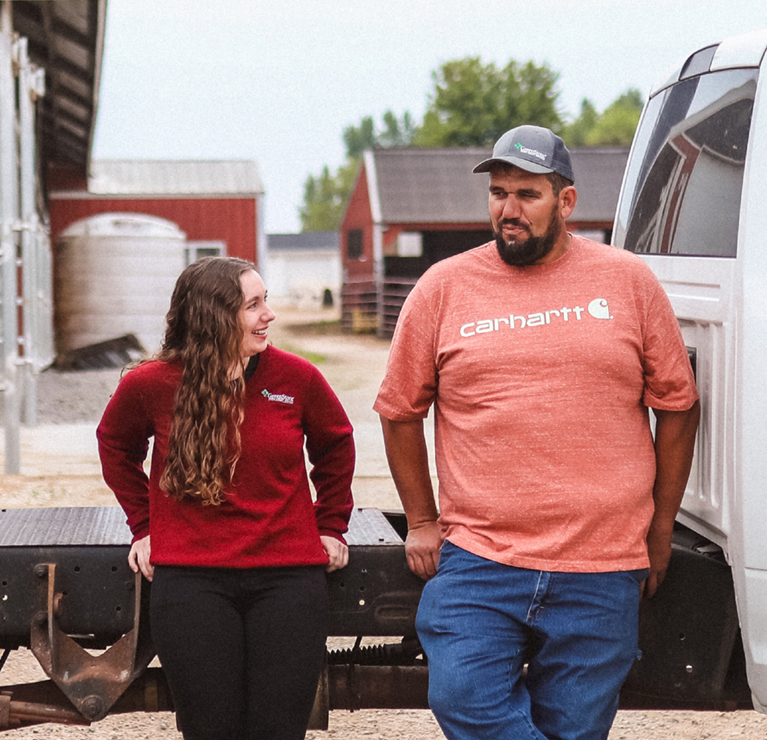
“That’s the thing about working with GreenStone, the people there understand our industry and there’s a good chance they’re also your neighbor or someone you know. It makes it easier because they understand the type of work we do whether that’s something like farming or hauling livestock,” Mike said.
“One thing I really appreciate about working with Mike is his willingness to learn,” commented Megan. “He sat down with me recently to learn more about the depreciation of his equipment and how it impacts his business. The fact that he’s eager to learn more about what goes on ‘behind the scenes’ so he can continue to run his business more efficiently says a lot about him as a business owner.”
What does continued success look like for Mike? That’s easy. It means continuing to serve the farmers of northeast Wisconsin and maintaining the same great relationships he’s built along the way.
“My goal is to continue to keep my people happy and have them keep calling me,” Mike says with a smile. “This is what I belong doing, and the relationships I’ve built and people I’ve met along the way are the reason I love what I do.”
To view the summer 2025 issue of Partners magazine in its entirety, click here.
I have to say right up front that I am spoiled when it comes to summertime here in Michigan. My family moved to the town of Ludington when I was in third grade and even though I didn’t realize it at the time, that move would change how I viewed summertime for the rest of my life. Although I don’t remember much from my third-grade year, I do remember moving. I remember it was dark and snowy the night we moved in and the moving truck got stuck in the driveway of our new house.
The best part about moving to Ludington was revealed in the morning. My parents were renting this new house, and it sat on a bluff overlooking Lake Michigan. Although this setting might give the impression, we weren’t rich. My dad was a State Farm agent, my mom did some art classes through the schools, but somehow they managed to make it work. We were now living on the banks of the big water, in a great summer town.
I did not travel much as a kid so my world was that lake – a 100 foot drop off to the beach and the water. This house and the view made me fall in love with Lake Michigan, especially during summertime!
As I grew up and started working with Michigan Out of Doors TV, I was able to see much of the state I never knew existed. Who knew there was an east side? Who knew of the marinas of Lake St. Clair? Who knew about all the cool port towns up along the sunrise side of our state? Although all those areas are great, I soon learned that where I grew up was one of the best places to spend the summer in the entire state. Every year tourists would come from all over to fill the state park and the downtown was always busy. However, you could always find a nice spot on the beach to call your own.
Between the mild weather and abundant fresh water, Michigan offers a summertime experience that few states can match. The beaches of Michigan are incredible. The endless miles of sand and the quant little towns that line our shoreline are destinations for residents and non-residents alike.
So, here is the question for you – and for me. What are you going to do so that this summer doesn’t pass you by? Here are a few suggestions. Get your calendar out now and block off several weekends, whatever you think is doable. You don’t need to worry about the exact plans right now, but hold the dates and think about some places you want to go this summer to experience summer in all its glory!
Being a west-sider and now living in another tourist location of Grand Haven, I am definitely biased to the gold coast! So here you go. Try the beaches of New Buffalo, there are some great establishments for food and beverages and lots to see. Consider heading north to South Haven, Saugutuck, Holland, or look for me on the beaches of Grand Haven! Take a trip to Silver Lake and rent a jeep to explore the dunes. Slip up to Pentwater and have dinner overlooking Pentwater Lake. Ludington has the most popular state park in the state; why not give it a try! If you’re a golfer, stop in and play Manistee National or splurge and try Arcadia Bluffs. Take the time to check out Frankfort and Leeland, both a little off the beaten path but both are great! Traverse City is crowded, but there is a reason, it’s awesome.
That’s only the west side of our great state; the east side and the Upper Peninsula are home to some great options as well! The main thing is this – get out and enjoy all our summertime can offer because we have a limited amount of time and we don’t want to waste it!
To view the summer 2025 issue of Partners magazine in its entirety, click here.
Additional LRP Products to Benefit You
As a dairy farmer or livestock producer, you know how rapidly changing market prices can impact your farm and your livelihood. Livestock Risk Protection, or LRP, is a risk-management tool used by producers to insure the futures prices of their swine, dairy, or beef cattle from declining markets.
Producers now have the ability to insure higher values for their cull cows and day-old calves due to lowered weight requirements for LRP coverage set in place by the USDA. Learn more about how these additional LRP products can benefit you and your farm!
How Does Livestock Risk Protection Work?
LRP is a revenue-based program that insures the prices of swine, dairy, and beef cattle against a decrease in market revenue. It protects up to 100% of the future values of an operation’s livestock, not the loss, death, or destruction of livestock.
Unlike conventional crop insurance, LRP is sold every weekday, based on market future prices. When the market closes at 3 p.m. Eastern Standard Time each day, those future prices are what are offered to you, the producer, with coverage levels ranging from 70% – 100%.
Coverage can be placed on your livestock anywhere from 13 to 52 weeks out. Producers can insure cattle and dairy cows based on live weight, while swine is based on lean weight.
LRP can also be combined with your Livestock Gross Margin policy to provide a more comprehensive risk management strategy.
Additional LRP Products Now Available
Due to beef cattle prices and non-milk prices on dairy farms reaching an all-time high, the USDA has introduced two new options for insuring your cattle through LRP. These additional products allow producers to reduce their risk to market movement and insure the value of their livestock.
Cull Cows
LRP for cull cows can be booked under a feeder cattle Specific Coverage Endorsement, or SCE, and settles against the feeder cattle index. This is because historically cull cows have a better price fit with feeder cattle in addition to having closer seasonal price movements.
Producers looking for coverage on their cull cows must market them within a 60-day window of the end date, and they must have a weight limit between 800 and 1,500 pounds.
Unborn Calves
LRP for unborn calves is intended to cover the increased value of any beef on dairy cross calves that will be sold between 60 and 99 pounds. This coverage option protects producers against declining market prices for day-old calves that are intended for beef.
Similarly to how LRP is now available for cull cows, day-old beef calf pricing is also booked under the feeder cattle SCE and is priced off the feeder cattle index. The Unborn Calves SCE is booked as a feeder cattle endorsement and settles against the Feeder Cattle Index. It uses a seasonal price adjustment factor to reflect seasonality and differences in cash dairy beef and cross calf prices compared to the Chicago Mercantile Exchange feeder cattle index.
Producers looking for coverage on their day-old calves have a 30-day window to market them and will need to provide a sales record.
How Do These Additional Products Benefit Me?
LRP coverage is customizable for all styles of operations. With rapidly fluctuating markets, it’s more important than ever to secure coverage to protect your livestock, your farm, and your livelihood.
GreenStone also offers an exclusive livestock analyzer tool through our app or the website. This tool allows producers to view quotes, request coverage, track endorsements, and access the latest market information to always stay informed.
Our dedicated team of livestock crop insurance specialists are here to answer any questions you might have on how LRP or other livestock insurance options can help benefit your farm. Contact your local branch to learn more!
To view the summer 2025 issue of Partners magazine in its entirety, click here.
On a member elected board of directors, the value of appointed experts is recognized. When the time comes to replace that knowledge, an important search and selection process unfolds. Thanks to a successful process, GreenStone’s board of directors selected two new appointed directors to serve on GreenStone’s board: Paul Lindow and Rick Snyder.
Paul Lindow joined the board as the financial expert, filling the void that will be left when current appointed director Gene College retires from the board in December 2025. As the financial expert, Paul will chair the board’s audit committee.
Rick Snyder joins the board bringing a new set of expertise to the board table – as a technology and cyber security expert. Recognizing the evolution of technology in the office and on the farm, this is a new appointed director seat for GreenStone. Rick will also chair a new, soon to be established technology board committee.
Paul brings extensive experience in serving large organizations in areas such as risk management, internal audit, finance, and corporate governance. Paul is a retired senior partner with Deloitte & Touche LLP, where he focused on the banking and capital markets sector including serving the Farm Credit System from 2013 until his retirement in June 2024.
Paul received his Bachelor of Arts in Accounting from Michigan State University and is a graduate from the University of Washington Pacific Coast Banking School. Paul is a past member of the Michigan State University College of Business Advisory Board and currently is a board member for The Grosse Pointe Academy as well as Teach for America – Teach Michigan. Additionally, he is a member of the American Institute of Certified Public Accountants, a Certified Public Accountant in Michigan and California, and a member of the Institute of Internal Auditors.
Rick currently serves as the CEO of SensCy, a cybersecurity start-up focused on helping small and medium-sized organizations improve their cyberhealth. He brings with him a myriad of experience as a business executive, venture capitalist, attorney, accountant, and served as the Governor of Michigan from 2011-2018.
Rick holds a Bachelor of General Studies, a Master of Business Administration, and a Juris Doctor, all from the University of Michigan. He is also a Certified Public Accountant. In addition, Rick serves on the board of Business Leaders for Michigan and PVS Chemicals.
Paul Lindow, Appointed Director with expertise focused in finance:
“My interest in participating on our GreenStone board stemmed from my extensive experience in serving the Farm Credit System as a consulting professional with Deloitte. This experience informed me of the strong reputation and brand of GreenStone within the Farm Credit System. As a result, I am honored and excited to be part of our board.
I hope to make a difference on the board as well as the audit committee by bringing my three decades of experience and board room knowledge to GreenStone. Additionally, I hope to be able to identify and guide us through the evolving and increasing stockholder expectations, and as the designated financial expert continue to provide the oversight to ensure strong internal controls, financial management and financial reporting.
I am most looking forward to serving as an ambassador for GreenStone within the Farm Credit System as well as the communities in which we serve. Also, I am relishing the opportunity to work with our outstanding management team and the board in assisting and advising on current and future strategic initiatives.
From a personal perspective, I am married with three children – all boys – including a 12-year-old. In addition to serving on GreenStone’s board, I am extremely active in my local community and an avid traveler, having visited over 80 countries – including all seven continents.”
Rick Snyder, Appointed Director with expertise in information technology:
“As Governor, I had the honor to frequently interact with our agricultural community. It was a great experience, and, with teamwork, we were able to achieve a number of positive goals. Key partners in these efforts were Farm Bureau, various commodity groups, and GreenStone. One of the bills I was most proud of signing into law was the Michigan Agricultural Environmental Assurance Act. A winning program for all!
I hope that experience, along with my business, public policy, and technology experiences can enhance the board’s ability to provide strong strategic direction and support to the GreenStone management team. In particular, I hope to leverage my expertise in cybersecurity to help GreenStone and its partners be even safer in the ever more challenging cyberworld.
My first farm experiences were interacting with my farm cousins in Ionia County and helping my best friend farm and fix old tractors in high school. Now, I am looking forward to building even stronger personal and professional relationships with members of the GreenStone family and contributing to the long-term success of the cooperative and its members. GreenStone’s historic track record has been great; we need to keep it going!”
To view the summer 2025 issue of Partners magazine in its entirety, click here.
As our world and industry continues to evolve and grow an online presence, it’s not surprising that even the most established like cattle auctions can be found online now as well. It is no longer necessary to set up gates and a tent or haul the cattle to a sale barn. It doesn’t take an entire day and hours of driving to buy cattle; it can all be done from your phone or computer. Online auctions provide buyers and sellers true price discovery and provide even more benefits than live auctions.
Selling Online with a Reputable Marketing Company
The first step in either buying or selling at an online cattle auction is choosing the marketing company you are comfortable working with. Look for a well-established, professional team that specializes in your industry with a strong marketing and online presence. This expert team will provide maximum value to both the buyer and seller of the cattle. One of the best ways to learn about marketing companies is through positive word of mouth from someone you trust.
After contacting the team you would like to sell with, they will make a visit to your farm to discuss your plans. After viewing your cattle, a professional marketing company will have the knowledge and data to make an accurate valuation and plan of action for the sale. If you are selling your herd, it is recommended to set a sale date at least 30 days in advance of having your cattle evaluated. It is essential you give your marketing team the proper amount of time to promote them to have a successful sale.
Preparing for an online dispersal auction is virtually no extra work for the owner. Your team can work with you on determining a schedule for gathering video of the cattle, vet work, and any testing needed. Your team will need all cattle records for preparing the catalog and advertising. Your marketing team will handle the promotion of the sale so you can keep doing what you do best – caring for and managing your herd!
In contrast to a dispersal, if you are selling a group of extra cows or heifers, they can be included in a weekly online auction and can be listed, sold, and loaded in as short as a week.
Preparing to Buy at an Online Auction
Purchasing cattle online through a professional marketing company can provide both simplicity and convenience. It’s even possible for a buyer to bid anywhere from their computer or phone. This opens a much larger market for sellers, and a much larger selection of animals for buyers as opposed to only what is available at their local auction barn. When purchasing from an online auction, you have the ability to view photos and videos of the cattle prior to the auction, so you can make informed decisions prior to bidding. You have the opportunity to view the cattle in person prior to auction.
When the online auction is over, the marketing team will help coordinate shipping the cattle directly from the seller’s farm to your farm. Your marketing team will also inspect the cattle at loading and will ensure they are the same as they were described when they are loaded onto the trailer. A professional marketing team will also give you the option to have a qualified truck driver deliver the cattle to you. This means as a buyer, you don’t have to worry about hauling a trailer to a busy auction barn the day of sale or having them delivered in the middle of the night. It can be worked into your schedule.
By purchasing your cattle through an online auction, you are also removing them from what can be a busy and stressful day at an auction barn. You can be sure the cattle you bid on will be in the same condition as the ones that are delivered to your door.
Be sure to work with your lender prior to participating in an auction, as most marketing companies will require payment in full before the cattle are loaded. Keeping open communication with your lender on what your plans are heading into an auction will set you up for success.
Benefits of an Online Auction
Online auctions enhance price discovery, prioritize animal welfare, and streamline efficiency. The option to purchase cattle online provides many opportunities for buyers and sellers alike, however it is just as important that old fashioned customer service and “cow sense” remains when choosing the marketing company you want to work with. Nothing will impact your experience buying or selling more than working with a team of professionals that provide quality service to both the buyer and seller in all aspects of the transaction. Between reaching a wider audience for sales and prioritizing the health and condition of the animals with minimal transport, it’s no wonder the popularity of online cattle auctions continues to grow.
The opinions stated herein are not necessarily those of GreenStone Farm Credit Services.
To view the summer 2025 issue of Partners magazine in its entirety, click here.
For David and Laura Boomer, purchasing their own recreational property was about more than just enjoying the beauty of the natural landscape and peace and quiet of the remote location. It was about creating lasting memories with their family for generations to come!
“We knew we wanted to purchase property up in the Traverse City area when our daughter moved up here,” said the Boomers. “We had been looking for years, but nothing had worked out up until we found this property. This one was just meant to be!”
Originally from Michigan, David and Laura moved to West Palm Beach, Fla., for a number of years where David worked as a firefighter and paramedic out of Dade County. “Living down there made us realize we really enjoyed living up north,” said Laura. “We moved back to Michigan thirty years ago after our first child was born, but that really solidified for us that our home was up here.”
After raising their family in the Eaton Rapids, Mich., area, Davidand Laura were ready to find land their family could enjoy spending time on together. “We started looking for properties every day on Zillow,” David explained. “It felt like there just wasn’t the perfect fit out there. But we kept looking.”
“It was getting kind of frustrating,” Laura added. “We were looking at properties for about three years, and there were several times we lost out on them just because the demand in the area is so high for recreational land. We didn’t give up though!”
Well Worth the Wait
While they were hunting for the perfect remote getaway, David made a call to Greenstone so they could secure financing and be ready to move right away if they wanted to put an offer in on a property.
“I had heard a lot of good things about Greenstone from people I knew, and also our son was familiar with Greenstone because he studied an ag-based program at Michigan State University,” said David. “He knew Greenstone from their agricultural lending services, so we were excited to learn they also provided financing for rural home loans and recreational land!”
The Boomers began working with Stacy Stinson, senior financial services officer at GreenStone. “Working with Stacy was great,” says Laura. “She explained the whole process and how it would work with us and answered any questions we had right away.”
David also recalled how Stacy worked with them to obtain a preauthorization letter prior to putting any offers in on properties so they would be ready to act quickly in such a competitive market.
“She explained to us why it was so important to have one and then was able to get us the letter back within the same day! There really were no hold ups working with Stacy, and we were amazed at how timely she was with getting everything we needed to us.”
“Most of the paperwork we had to sign was able to be done right on our phones,” Laura added. “It truly was a very easy process.”
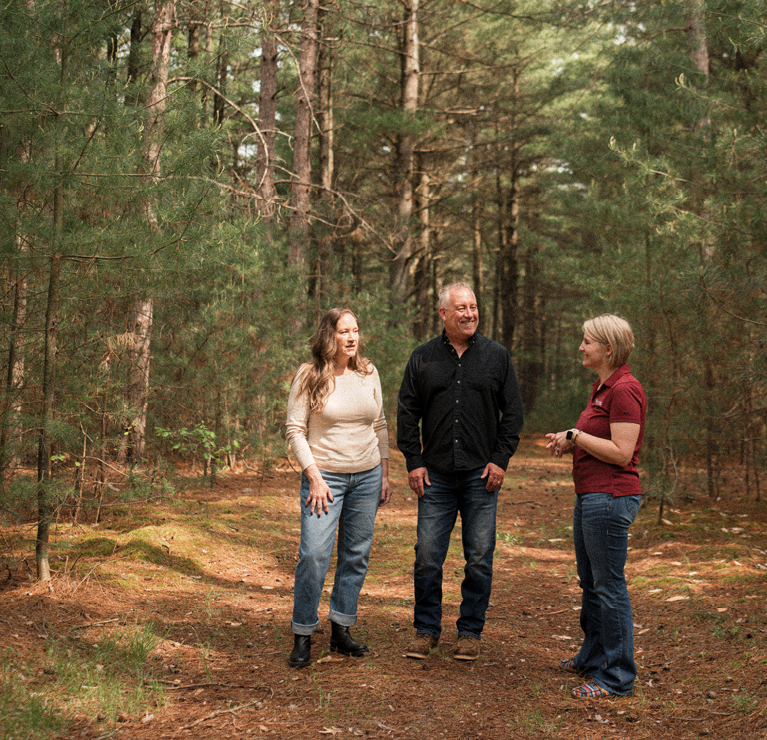
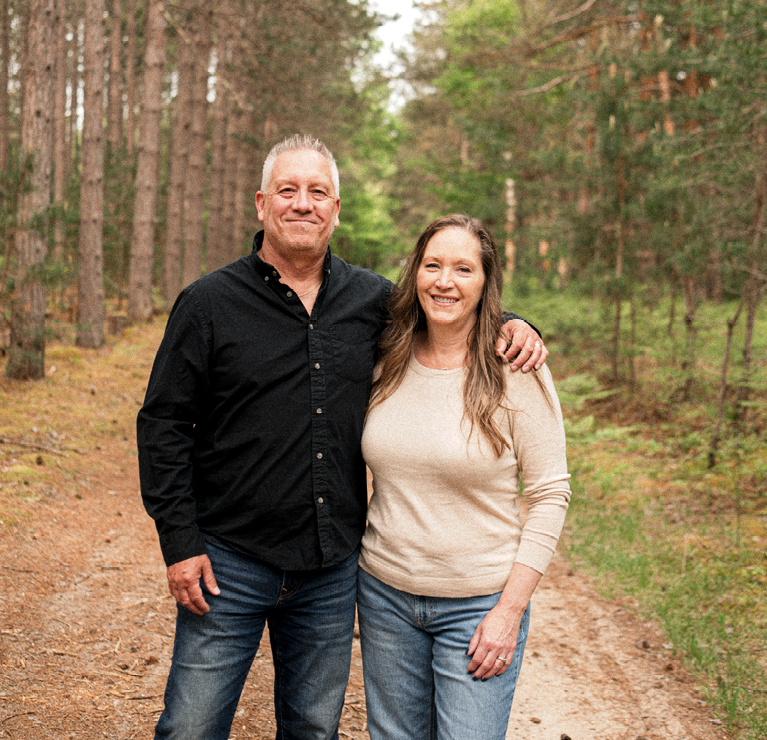
The search continued, until they came across a parcel of 21 acres of red and jack pine forest located near Grand Traverse Forest Management property. “We actually almost passed on this land too just because we had been looking for so long and we wanted to make sure it was everything we had been searching for,” said Laura. “When we went to visit the land in person, we knew we had finally found the right one, and we put our offer in right away!”
Property to Call Their Own
“I remember one of the first times we visited the property after we purchased our land. We were out walking in the woods, and I said, ‘do you hear that?’ and it was dead quiet. I said, ‘That’s the sound of nothing!’,” David laughed.
David and Laura both agreed one of the most important attributes of their perfect plot of land was that it had to feel like you were up north. “We just love the serene atmosphere of being surrounded by all the trees. When we’re out here it just feels like you’re somewhere else completely,” commented Laura. “We’ve always loved spending time out in the woods, and this property really gave us that remote “up north” feeling we were looking for.”
Both David and Laura are excited to experience the change of the seasons on the land, especially the winter. “I’m just excited to be able to take a walk in the woods and see the snow decorating all of the trees,” says David. The property is mostly wooded, with a mix of red and jack pines standing up to sixty to seventy feet, providing plenty of shady coverage and making the property feel even more enclosed and private.
A Place to Gather
“Our goal with this property was to have somewhere to spent time as a family and get to watch our grandchildren grow up and have fun out here,” the Boomers said. “We plan on adding trails to the property and are hoping each of our grandkids can have their own special place on the property that they will enjoy coming back to as they grow up.”
With their dream property secured, David and Laura are looking forward to being closer to family, spending more time in nature, and eventually would like to build a home on the land and retire there.
“We just love how peaceful it is out here, and the potential for what we can do with the land is endless. We’re just looking forward to spending as much time as possible up here and making meaningful memories with our family,” they shared.
To view the summer 2025 issue of Partners magazine in its entirety, click here.
Strengthening Your Family Business Relationships
What’s one of the most significant challenges with family business partner relationships? In a recent discussion with a group of my Family Business Consulting Group colleagues about this question, the topic that rose quickly to the top of the list is the ability to share and receive feedback effectively with one another. Feedback is a foundational element that contributes to stronger family business partner relationships. Learn more about these practical ideas on how to more effectively provide and receive feedback from your family business partners!
Feedback Can Be Challenging Work
Whether you’re related to your business partners or not, providing and receiving feedback effectively can be challenging. When you overlay family relationships (father-daughter, mother-son, siblings, cousins, nephew-uncle, etc.) the challenge is magnified due to emotional involvement and intimate knowledge of one another. The closeness that is so powerful in bringing family together can also create the greatest obstacle in effectively giving and receiving feedback. Therefore, feedback is often delayed or non-existent for fear of damaging the relationship. Avoiding these conversations often leads to a buildup of negative emotions between family business partners which at some point can be expressed in damaging ways and cause relationships to spiral downward.
Ingredients for Effective Family Business Partner Feedback
Clear Expectations: The precursor to being effective with family business partner feedback is to agree on what constitutes acceptable levels of performance for respective partner roles and what behaviors will support the desired culture. With these standards in place, the feedback conversation is designed to be about a partner’s performance and behaviors as compared to the agreed upon standards, rather than an arbitrary viewpoint. Absent clear expectations, having effective feedback conversations with family business partners is a non-starter. Clear expectations combined with effective feedback against those expectations drives accountability for performance.
Right Time, Place, and Format: Holding feedback conversations at the right time, in the right place, and the right format will greatly increase the effectiveness of family business partner feedback conversations. In terms of timing, establish dedicated times throughout the year for feedback conversations. As an example, one of our clients has a feedback process where written input is obtained toward the end of the year from multiple people in the business and the results are compiled and delivered in a third-party facilitated conversation.
This is paired with a dedicated meeting mid-year when the family business partners have a conversation and answer some basic questions to drive the conversation, such as: To what extent am I meeting performance expectations in my functional role? Am I interacting with my family business partners in the manner we agreed to? What have I done particularly well? What adjustments do you suggest I make?
All conversations are held in a private setting and scheduled well ahead of time. Other family businesses may find success with a less formal process along with allocating dedicated time and a private setting.
Balanced Approach: Edna Ferber, an author and 1924 Pulitzer Prize winner said, “Perhaps too much of everything is as bad as too little.” A balanced approach applies to feedback as well. Assuming family business partners have the competencies and motivation to be effective in their role, it is likely they are performing and behaving well in some areas as compared to expectations. (Note, if a family business partner does not have the competencies and motivation to be effective, that is another topic to address.)
Providing authentic, positive feedback against the agreed upon standards helps set the stage for feedback that involves a partner needing to make some adjustments. If all a partner hears is what they are not doing well as compared to expectations, usually they quit listening and will take a defensive posture. A balanced approach wins the day as authentic, positive feedback creates an environment of psychological safety.
Continuous Learning: Rare is the person who has family business partner feedback – giving and receiving it – all figured out. There are many resources available in the form of articles, books, live and recorded webinars, communication coaches, and live seminars focused on communication in general and giving and receiving feedback in particular. Investment in yourself and on behalf of your family business partners to build your skills at giving and receiving feedback will pay off for you personally, for your family, and for your business. And learning together as a group of partners can be a powerful bonding experience!
Make the Commitment
If you want to enhance your family business partner relationships, commit to developing a sound process for giving and receiving feedback. Begin with setting clear expectations for each partner in their functional role with the business, along with behavioral expectations for all partners. Feedback is a gift that will contribute to having great relationships. Those great family business partner relationships will set an example for the next generation of family business partners and will be a driver of multi-generational success.
About the Author: Mike Fassler is a consultant and board chair of The Family Business Consulting Group. Mike provides family business consulting services with a focus on leadership and ownership transition, governance, and ownership group strategy. Mike can be reached at 517-896-3001 or [email protected]. More information about The Family Business Consulting Group and Mike can be found at www.thefbcg.com.
The opinions stated herein are not necessarily those of GreenStone Farm Credit Services.
To view the summer 2025 issue of Partners magazine in its entirety, click here.
Sometimes, no matter how much hard work and dedication you put in during the growing season, Mother Nature will not cooperate. If you are anticipating your yields may fall below your guarantee, just know many producers have been there before.
While this is not the situation you’d like to be in, crop insurance provides an added layer of protection to your risk-management plans. If you do find yourself having to make a claim, here are some important things to remember that can help the process go a lot more smoothly. Don’t lose out on a potential indemnity because notification was not given on.
- Perils – Most naturally caused perils are included under multiple-peril crop insurance (MPCI) coverage. This includes but is not limited to adverse weather, failure of irrigation water supply, fire, insect damage or plant disease (unless you improperly or insufficiently applied pest or disease control measures) and wildlife damage. Those covered under Revenue Protection are also protected from a decline in market price as well.
- Timeframe – Insurance coverage generally begins at time of application or time of planting, whichever is later. The end of the insurance period is generally recognized as the earlier of total destruction of the crop, final harvest of the crop, abandonment of the crop or the end of the insurance period (which is December 10 for corn insured as grain and soybeans).
- Insured’s responsibilities – For planted crops, the insured must notify the insurance company within 72 hours of the initial discovery of the damage or production loss, but no later than 15 days after the end of the insurance period, even if the crop has not yet been harvested. If you have a revenue protection policy and have a claim based on strictly price, the insurance company must be notified within 45 days of the harvest price announcement for the crop.
- Appraisals – If you are going to harvest your planted crop in any non-traditional manner, a crop appraisal needs to be completed, otherwise you may lose out on a potential indemnity payment. The most common time an appraisal is needed is when you’re going to chop corn for silage that is insured as grain. If you have a corn policy, any acreage that is not harvested traditionally as dry grain should be appraised. You should contact your crop insurance specialist at least one week in advance of when you are planning on harvesting, so an adjuster can come out and perform the appraisals while the crop is still in the field.
If you harvest before an adjuster can perform appraisals, representative sample strips must be left in the fields so the adjusters can use them for appraisals. The strips must be at least 10 feet wide and run the entire length of the field. If you do not agree with the appraisals you’ve gotten from the adjuster, do not sign them. Call your crop insurance specialist right away and we can have another adjuster come out and perform a second appraisal.
If you have any questions throughout your claims adjustment process, please contact your crop insurance specialist.
Updates:
Fresh Apple Reviews
This is a reminder that your fresh apple policy can be signaled out for a fresh review at any time during the year or at claims time. You will be asked to prove that you have sold your apples as fresh and at what price they were sold at. The requirement is that 50% or more were sold as fresh, at a fresh price in at least one out of the last four years. Call us if you need more information regarding what documents can be submitted and what needs to be on those documents. If you cannot prove fresh sales, RMA requires your apples to be changed to processing for the current crop year.
Hail Insurance
It’s not too late to purchase hail insurance for 2025. Hail is a separate policy from your multi-peril crop insurance coverage. As a bonus, your hail policy can provide coverage for fire, lightning, vandalism/malicious mischief and transit to the first place of storage. Rates and coverage can vary by crop and county. Keep in mind, hail insurance must be purchased before damage occurs. Contact your crop insurance specialist today to set up an appointment to review your options.
Important Date Reminder
Late fees will be charged on any unpaid premium on October 1. Please make note of this important change as late fees cannot be waived. If you cannot pay your premium before the due date, please contact your contact your Approved Insurance Provider (AIP) to make payment arrangements. Payment is due regardless of whether you have an outstanding claim.
2025 Fall Wheat & Forage Claims
Appraisals are required when a customer plans to do something with the crop other than harvest in the normal manner. If you do not plan to take your wheat/forage to harvest, we must appraise the acres prior to destruction.
Forage Production
If you think you may be facing a forage production loss, make sure to contact your specialist to file a claim. If you didn’t have forage insurance for the 2025 crop year and are interested in coverage for 2026, the sales close date is the same as wheat, September 30.
Alert Before You Chop!
It won’t be long until it’s time to fill the bunker silo. Before chopping corn for silage, please call and arrange for an appraisal ahead of time. Every effort will be made to have your crop appraised before you chop. Otherwise, you will be instructed on how to leave samples in your field for later evaluation.
To view the summer 2025 issue of Partners magazine in its entirety, click here.
As we look at the factors driving the U.S. economy in the first half of 2025, one of the most prominent topics is tariffs. The threats of, implementation of, and retraction of tariffs have influenced stock market movements and business purchasing decisions, with many companies building up inventory in Q1. This surge in buying activity led to an increase in imports, as businesses attempted to get ahead of looming tariffs.
As a result, the spike in imports temporarily contributed to a contraction in real GDP growth. With negotiations still ongoing, the long-term impact of tariffs on the U.S. economy remains uncertain.
Another key issue is unemployment. The U.S. Bureau of Labor Statistics reported a May unemployment rate of 4.2%, unchanged from April. Unemployment is expected to rise through mid-2026, peaking at 4.9%, before declining in 2027 as population and labor force growth slow.
Consumer Price Inflation decreased from 3.1% core inflation in Q1 2025 to 2.8% in April. Broad-based tariffs are expected to push inflation to 3.6% in Q3 2025, peaking at 3.8% in Q2 2026. As tariff effects filter through the economy, core inflation is anticipated to decline by the end of 2027.
The trajectory of the unemployment rate, along with the inflationary impact of tariffs, will be key factors in the Federal Reserve’s (Fed) approach to interest rate policy. With upcoming meetings scheduled in July and September, the Fed is being closely watched after holding rates steady since December 2024. Current estimates suggest the Fed will aim to reduce rates to a range of 3.25%–3.5% by mid-2026.
No discussion of the U.S. economy would be complete without mentioning The One, Big, Beautiful Bill. Having passed the House and now under debate in the Senate, the bill proposes to drive economic growth through tax policy changes, adjustments to Medicaid, and increased military spending. If enacted, its impact will be closely monitored—particularly regarding its promises of growth and the resulting implications for the federal deficit.
Dairy
In 2024, the U.S. recorded $8.2 billion in dairy exports, marking the second-highest export value on record. About 16% of all milk solids were exported, with Mexico and Canada accounting for more than 40% of total U.S. dairy exports. Current global prices for butter and cheese remain competitive, supporting continued export growth.
According to the USDA, the average price for a dairy herd replacement cow ready to enter the milk barn reached $2,870 in April, up from $2,120 a year earlier. With positive margins and a shortage of replacement heifers, producers are holding onto cows for longer lactation cycles. From January to April 2025, the U.S. dairy herd grew by 70,000 milk cows, driven by reduced slaughter rates.
Beef prices are expected to remain elevated, boosting both calf and cull cow prices—significantly enhancing revenue streams for dairy producers. However, if margins weaken, cull rates could rise.
The futures markets have seen volatility due to trade and tariff uncertainty, as well as ongoing reforms to the Federal Milk Marketing Order (FMMO). Nonetheless, U.S. dairy margins are projected to rebound in the second half of the year. As of late May, the 12-month average futures prices for Class III and Class IV milk were $19.17 and $19.34 per cwt, respectively. April margins, calculated through the Dairy Margin Coverage (DMC) program, were forecast at $10.31 per cwt—expected to be the year’s low, with margins projected to rise above $13 per cwt by year-end.
Pork
The market hog price rally and improved producer margins that began in the second half of 2024 have continued into 2025. The outlook for the remainder of the year presents strong opportunities for producers to lock in profits through hedging, with futures contracts for July and beyond reaching contract highs as of early June.
The Pork Cutout value has remained strong, sitting at $111 per cwt, while the Lean Hog Index reached $97 per cwt, its highest level since August 2023. Cash hog prices are currently over $100 per cwt. In contrast, prices for weaned pigs and feeder pigs have declined by roughly 50% from Q1 highs but are now within a more typical range.
April estimates from Iowa State University show positive hog profits for farrow-to-finish operations for the 13th consecutive month, though profitability continues to vary based on productivity, hedging strategy, and packer contract index.
While feed costs have been favorable, with strong corn and soybean meal margins, rising non-feed costs have limited profit potential. As of March 1, 2025, both the breeding herd and market hog inventories were down slightly year-over-year, supporting higher prices. The average number of pigs per litter held steady at a record 11.65, despite some disease challenges.
On May 6, the National Pork Board launched a new digital marketing campaign, Taste What Pork Can Do™, aimed at younger consumers. The campaign highlights pork’s flavor diversity, health benefits, and versatility, seeking to boost domestic demand, which remains a key focus alongside generally stable export demand, despite trade uncertainties.
Corn and Soybeans
The 2025 U.S. corn and soybean crops are now in the ground, and early reports from key producing states indicate strong crop conditions. The June 9th NASS report shows high ratings in Iowa and Illinois, though Michigan lags due to delayed planting and wet conditions.
The June WASDE report for corn shows little change from May. A record U.S. supply is forecasted, with 15.8 billion bushels of production, driven by more acreage and higher yields. If realized, the 95.3 million acres planted would be the highest in a decade. Despite strong domestic use and modestly higher exports, the season-average price remains steady at $4.20 per bushel.
The June soybean outlook also remains mostly unchanged. For 2025/2026, lower supplies and reduced exports are expected to be offset by higher domestic crush demand, resulting in lower ending stocks. Planted acreage is expected to shift from soybeans to corn. Based on trend yield, total production is projected at 4.34 billion bushels, with domestic crush up 70 million bushels from the prior year. Ending stocks are forecast at 295 million bushels, down 55 million from 2024/2025. The season-average price is estimated at $10.25 per bushel, up from $9.95.
Export uncertainty remains top of mind for grain producers. With the tariff pause against China set to expire on July 9, market watchers are awaiting clarity. Meanwhile, Brazil is expected to produce its second-largest corn crop on record. However, strong domestic demand may limit its export capacity, allowing the U.S. to maintain its position as the world’s top corn exporter.
To view the summer 2025 issue of Partners magazine in its entirety, click here.
Thank you to Michigan Farmers Market Association for sharing this tasty summer stir fry recipe! Using any fresh veggies you have available, this recipe is great as a main dish or a passing plate!
Ingredients
- 1 tablespoon vegetable oil
- 2 chicken breasts, cut into strips (optional)
- 1/2 cup diced onions
- 1/2 cup diced celery
- 3 cups chopped seasonal, fresh vegetables
- 1 tablespoon soy sauce
- Pepper to taste
Directions
Chop or dice vegetables. Heat frying pan or wok over high heat. Add oil to pan. Stir-fry onion for three minutes. If including chicken, add and cook. Add seasonal vegetables. Stir fry vegetables for three minutes or until all vegetables are tender-crisp. Add soy sauce and pepper and stir to blend. Serve over rice.
To view the summer 2025 issue of Partners magazine in its entirety, click here.