

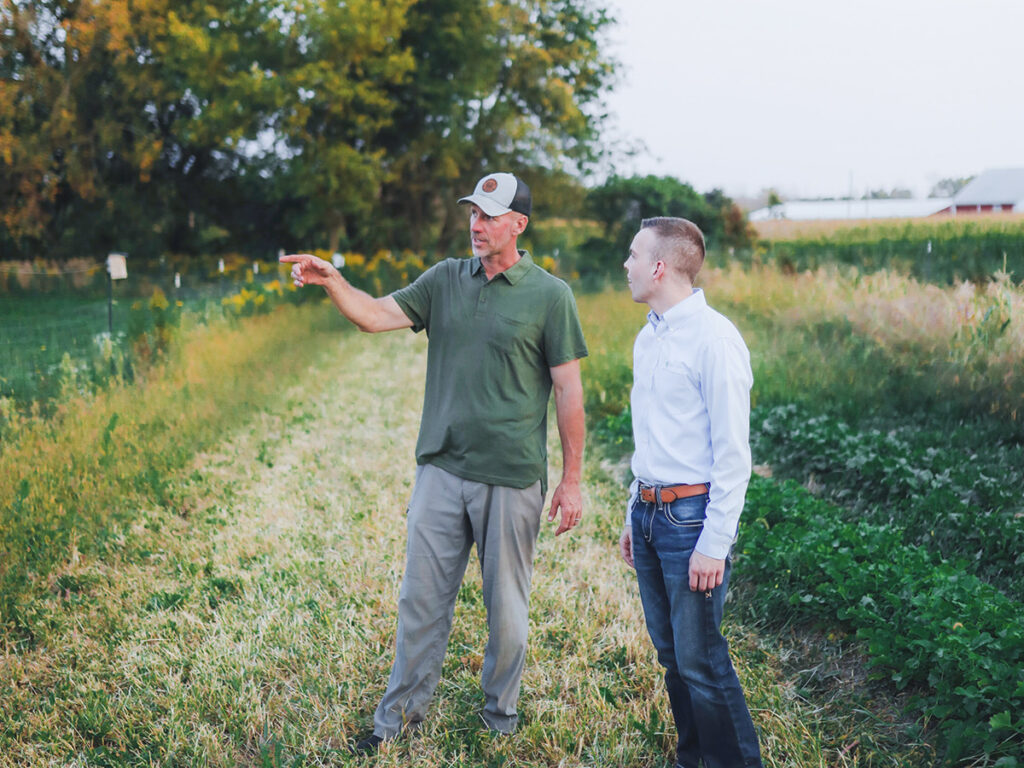
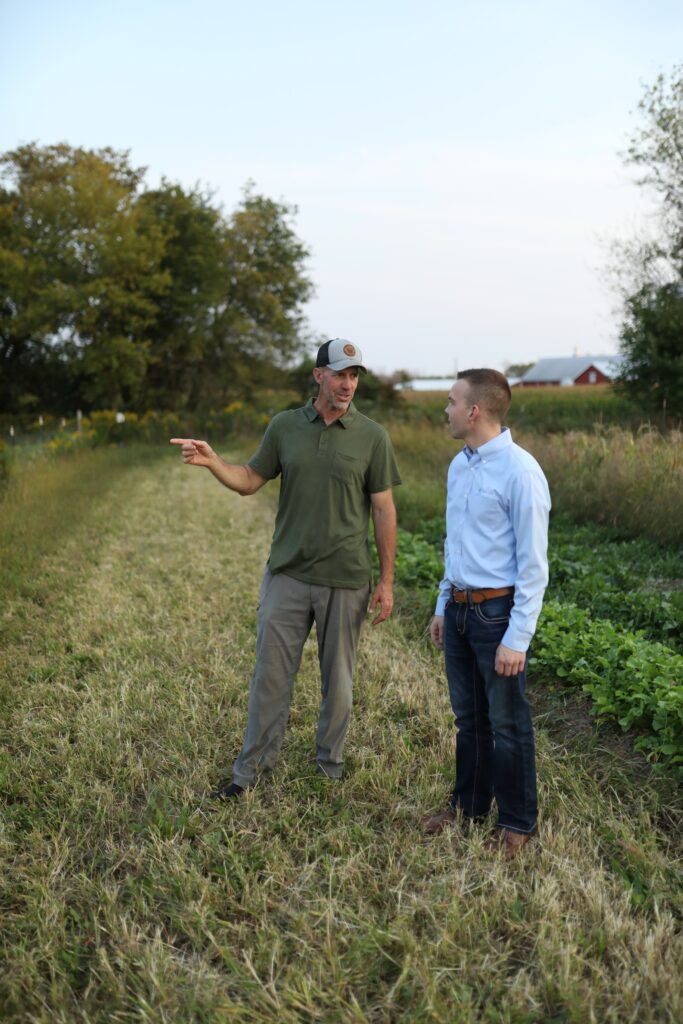
Interested in enhanced coverage for your crops to help mitigate risk on your farm? Here’s what you need to know about Enhanced Coverage Option, referred to as ECO, as a fruit producer to receive more insurance coverage options than ever before.
What is Enhanced Coverage Option?
You may be wondering, what is enhanced insurance coverage? Enhanced Coverage Option (ECO) is an area-based band of coverage that attaches to your existing eligible crop insurance policy. ECO provides two coverage option levels from 86-90%, and from 86-95% depending on your specific needs. ECO was developed by the USDA to provide producers with higher levels of coverage at a more affordable rate. “What makes ECO different from other coverage options is that it provides great shallow loss coverage at a reasonable premium,” says Cory Blumerick, crop insurance manager at GreenStone Farm Credit Services. “Because of this, it may benefit producers to consider this band of coverage in conjunction with their underlying Actual Production History (APH) policy to more effectively manage their risk.”
Why Fruit Growers Should Consider ECO in 2025
Enhanced Coverage Option for fruit growers is now available. Starting in 2025, apple, grape, and blueberry growers will all be eligible for ECO in the state of Michigan. Here’s why you should consider it.
The growing season for fruit producers in Michigan is notoriously volatile with many growers across the state finding themselves in various loss situations every year. For those without ECO, producers can sustain considerable damage in their production area before their individual policy indemnifies. With ECO however, fruit producers can receive a payment when the production area (typically county) has either a 5%, or 10% (depending on elected coverage level) decrease in expected production, even if they are individually experiencing a bumper crop that year.
ECO for apple, grape, and blueberry fruit crops is available in Yield Protection form only. Certain commodity crops such as corn and soybeans also have a Revenue Protection form of ECO available ECO is an option that is elected during fruit sales close, which is November 20th every year in Michigan.
ECO is subsidized at a 65% level, meaning the federal government pays 65% of the premium, while the producer is responsible for the remaining 35%. This makes ECO a cost-effective option to insure for shallow losses.
How Does ECO Insurance Work?
ECO is based on your production area’s (typically county) expected yield, instead of producers’ individual yields. If your area’s final production falls below the coverage levels of 90-95% depending on the level you have selected with your policy, the indemnity will begin to be paid. If the area’s final production falls below 86% if the expected yield, then the full amount of ECO coverage will be paid out. The claims are paid independently of how your own farm yields, so it is possible to experience a personal loss yet not receive payment from ECO due to the level of county average yield or revenue.
For example, if you added an ECO policy at 90% coverage to your existing APH apple policy, you would be eligible to receive payment if the area’s final yield fell below 90% of its expected yield.
Note that the expected area yield is based on a 30-year linear trend line and is typically increasing steadily yearly to keep up with planting patterns. GreenStone’s team of crop insurance specialists can help you understand your area’s historical analysis by looking at your area’s ECO performance over the last 30 years.
How Can ECO Be Purchased?
If you are interested in obtaining ECO coverage, the first step is to reach out to your crop insurance specialist to see what band of coverage would benefit your operation most. “In order to obtain an ECO policy, you will need an underlying buy-up policy for apples, grapes, or blueberries. ECO attaches to all crop lines of that insured crop. If the insured elects to add ECO to their policy, it is added onto the fall application,” Cory noted. If you have questions on ECO and if it would be a good fit for your farm, GreenStone’s dedicated team of crop insurance specialists are ready to help answer any questions you might have on how ECO coverage can benefit you most.
“I dreamed about creating a farm where we could connect children and young people – those just starting out in life – with really nutritious food and the joy and peacefulness that comes with working outdoors side-by-side with others,” Kristen Muehlhauser shared as she reminisced looking back on the start of her journey in 2007.
Kristen and her husband Adam started at a community garden in Ann Arbor, MI. “That first year the weeds grew higher than the plants, but, to my total amazement, delicious vegetables hid in that jungle and made their way onto our plates.” The couple then added seeded flats to windowsills and continued to add plots every season.
Then, in 2012 the Muehlhauser’s welcomed their first daughter. Kristen shared, “Her delight in the worms, weeds, and wind brought great joy and wonder for me, and made me look for new opportunities to share gardening with children and adults.”
With those experiences in mind, five years ago when their youngest child started school, the Muehlhauser’s began their journey of connecting people to agriculture sustainably. Their farm, Raindance Organic Farm, offers a wide variety of produce, from vegetables, herbs, and flowers to workshops where they share their knowledge with others.
As the farm advanced, Kristen wanted to grow her skills in cut flower production, so she applied and received GreenStone’s CultivateGrowth Grant. Kristin was able to take The Lily Workshop Course where she learned the ins and outs of successful lily production. The couple has recently invested in a new greenhouse in order to increase the scale of lily and other floriculture crops on their operation, which will be ready for use in early 2025.
With what Kristen learned throughout her course, her and Adam decided to run a pilot crop this year with 2700 lilies grown over nine months. GreenStone’s grant was able to help the Muehlhauser’s grow and expand their knowledge to ultimately better their operation. While focused on growing skills, the Raindance Organic Farm is also focused on closing the gap between farm to fork. For the past three growing seasons, all their produce was sold within a 10-mile radius to their farm, making sure they can connect each person and family who purchases their products to the environment it was grown and sharing their love for the land. The Raindance Organic Farm showcases how dreams can become reality when rooted in growth.
Kristen concluded with, “We’re five years into this journey and I’ve learned that small business owners wear many hats and develop diverse skillsets. I love the problem solving. I love connecting with the beautiful humans who are drawn to farms, community, and good food. I love the creative opportunities. Most of all I love that I am doing work that I strongly believe in together with people I love.”
GreenStone is proud to support agriculturalists rooted in growth like Kristen and Adam. We work to provide the educational and financial resources needed to help grow your passion for your operation. To apply for a grant, visit CultivateGrowth Grant.
Peter Lemmer
Executive VP and Chief Legal Counsel
16 years of Service
What made you want to pursue this career?
It’s important to me to play a role in communicating the importance of the Farm Credit System and promote a good agricultural policy for our rural communities. It’s an honor to represent our GreenStone team!
What do you enjoy most about your role?
The resilience of our members over generations is humbling and inspiring to me. I enjoy any chance I get to learn from our members about what they do and how their family has grown through agriculture. I’m so grateful to all of our members for how they continue to navigate through the challenges of operating their businesses, and how they continue to support their rural communities.
How does your role support GreenStone’s mission of supporting rural communities and agriculture?
GreenStone’s mission is to be the first choice for providing credit and financial services for farmers and rural communities throughout Michigan and northeast Wisconsin as a part of the Farm Credit System. The sustainability of our Farm Credit System is dependent on so many factors working together. Legislative, legal and regulatory matters are the areas I stay laser-focused on to identify and minimize risk and threats to our cooperative’s mission. Communicating our entire value proposition as a cooperative to a wide variety of public and private interests is core to my role to assure members of our sustainability now and in the future.
What are some things most people don’t know about the legislative team and your role?
The duties of the legislative team are essential because of ongoing legal threats to the Farm Credit System. Legal and legislative matters can be divisive and create conflict. It’s important for people to understand how important it is to have a conversation anyway and do it with fairness and compassion to overcome biases that can get built into divisiveness.
What do you enjoy doing in your free time?
I enjoy a variety of recreational hobbies, but the ones centered in the beautiful Upper Peninsula of Michigan are greatly cherished. We live in the best states in the country in Michigan and Wisconsin, so doing anything here I find to be an unparalleled blessing.
Becky Taylor
VP of Loan Administration and Legislative Affairs
10 years of Service
What made you want to pursue this career?
Originally this was not something on my radar, but as an accounting intern at GreenStone I was asked to help communicate a story about our public policy in financial terms and it was an easy connection for me. While the news often only highlights the politics of the government arena, I found it refreshing and interesting to participate in more data-focused conversations about our public policy.
What do you enjoy most about your role?
I enjoy the ongoing education and making connections. Challenges and opportunities are constantly presenting themselves. With this comes the need for my own education and the education process of administrative and legislative officials. It is always great to connect legislators with customers, employees and industry experts to discuss different issues.
How does your role support GreenStone’s mission of supporting rural communities and agriculture?
As part of the legislative team, time is spent advocating and protecting the very successful credit and financial services cooperative delivery model. GreenStone, as a Farm Credit System institution, is a Government Sponsored Enterprise (GSE). This status gets quite a bit of attention for an array of reasons, and changes to the System and requirements can impact GreenStone and our customers. Our legislative efforts assist in ensuring GreenStone can continue to support all rural communities and farmers in Michigan and Wisconsin.
What are some things most people don’t know about the legislative team and your role?
GreenStone’s legislative approach is very collaborative and broad. It isn’t just focused on campaign contributions through Political Action Committees (PACs). In both Michigan and Wisconsin, our best work is done in partnership with other rural and agricultural organizations. We call it agricultural advocacy, and this is where grassroot individuals and organizations work together to educate public policy makers about issues of importance through meetings, events, and other means of direct contact. We also have fantastic lobbyists that assist us and lead the technical side of the legislative process in Michigan, Wisconsin, and Washington, D.C.
What do you enjoy doing in your free time?
My husband, Nick, and I are raising our three, soon-to-be, four kids on the farm in Genesee County, Michigan. We are actively involved in our community through church and supporting our local FFA chapter, and together we enjoy spending time outside caring for our sheep.
To view the fall 2024 issue of Partners magazine in its entirety, click here.
Michigan 4-H stands strong in their mission, giving young people access to opportunity. They do precisely that through programming and events. There are opportunities ranging from county fairs to summer youth camps. Michigan 4-H invests their time and resources into the youth, they are preparing the next generation of students in many different industries.
GreenStone knows youth development is the cornerstone of the next generation in agriculture. We are proud to continue to support the Michigan 4-H in all their endeavors. GreenStone is especially fortunate to support the Livestock and Veterinary Science Programming, Volunteer Recognition, Financial Literacy Training, and the launching of a Tech Changemakers Program!
These programs are rooted in what GreenStone believes in, getting involved, and doing the right thing. Together with Michigan 4-H we can strengthen our communities through opportunities for youth. Check out other ways we support the youth through partnerships in upcoming issues of Partners.
To view the fall 2024 issue of Partners magazine in its entirety, click here.
From the Air Force to Full-Time Farming
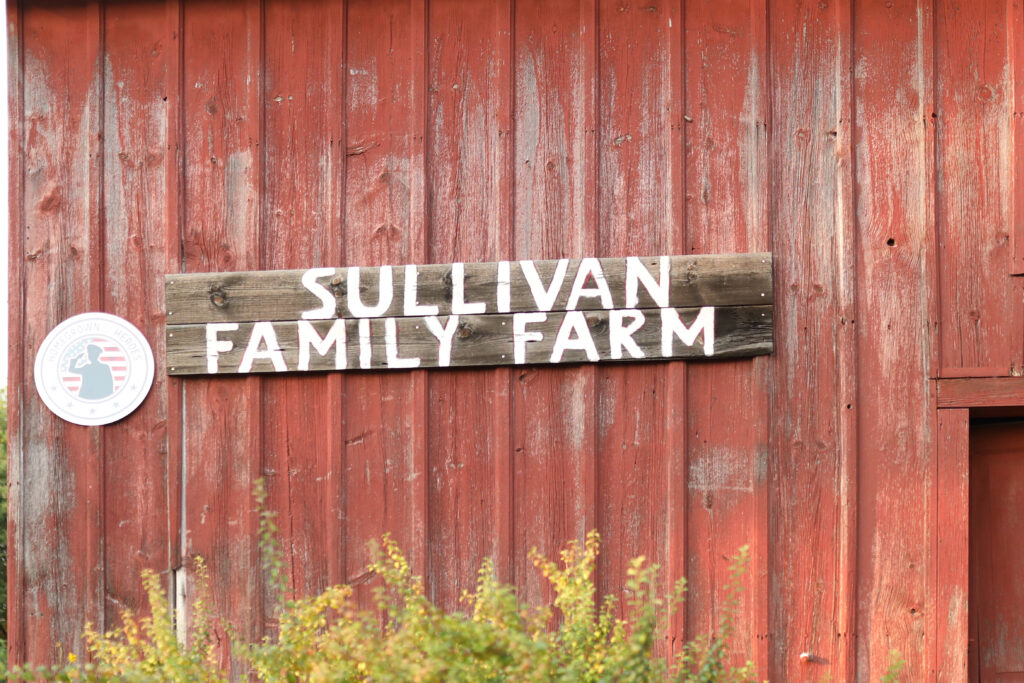
Ryan Sullivan is no stranger to hard work. After spending over 25 years in the U.S. Air Force and South Dakota Air National Guard as an aircraft technician, he and his family were ready to set their sights on a new mission. Using the skills, determination, and discipline he learned in the military, Ryan and his family have established a thriving operation where every member of the Sullivan family has an important role to play.
Ryan grew up in Mitchell, South Dakota, and was stationed at Ellsworth Air Force base not far from Rapid City, South Dakota after completing basic training. As a technician, he worked on rebuilding military aircraft, larger transport, and small commercial aircraft. Throughout his career with the military, he completed six tours across Iraq, Afghanistan, and Jordan conducting technical aviation training.
It was 2010 when Ryan and his wife Jackie, who was expecting their first child, began to research eating healthier. “We started learning more about food, and we would joke about what we were going to feed this kid! We knew we had to get smarter about it,” Ryan remarked. A humble vegetable garden and a few egg-laying chickens later, Ryan and Jackie were ready to get even more involved with where their food was coming from.
Forging their Future
In 2011, Ryan and Jackie attended a Farm Beginnings course in South Dakota while he was home from deployment. With their second child on the way, they knew they wanted to build a sustainable lifestyle for their growing family. The Farm Beginnings course taught them the basics of owning a farm-centric small business and gave them the confidence they needed to take the leap and start looking for property. With Jackie’s parents back home in Wisconsin, it seemed like the perfect place to plant their roots and raise their family. Ryan was deployed to Jordan at the time, so searching for the perfect property was a challenging venture but they didn’t give up on the vision they had for their future and their family.
It was late 2013 when Ryan and Jackie purchased their dream property on five acres. Not long after they packed up the life they knew in South Dakota and moved to Manitowoc, Wisconsin with their now three children. While there, Ryan worked for the Air National Guard as a part-time guardsman before retiring from the military in October of 2021.
“Everything we’d been doing over the years had been building towards being able to purse farming full time,” he explained. Ryan now works full-time on the farm with the help of his wife Jackie, who also works part time as a physical therapist.
The Importance of Farm Fresh Food
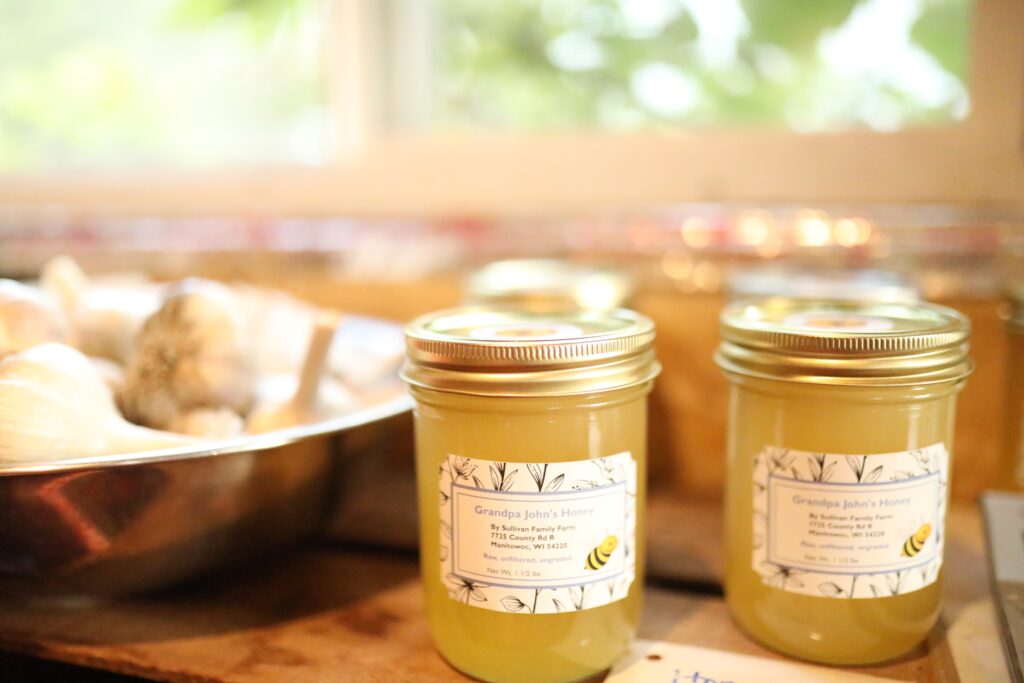
Sullivan Family Farm has a diverse range of offerings such as a wide variety of seasonal fruits and vegetables, free-range eggs, pasture-raised meat birds, and grass-fed lamb and beef. In addition, they offer weekly Farm Boxes which include a mixture of in-season fruits and vegetables. The farm’s products are all-natural and use organic practices as the Sullivan’s don’t use any pesticides or herbicides on their crops.
“We want to leave our little piece of Earth better than when we found it when we’re gone,” says Ryan. “Since the beginning, our focus has been on providing families in our community with natural, healthy foods.”
What started as a single refrigerator in the corner of their garage and a hand-painted sign advertising “eggs for sale” has transformed into a bustling self-service stand on the farm’s property. The Sullivan’s also serve as a rotating vendor for Seasonal Harvest, LLC, a local food co-op as well as a woman-owned pop-up market in the Green Bay area. But their true passion lies in providing farm fresh food to local schools, restaurants, and Grow it Forward, a nonprofit organization based in Manitowoc that partners with the Local Food Purchase Assistance (LFPA) program to provide access to healthy food to those in need.
“One of the biggest ‘pinch-me’ moments I’ve had since farming full time was when we were able to load a full pallet of food onto a 53-foot semi-truck that was headed to a local food bank,” said Ryan. “That was a huge accomplishment for us. It’s important to us that we are involved in these programs and can continue to provide fresh food to our local community.”
More Than a Financial Partner
The farm’s success didn’t come without quite a bit of learning, growing, and trial and error, however. Sullivan Family Farm became an established business in June of 2020, right in the midst of the Covid-19 pandemic. “That’s when we saw an explosion in the number of customers we were getting, and that also came with a new set of challenges on how we would produce a larger volume of food,” Ryan acknowledged.
That’s when GreenStone became a resource for Ryan. “Initially working with GreenStone gave us the capital we needed to step up to the next level of what we wanted to do,” he explained. “GreenStone has provided us more than just the capital we needed. They’ve heavily invested in us and our success. They were the exact thing that we needed as far as training and mentoring goes.”
As a recipient of GreenStone’s CultivateGrowth grant, Sullivan Family Farm was able to gain the knowledge needed to add more hoop houses for growing seasonal produce to their property and establish a 40-acre plot of land they rent for their beef cattle and sheep.
In addition, Ryan has attended GreenStone’s annual CultivateGrowth conference twice, and even spoke on the panel of young, beginning, and small farmer experts at the 2023 conference.
“The most remarkable thing about Ryan is his commitment to continuous learning and sharing the knowledge he’s gained over the years with others who are in the same position he used to be in”, says Joe Schlies, financial services officer at GreenStone. “It’s clear Ryan sees the importance in mentorship and learning from others and wants to share the passion he has for producing healthy foods with others who want to do the same.”
As for the future of Sullivan Family Farm? “Our hope is that we can grow sustainably. We want to get even better, and more efficient at what we’re doing now,” says Ryan. “I say to anyone and everyone, GreenStone has been an excellent connection for us, and they have always been invested in our success.”
To view the fall 2024 issue of Partners magazine in its entirety, click here.
George Washington devoted his life to the improvement of American agriculture. While his initial interest in farming was driven by his own needs to earn a living and improve his homestead in Mount Vernon, in later years Washington realized his leadership and experimentation could assist all American farmers.
Washington was a leader in service in the all-important emerging governance structure of a new nation. He led the Executive Branch as our first President. This governance structure remains the envy of the world, and Washington’s service serves as a standard bearer of the highest caliber. This example has grown in strength over centuries with leaders chosen by a population of citizens voting for its leaders. While many skills are necessary to be one of those exemplary leaders, leaders that listen distinguish themselves amongst the competition.
Washington built his leadership with the skill of participating in agriculture, listening and acting. Washington stated in his Eighth Annual Address to Congress on December 7, 1796, “It will not be doubted that with reference either to individual or national welfare, agriculture is of primary importance. In proportion, as nations advance in population and other circumstances of maturity this truth becomes more apparent and renders the cultivation of the soil more and more an object of public patronage. Institutions for promoting it grow up, supported by the public purse; and to what object can it be dedicated with greater propriety?” Washington heard the cries of a growing population and the need to feed the nation. Public patronage was necessary to be the object of promoting agriculture.
It is important for our current legislative and public policy leaders to understand this truth as it remains critical to our nation. We are all required to support our farmers. It is essential to our nation. Considering farmers being fewer in number as the years pass, it is common sense that we all find ways to continue the mission of public patronage for greater prosperity to support the engine of agriculture, our farmers. Agriculture is core to the strength of the nation as first recognized by our first President. Washington is well recorded with this most useful common-sense statement, “Agriculture is the most healthy, the most useful, and the most noble employment of man.”
As the noblest of all men and women, recognized at our nations very formation, those employed in agriculture and humble in heart, we must journey in our actions by first recognizing this for ourselves. This will strengthen our communications and the messages that our elected officials need to hear. There is a difference between listening and hearing, but it starts with listening. When we communicate, if we want someone to listen, we need to talk about something they want to hear. If the legislative leaders hear, they will act. They must act, or the very strength of our nation will be weakened. It is a critical responsibility of agriculture to tell our story, the story of the farmer, in a manner that makes these policy leaders hear.
One of the sincerest forms of respect is listening to what someone has to say. Respect the listener in return with clear and consistent action and advocacy in all that we do out of necessity to support agriculture. Actions are the cement which holds everything together. As James recounts in the Bible, chapter 2: 17-18, “So also faith of itself, if it doesn’t have works, is dead. Indeed someone may say, ‘You have faith and I have works.’ Demonstrate your faith to me without works, and I will demonstrate my faith to you from works.” As a farmer shows nobility through their works, so must legislative leaders. Legislators need to act favorably towards agriculture, by first listening and then demonstrate that they heard by acting in support of agriculture. Action verifies listening and overcomes mere talk.
To view the fall 2024 issue of Partners magazine in its entirety, click here.
GreenStone is a cooperative governed by a board of 16 members, 14 of which are elected by our members and two are appointed to provide specific areas of expertise. While our members might assume that means these directors attend board meetings, what you might not realize is they also provide a great deal of support and engagement in the agricultural and financial industries. In this Directors’ Perspective, a few of your board members share insight into how they represent GreenStone and interact at other opportunities throughout the year!
Mike Timmer
Allegan County, MI
The opportunity to serve on the Greenstone board has given me a greater appreciation of all the hard work that goes on behind the scenes. The first board meeting left me feeling overwhelmed with all the financial terms and acronyms we discussed. It made me wonder if I would ever be able to remember them. The educational experience, however, has been great! There are many resources that are available to the board members if we have questions or would like a better understanding of topics we discuss. The staff is extremely helpful and willing to answer questions, and the board training sessions are a terrific way to learn about technology, security, and other areas of interest to the board.
Outside of the board room the annual meetings are a wonderful place to talk with board members from other Farm Credit associations. These meetings allow us opportunities to share ideas and learn from each other about the challenges and successes each association has as we strive to meet the needs of our customers. As a board member it is important to stay up to date on the challenges so GreenStone can be a great partner through both the good times and the challenging ones.
Gene College
Appointed Director
The 16-person board of directors for GreenStone is an outstanding board, consisting of 14 elected and two appointed members. I am one of the appointed directors and live in Omaha, Nebraska. The GreenStone board meets quarterly and has four committees with specific responsibilities, each of four members, which meet separately as a part of each quarterly meeting. I serve on the Audit Committee, which I thoroughly enjoy as it involves many aspects of financial, internal audit, credit, technology, and other key areas. The board also has periodic training sessions as a part of the regular meetings dealing with a variety of areas that involve potential risks to the organization such as cybersecurity, possible adverse regulations, etc.
I also annually attend the AgriBank, our funding source, annual meeting as well as a Farm Credit systemwide director leadership conference where directors from essentially every state have a variety of joint and breakout sessions meant to challenge us with ideas and concepts that we can take back to our regular board meetings. Although I live outside GreenStone’s lending territory of Michigan and Wisconsin, I still get the opportunity to be involved with congressional leader events in Nebraska to continue to press the importance of current agricultural and Farm Credit matters. The GreenStone board has also had a joint meeting the past couple years with two other Farm Credit association boards. These sessions have been very helpful to gain insights into other association practices, challenges, and more.
No board has all the answers, and ideas gained from such meetings are helpful as we oversee our own association activities.
The external conferences are particularly helpful to me. They delve into many issues including agricultural and general economic conditions, political and legislative landscape, collaborative leadership, futuristic thinking, strategic decision making, technology risks, and artificial intelligence to name a few. These events also provide the opportunity to develop relationships with directors from across the nation and to “pick their brains” relating to matters of interest.
The learning process never ends, and thankfully so!
Scott Roggenbuck
Huron County, MI
As a board member we are asked to attend some conferences outside of our regular board meetings.
These may include the AgriBank Annual meeting, the Farm Credit Annual Meeting, or the Directors Leadership Council. System business is discussed, and valuable training is included. One of the most enjoyable parts of attending these nationwide functions is the networking we get to do with farmer and rancher directors from across the country, many of which have become great friends over the years.
I do try to attend the Michigan AgriBusiness Association winter annual conference here in Michigan to gain insight and to broaden the GreenStone reach, and I stop by our branch office on Patronage Day to say hi to the staff and the customers who are picking up their Patronage checks. I do enjoy the board meetings though as much as anything. It is where we really get to dive into the business and work closely with management as GreenStone navigates the ebbs and flows of the economy and works with our customers to help them thrive.
If you see the hardworking GreenStone staff at a trade show or event manning a booth, stop by and say hello!
To view the fall 2024 issue of Partners magazine in its entirety, click here.
The stories told of rural communities and agriculture are building a foundation for legislative support.
GreenStone’s outreach to legislators and partnering with other similarly minded agricultural organizations on legislative matters continues to bring focus on ensuring the future of rural communities and agriculture, and the Farm Credit System is bright. Communicating this is an important responsibility of all members and it is built through the open and ongoing conversations.
At the state level, in Michigan and Wisconsin, over 35 meetings have taken place with state Senators and Representatives at the capital or out in the districts. Disbursements are also being completed to provide support to elected officials running for the Legislature this year. The majority of the meetings have focused on demonstrating the connection between GreenStone and the urban and rural districts of elected officials. In addition, time has been spent asking and getting an understanding of what rural and agricultural tours would be helpful to continue the education of our elected officials.
The Farm Credit PAC continues to support federal elected legislators both in Michigan and Wisconsin. Over 20 meetings have taken place with Senators and Representatives this year, both in state and in Washington D.C. The discussion has centered around the Farm Bill conversation and the need for it to provide a level of certainty for farmers and ranchers. Communication is direct: producers are facing a more challenging economic environment, and conditions are expected to continue deteriorating. An update on the growing season and stories of how GreenStone is fulfilling our mission to support rural communities and agriculture to 28,000 members is also provided.
Our elected officials continue to receive the Farm Credit message as the impact of rural communities and agriculture stretches far beyond the rural parts of Michigan and Wisconsin. Those that represent our rural communities and agriculture recognize the great responsibility, and we continue to build relationships with those that do not for the sake of prosperous futures for everyone. The relationships being built establish GreenStone and our members as reliable sources of grassroots information and resources. None of this could be done successfully without active engagement, and your involvement is essential.
Thank you for helping build the voice of rural communities and agriculture!
To view the fall 2024 issue of Partners magazine in its entirety, click here.
Are you ready for the new year? While fall may still be in full swing, it’s never too early to start thinking about your year-end financial documents.
Year-end financial documents not only provide an overview of your finances from the previous year but can also help you plan for the coming year. Planning ahead will help alleviate the stress of making future financial decisions by giving you a baseline of your financial progress so you can make better and more informed decisions.
Keeping track of your financial progress allows you to see any trends that have developed over the past year and can provide insight into what your budget for the next year should be. Did you experience a significant increase or decrease in the cash flow and balances over the past year? Were there any unexpected expenses that popped up, or do you have plans that require financing in the coming year? These are all factors that help determine your financial progress and can help you focus on making the best decisions for you and your operation.
For our GreenStone members, this year we’ve made some exciting improvements that will help make the process of submitting your year-end financial documents even faster and more efficient. You will now be able to submit your balance sheet through our online customer portal, My Access. This will allow you to upload your balance sheet separately from other year-end financial documents. While your balance sheet can be submitted through the portal at any time, it is important your balance sheet includes the most up to date and accurate snapshot of your finances going into the new year and therefore may be best to wait as close to yearend as possible to ensure it captures all yearend income and purchases.
What can you do now to start preparing to submit your year-end financial documents? Follow this checklist of items to ensure stress-free financial documentation:
- If you do not already have a My Access account, scan the QR code to view the My Access enrollment guide and create your account.
- Navigate to My Access and familiarize yourself with the new My Financials feature. This is where you can access a digital balance sheet and provide updated information regarding your current assets, current liabilities, non-current assets, non-current liabilities, and debt schedule by navigating the 6 tabs.
- Start gathering and preparing necessary information for your year-end financial documents, such as your balance sheet, tax returns, cash flow statement, etc.
- Be on the lookout for your end of year financial packet that will be mailed around December 20th.
- Input your balance sheet information using the digital interface through the My Financials tool in My Access as close to the end of the calendar year as possible.
- Be sure to have all year-end financial documentation submitted by the deadline in January 2025.
Submitting your year-end financial documents in a timely manner provides you with the peace of mind you need to make informed decisions about your finances going into the new year. Should you have any questions regarding your My Access account, or how to submit your digital balance sheet, please contact your financial services officer for more information.
To view the fall 2024 issue of Partners magazine in its entirety, click here.
What is the best time of the year for someone who loves the outdoors? Speaking as someone who loves to hunt and fish, and who has had the privilege of going all around our great state, this simple question is rather hard to answer. For sportsmen and women around Michigan, each season is special and unique.
Winter
The frozen lakes that call us out onto the hard water are for sure special. Chasing smelt on Higgins Lake, or one of the many other ice fishing opportunities around the state, are a favorite. The annual pilgrimage to Black Lake, in hopes of spearing a sturgeon, is another highlight for many Michiganders. There’s also lots of hunting options during the winter, as fresh snowfalls create ideal tracking opportunities. Winter is a special time for the outdoor lover, no doubt.
Spring – Spring could clearly be made the favorite for many as the woods and water awake from their winter slumber. The rivers are ready for the trout fisherman and the spring turkey woods are full of thundering gobbles around both of our peninsulas. For those who are looking for excellent table fare, the morel mushrooms are also popping this time of year. Spring has a certain smell and feel, the promise of hope and things yet to come are all a part of this special season.
Summer
Is there anywhere on earth as great as a Michigan summer? I think not. We as Michiganders have a few month window of perfection. Fishing for salmon, walleye, and bass on the Great Lakes is a destination for folks around the world during the summer months. Our large inland lakes like Burt, Mullett, Houghton, Hubbard and Higgins are also popular destinations for anglers and families alike. There’s just so many places to see and experience, so many beaches to enjoy. Summer, although to short, has to be in the running for the best time of the year.
Fall
Winter, spring, and summer all have their redeeming qualities but there is one season that steals the show. The first cool breeze in early September reminds the sportsmen and women of what is about to happen again. It starts with some early waterfowling, followed shortly by the opening of small game season, bear season, and the youth deer season. By mid-September, rivers around the state will be full of thousands and thousands of salmon providing an incredible opportunity for anglers to target them however they choose! Deer season isn’t far behind and once October 1st rolls around, bowhunters flock to the woods hoping to fill a tag. Grouse and woodcock hunting also picks up this time of year, accompanied by the changing colors of leaves. The amount of things that fall brings the sportsmen is almost too much to handle. It is like drinking from a firehose! So much to do, if only October could be 90 days!
This fall is just starting to take shape, and as much as it’s hard to say goodbye to summer it’s so good to say hello to what has to be the best time of the year! To those of you who love the winter, she will be here soon enough. For the lover of the spring, her green will soon be back, we know. For the one who loves the summer, we get it, and we can’t wait to see her again. But – FALL, you have won the hearts of many. Fall brings out our best, its color and crispy leaves under foot reminds us of days gone by, and yet paints the pictures of days to come and adventures we have yet to have!
To view the fall 2024 issue of Partners magazine in its entirety, click here.