

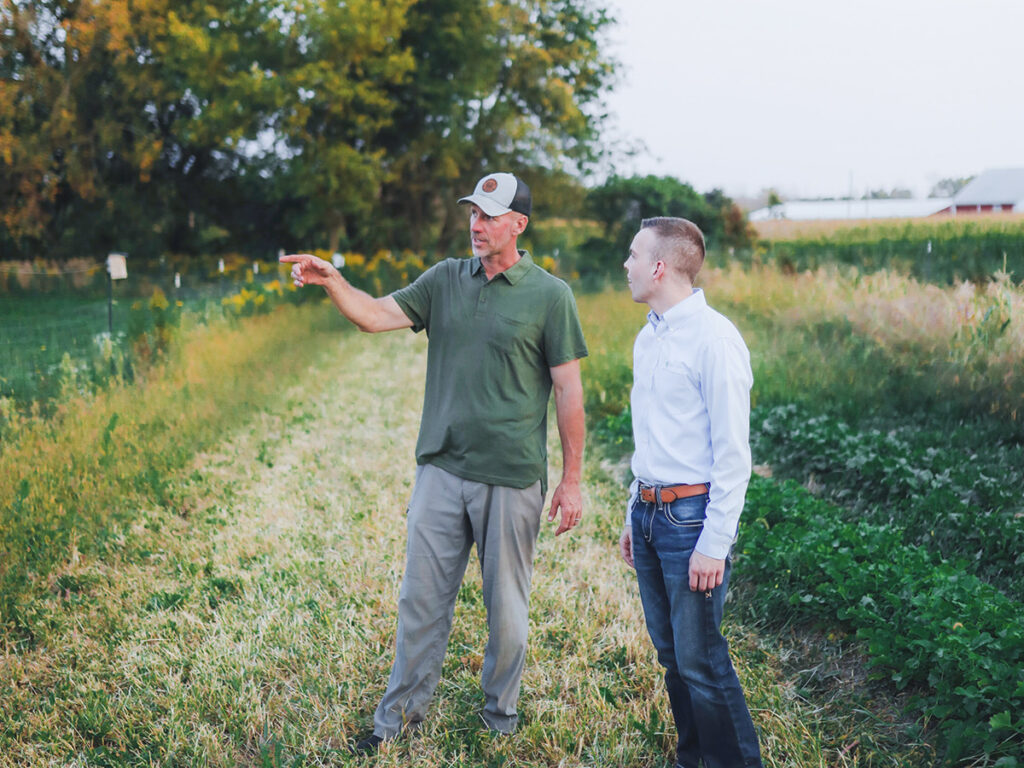
GreenStone Farm Credit Services is pleased to welcome Angela NaDell to the team as its Executive Vice President and Chief Human Resources Officer (CHRO).
NaDell assumed the role in March, spending time working alongside longtime CHRO Beth Barker who will be retiring later this month. She reports to President and CEO Travis Jones.
“Angela will play a crucial role in shaping and implementing the human resource strategy aligned with GreenStone’s overall business plan and organizational direction. She understands the success of our business starts with our people. Her strategic thinking, business acumen, and depth and breadth of experience will allow GreenStone to remain an employer of choice and a successful leader in the marketplace,” said President and CEO Travis Jones. “Angela will oversee all aspects of the human resource function including talent acquisition, learning and development, change management, organizational development, human resource operations and compensation and benefits for GreenStone employees.

NaDell brings over 20 years of human resources leadership experience to GreenStone, most recently working as a Chief People Officer in the banking industry, and held notable roles at companies like Consumers Energy, Eaton Corporation, and Campbell Soup. She earned a master’s degree in human resources and employment relations from Penn State University and a bachelor’s degree in business administration from Central Michigan University. NaDell’s proficiency has allowed her to fluently transition successfully into the role while Barker provides insight from her 25 years of service with GreenStone.
“One of our core four values is Customer First. It was clear from my first interaction with GreenStone they understand exceptional customer service begins with building the right culture. As evidenced by first quartile employee engagement results, they’ve demonstrated a best-in-class employee experience, and I look forward to building on that momentum and driving our people strategy to continue enabling delivery of our business outcomes,” NaDell acknowledges. “This is truly a great place to work. I’m honored to be here and look forward to maximizing the potential of our people, processes, and systems. My passion, tied with GreenStone’s culture, makes me even more excited to bring my focused energy to the team.”
The CHRO provides strategic and operational leadership to all areas within the human resources function, impacting the overall employee experience.
“Our staff have warmly welcomed Angela and I am pleased to say her wealth of experience is already contributing to our continued success as an association,” Jones said.
GreenStone is continuing to evolve each year with projects focused on improving the way we do business, creating efficiency, and evolving customer solutions. Here’s a glimpse of a few of the team behind these different projects:
Eric Thompson
14 years of service
Project Manager

How does your role help carry out GreenStone’s mission of supporting rural communities and agriculture?
A project manager is essentially a change agent, helping to guide teams to bring about positive change for our customers.
What do you enjoy about your role?
For me the most enjoyable part of my job is working with the project team members who share a common vision for the organization.
How does your portion of the loan process ensure great customer service?
A key aspect of project management is identifying risks that may impede or prevent a project from bringing value to the organization. This forward-thinking model allows me to guide the team to have a plan in place to react to a risk proactively rather than reactively.
What do you enjoy in your free time?
One of my passions is to coach high school boys lacrosse, which is a sport I learned as a young man growing up in New York. Working with young people keeps my outlook on life fresh and gives me hope for our future as I have a chance to show these athletes how discipline in sport can directly impact how they make lifelong decisions, and be part of something bigger than themselves.
How has your work changed over the years?
Some aspects of my work have remained steady – namely attention to detail, take care of the little things and the big things will take care of themselves. Project management is evolving as the model that I worked with a few years ago was highly predictive, planning a project from start to finish then managing change as needed through a structured method of approval. The new model we have been employing here at GreenStone is to be more adaptive, setting our initial goals for the project at the start but empowering the team to make decisions and trust them to get the work done to achieve our vision and deliver value.
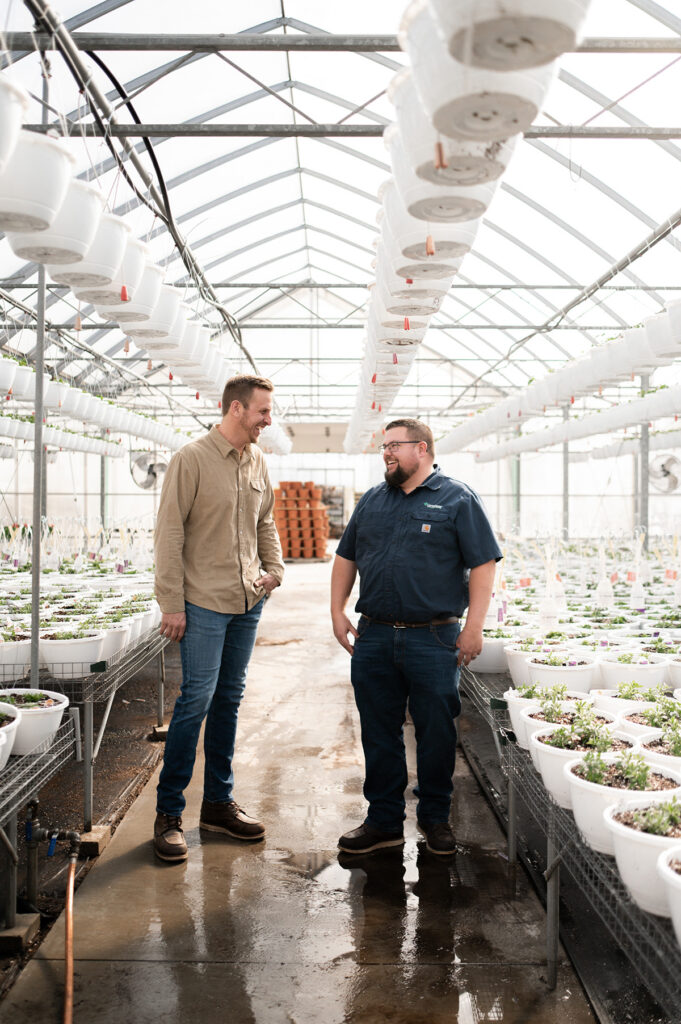
Taylor Martin
5 years of service
Business Analyst

How does your role help carry out GreenStone’s mission of supporting rural communities and agriculture?
My role as a business analyst is to improve GreenStone’s internal processes and systems to provide value and increase efficiency across all departments to give our frontline staff the tools they need to provide quality service to our customers. I have a bachelor’s degree in horticulture from Michigan State University and we have a decent size dairy farm so I am not the “normal” person that you would usually see in a business analyst position. I use my degree and industry knowledge every day to improve GreenStone’s internal processes thinking about each project I work on and assisting my peers in thinking about their projects from the customer’s perspective. I try to keep in mind, especially in our current economy, how each item I work on will ultimately help us provide our customers with consistent financing, crop insurance, tax services, and so much more to help their farms and agricultural business be successful!
What do you enjoy about your role?
I love that there are so many jobs you wouldn’t ever think of as having an impact on the agriculture industry, including mine, but I get to support the industry I love every day.
How does your work ensure great customer service?
My role helps enhance business process and systems for our staff to follow and use to assist our customers. Without consistent processes and tools, GreenStone could not provide the level of service we do to our customers.
What do you enjoy in your free time?
Spending time with my husband, and our 2-year-old and 6-month-old children on our family dairy farm!
How has your work changed over the years?
I have been with the company five years. GreenStone implemented change management approximately three years ago to help improve the way we roll out changes. We have continued to become more and more efficient across the board, implemented better, more consistent communication across our internal teams, and reinforce changes with our staff. Change management has helped us to really streamline the process, which ultimately leads to a higher adoption rate and more consistency with our customer service.
To view the spring 2024 issue of Partners magazine in its entirety, click here.
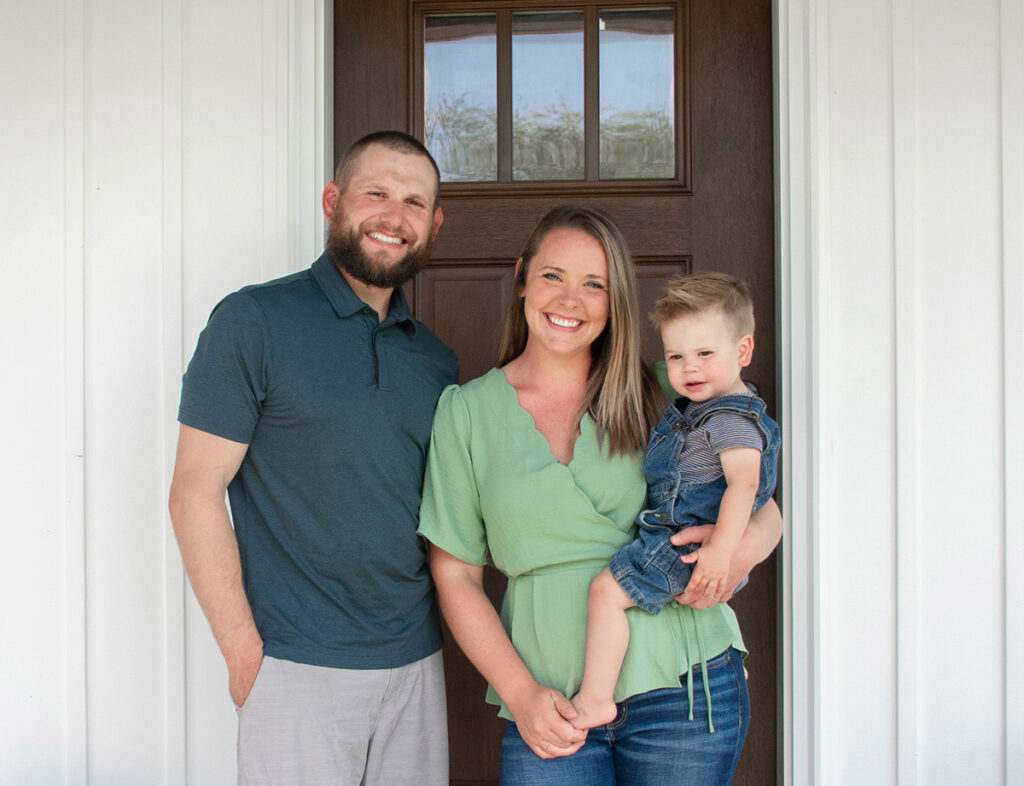
Originally both from Michigan, Travis and Breezy Bernheisel built a life in Charleston, South Carolina. The hustle and bustle of city life excited them, and during their 14 years there, their family of two grew into a family of three, and eventually a family of four. It was that focus on family that drove their decision to move back to Michigan closer to loved ones.
“The last six years in Charleston, we were praying we would end up back in Michigan,” Breezy explained.
“The big city was great and has its own perks, but we were ready to be back in the country,” said Travis.
After Breezy obtained her master’s degree in educational nursing, the big move back to their home state started to fall into place.
“I got my master’s degree, and doors started flying open from there,” Breezy reflected. “Travis got a job offer from the company he was working for, and I was able to find work in Michigan as well.”
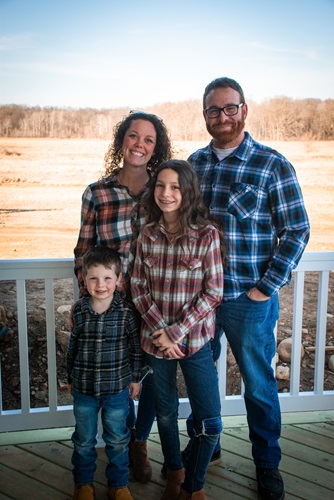
Since the summer of 2022 when they packed up and moved back to the mitten state, Travis and Breezy, along with their 10-year-old daughter and four-year-old son, have lived with family, but soon they will move into their brand-new home in Jackson County.
The couple worked with builders to make their dream home a reality.
“I definitely can’t wait for our house to be completely finished and my kids will have space. They’ll have their own rooms for playtime,” said Breezy. “Dreams are being unraveled in front of our eyes. It’s all coming to fruition. It’s been a blessing for sure.”
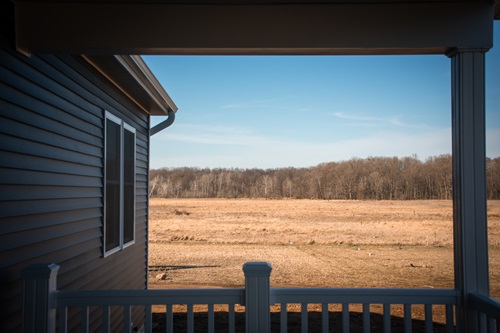
Although the moving truck is booked and the bags are mostly packed, this home build didn’t happen overnight. It all started with a plan drawn out by a friend of the two.
“We worked with someone to draw prints. We got to lay out the floorplan and incorporate almost everything we wanted into the floorplan. The homes we had in Charleston were predesigned, but with this house, we got to pick out the whole floor plan.”
Travis and Breezy worked with GreenStone Financial Services Officer Ben Hawes to finance their new endeavor. Being familiar with their family and having mutual friends, Ben was excited to help make their dream a reality.
“This is a small community. The fact that they wanted to come back and raise their family here is pretty sweet,” said Ben.
“We had talked to Ben a few different times,” said Travis. “I called him and asked him questions about moving, buying and selling. He helped with a lot of other stuff too. He was always willing to have a normal conversation.”
Many conversations later, builders were able to break ground on the three bedroom, two-and-a-half bathroom house filled with features specifically picked out by Travis and Breezy.
“It’s ours,” explained Travis proudly. “We got to pick and design and there was some give and take between the two of us and budget wise, but for the most part, we’ve picked out and designed everything in the house. That’s a pretty cool feeling, especially now that it’s nearly done.”
“I love the marine blue siding we picked out,” said Breezy. “It’s one of my favorite colors and I love how it turned out.”
Ben, along with family and friends of Travis and Breezy, have been able to follow the home build in real-time as the couple posted Facebook live updates throughout each project.
“It has been really cool to watch them post their videos and see the build every step of the way,” said Ben.

The two plan on watching many sunrises and sunsets in their new abode, as well.
“I love the porch. The porch on the back has a great view of the sunrise, and the porch on the front has a great view of the sunset. It’s one of my favorite parts of the house,” said Travis.
And don’t worry, their two kids also had a say on their spaces — and they were both strategic.
“My daughter wanted the front bedroom so she can see the sunset,” explained Breezy. “My son wanted the back bedroom so he can see the deer and wildlife roam out back.”
It’s the countryside paradise the family always dreamed of having.
“Having a large property has always been something we’ve talked about, and now we’ll have some property to hunt on. That’s exciting,” said Travis.
With just a few more projects to wrap up, the family plans to officially move into the home this spring, and they are more than ready to unpack their boxes and enjoy their new forever-home.
“We’re just ready to be in,” said Breezy. “It’s our own space and I can’t wait to have my family at my house.”
And possibly more excited than them – their team at GreenStone.
“I get excited about their home construction as if it’s my own home,” explained Ben. “It’s a feeling you can’t really describe.”
“Everyone I worked with at GreenStone has been amazing, especially Ben Hawes and Renee Lewis,” said Breezy. “The people we’ve encountered were so kind. I’d point anybody to GreenStone, for sure.”
To view the spring 2024 issue of Partners magazine in its entirety, click here.
When it comes to crop insurance, one of the most underutilized tools is the use of Precision Data. Reporting your acres and production via Precision Data has many benefits and comes at no cost!
Regardless what you might think, producers do not have to use acres that they report to the FSA for their crop insurance. The fact is, you are allowed to report your acres to your crop insurance agent using Precision Data. Some have estimated there is a 3-10% acreage increase when using the FSA data due their boundaries that can include untillable fence rows, ditches, roads, etc.
What are the benefits of using Precision Data for Crop Insurance?
- Accuracy- Pay premium on the acres you actually plant
- Efficiency- Reduce the amount of time to report your acres to your agent
- Precision- Maintain the most precise Actual Production History (APH) information possible
Cameron Jodlowski, Precision Ag Specialist with Rural Community Insurance Services (RCIS) states, “Utilizing precision ag data for acreage reporting could help you have a more accurate crop insurance policy.”
A lot of producers are taken back when they realize the difference in acres they actually plant compared to what they certify. This has two negative impacts. First, you are paying premium on acres that are not planted. Second, when you go to report your production in the fall, your production numbers are actually being deflated because you are applying your production to inflated acres.
“When utilizing precision ag harvest records, the harvest maps can be used as a hard record when paired with a calibration report, which helps in case their would be an audit or policy review,” added Jodlowski.
In a claim situation, we can use a planting map, harvest map and a calibration report to finalize a claim. Precision Data claims are worked much faster than your traditional claims using livestock feeding records, bin measurements and settlement sheets.
The quality of your data has an impact on how well it will work for crop insurance reporting. Here are a few tips for collecting good data.
- Make sure your field boundaries are set up.
- Name your fields. Your crop insurance policy can use those field names to help match up APH databases with planting information.
- Be able to provide your agent with “raw” data.
Lastly, you should know that you do not have to report both planting and harvest using Precision Data. If you choose, you can use it for planting only, production data only or both. For a claim to be worked using Precision Data, you will need to utilize it with both planting and harvest.
If you are interested in utilizing Precision Data for your crop insurance policy, simply contact your local GreenStone crop insurance specialist!
To view the spring 2024 issue of Partners magazine in its entirety, click here.
On a sunny, spring afternoon in Eaton Rapids, Michigan, the cattle of Two Sparrows Farm roam the 80-acre pasture. The cattle chow down on hay grown and made by Dan and Whitney Belprez, the farm owners.
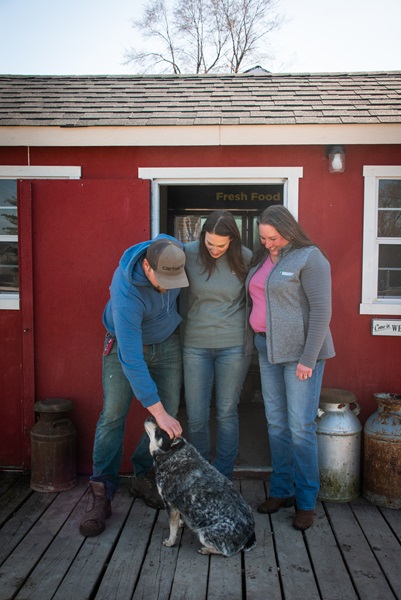
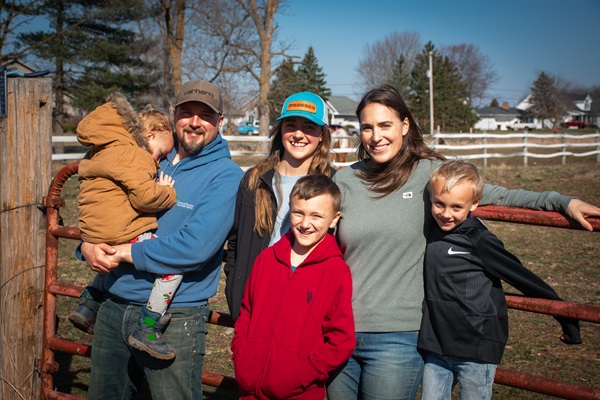
Look closer and you’ll find Dan and Whitney’s four children helping with farm chores as customers pull in for their latest share of fresh milk.
Dan and Whitney have their business down to a science–partnering with nature to grass feed their cattle.
But Dan and Whitney will be the first to tell you that the farm’s great success had humble beginnings, and took plenty of research, experimentation and hard work.
“We’re both first generation farmers,” explained Whitney. “My mom is an attorney and my dad works in finance. Dan’s mom was a teacher and a principal. So, our families have nothing to do with farming. Neither of us have a degree in agriculture. In fact, we didn’t become interested in it until the tail end of college.”
That newfound passion sparked Dan to work for two apple orchards, and eventually, a large dairy operation.
“For me, I just liked doing hands-on work,” Dan said.
Whitney also jumped into the industry interning on an organic vegetable farm.
A Growing Business
From that point, the two began renting a farmhouse raising chickens in their backyard. When they outgrew that, they bought their first home on 12 acres in Lowell, Michigan. Their business began to take off, and the couple bought a 40-acre farm in Big Rapids before eventually settling down on their current property in Eaton Rapids.
Dan and Whitney worked with GreenStone to finance their farmland and utilize an operating loan for everyday farm expenses. As young, beginning and small farmers, they are able to take advantage of GreenStone’s CultivateGrowth program providing flexible loan terms and joint financing with the Farm Service Agency, or FSA.
Retired GreenStone Financial Services Officer Kelly Aiken is proud to be a part of their growing operation.
“I’ve been impressed with them as long as I’ve been working with them,” said Kelly. “They started small and have grown into a successful operation and that’s exactly what our relationship with FSA is supposed to do.”
“We have nothing but good things to say about GreenStone,” said Whitney. “Whether it’s selling and buying farms, whether it’s calling us to convert our mortgage to a lower rate, or the revolving line of credit that we’ve utilized. Everything that we’ve needed – GreenStone has been there and they’ve been super supportive and our biggest cheerleaders.”
Dan and Whitney have been on their current property for more than half a decade, and now offers fresh, whole, unprocessed milk to 320 families through a herd share and sell grass-fed beef to 30 additional families. It’s the type of growth they always wanted for themselves, but never could have imagined at the beginning.
“It has been interesting because early on, I think our families kind of looked at us like we were crazy,” explained Dan. “We started seeing the fruits of our labor ourselves and our customer base had grown and our families kind of saw that same growth and people started realizing, oh, you know, maybe there’s something to it and that small farms can be viable if they’re able to sell directly to consumers.”
If you ask Whitney, their secret superpower is being first-generation.
“In some ways, it’s our greatest detriment, but it’s also our greatest asset because although we didn’t have access to the capital, the land, the infrastructure or the equipment, all of those things that somebody who grew up in a farming family might have access to, we didn’t come into it with any preconceived notions of how one should farm. So, we could come in and think a lot more creatively about how to make our farm.”
Being Green to Make Green
Using regenerative farm practices are important to Dan and Whitney – they say it’s the perfect way to partner with planet earth and be eco-friendly while also helping their bottom line.
“With sustainable farming methods, you don’t need the facilities, you don’t need the equipment and you don’t need the feed pads so your input costs aren’t as high,” Dan explained. Dan and Whitney found the practices used in regenerative farming resonate with a large market of customers in their area.
“There’s a big market there for direct-to-consumer products that people can buy and feel like are produced ethically with animals that live in a more natural system,” Dan explained. “So, we found that basically there’s lower costs in that it does tend to benefit the environment and it does match up with what customers were wanting and willing to pay for, so it kind of checked all three boxes.”
“We’re trying to capture as much of the retail dollar as possible and so we can get our highest retail with customers that are willing to seek producers out that raise animals in a sustainable or regenerative way,” said Whitney. “For us personally, we do hold ecological values and want to farm in a way that is good for the environment.”
Helping Hands
Although Dan and Whitney didn’t grow up on a farm, they are sure glad their children do. They hope the farm instills the values of hard work and grit in them.
“They get to learn about calves and keeping cows healthy and different pieces of equipment,“ said Dan. “When things break, a lot of times they’re right there watching over my shoulders while I fix them. There’s so many different hats you have to wear farming and they get to absorb a lot of that. Hopefully it makes them more well-rounded or at least interesting individuals when they grow up.”
Most importantly, they hope their children have fun and create lifelong memories along the way.
“That’s something that very few kids get to experience, and it’s just a normal thing for them,” Whitney reflected. “I feel like they’re going to go out in the world and realize they had a different experience in their childhood, and I hope they appreciate it. They don’t have screens, they don’t have phones, they don’t have iPads, but they have nature at their back door and they have animals and I hope they appreciate that when they grow up.”
Just Getting Started
As young farmers, Dan and Whitney have a long road ahead. For now, they’re pumping the brakes on expanding, but rather focusing on best practices for their operation and family.
“I think right now we’re more focusing on just increasing efficiency and increasing our profit margins rather than just growing,” Dan explained. “We’re kind of cautious not to overrun our headlights, so to speak.”
“Having four kids along the way has really shaped our values and our perspective on what we want the farm to do for us, and I think our biggest goal is making sure there’s a balance of focusing on our family and work time basically to balance that for a sustainable lifestyle,” said Whitney.
Whatever lies ahead for Two Sparrow Farms, GreenStone is proud to be a partner in their growth.
“They’re just a wonderful family,” said Kelly. “I love being part of a farm team and helping people realize their dreams. It’s fulfilling to have those things happen and to be the partner that can help them do that.”
To view the spring 2024 issue of Partners magazine in its entirety, click here.
It’s nearly election time for GreenStone for our nominating committee and board directors, and we thought now would be a great time for a few of our directors to share their perspective on how they became involved on the governance side of the cooperative!
Read on to learn three individual stories – each unique to them – and why they encourage all members to consider getting involved in GreenStone’s governance. Those interested in learning about GreenStone board of directors and nominating committee can read more on page 16, or submit interest through a profile form on our website!

I became interested in Farm Credit probably the same way most of the board of directors did, by acquiring loans within the Farm Credit System and wondering how it all worked. I have been on and off GreenStone’s board three times, spanning the mergers to how we know GreenStone today.
There have been a lot of developments over the years, and as a director, what I have found surprising is the speed of which GreenStone has been able to grow through mergers, capital markets, a lot of IT development, crop insurance, partnerships, participation loans with other associations, and more.
One of the benefits of being on the board is that directors participate in National Farm Credit Association meetings where we gather with directors from all the other states across our country. I have realized from my conversations with other directors, that our diverse agriculture in our territory makes this the best place to farm in America.
My time on as a director on GreenStone’s board has been a very satisfying and rewarding experience. Taking into consideration my time on the board prior to the mergers and through today, I have had the opportunity to work with probably 60 different directors. It’s taken all of us working together to accomplish everything along the path to where GreenStone finds itself today. Working together to build good things is an American tradition, and I would encourage anyone to step up to become a director on the board of GreenStone Farm Credit Services. Anyone who wants to become a director should not think it’s impossible, because we all thought that before being elected.
GreenStone is a great advocate for Michigan and Wisconsin agriculture, and partners with others to advance economic opportunities for members. Between the GreenStone’s products and services for members and its political action committee, GreenStone stays involved and our whole territory continually enjoys the positive results.
In early 2022 I was putting plans in place to retire from my longtime career with MSU Extension. I hadn’t thought much about what 2023 would bring.
Word had gotten out that I was going to retire and one day my husband Lee mentioned to me that there was going to be an opening in our district on the GreenStone board of directors. He asked if I had ever considered serving on a board. In my career I had worked with many boards, but had not served on many. However, this got me thinking about the possibilities. I knew GreenStone from the farm side.
I worked with the local GreenStone financial services officers to plan and conduct educational programs, but I knew little about the business side of GreenStone.
The wheels were in motion and I began talking with past directors about the position. The responses piqued my interest, so I submitted an application and was interviewed and appointed to the board mid-2022 to finish out a vacant term.
I enjoy learning new things and the directorship did not disappoint. The view of lending from the lenders side is interesting, involved and a very important piece in getting the funds to farmers. The path money takes before making it to the farm and the measures that are put in place to reduce risk are two things that have intrigued me. I’m sure I have a lot more to learn, but at this point I am just excited to be a part of the organization and have the opportunity to keep learning!

For my family’s farm, GreenStone was something that just worked, like a 4020 John Deere that always started when you needed it. We never gave any thought to the governance of the organization.
However, in 2016 I was asked to be one of several farmers that gave testimony to the Senate Agricultural Committee on the importance of the Farm Credit System. This gave me my first glimpse of what it took to make a co-op like ours work and I was impressed with the professionalism and dedication of our employees. A few years later when I was asked to consider running for the board, I was excited by the opportunity to be more directly involved with this great institution.
Within our local agriculture industry, GreenStone seems to be a trusted organization by so many diverse groups, one which puts the needs of farmers ahead of other agendas or political trends. I’m continually challenged to keep up with the incredible group that makes up the executive team and the board of directors. The broader perspective I’ve gained being a part of this team is a great compliment to the intensely narrow focus that growing crops requires. Being a part of GreenStone is an honor and I recommend all our members consider being more involved at all levels!
To view the rest of the 2024 spring Partners articles please click here.
Before I get into the meat of this article, I first must pause to note that I am down my #1 reader of the articles I write. My wife’s grandmother passed away in mid-March at the age of 98 – she was around farming her entire life in Six Lakes, Michigan and was a devote follower of the industry. I’ll keep sharing important information and writing these articles not only because of the value they give our members, but because I know she would have enjoyed them!
There are a number of observations and items for you to be aware of and to monitor going forward that may impact you come tax filing time in the future!
Avoid March 1 Stress! March 1 is known as the farmer tax filing deadline for individual income tax returns. Farmers are exempt from a penalty for failing to file estimated taxes if they:
- File their return and pay all tax due by March 1. OR
- Their income tax withholding will be at least 66.67% of the total tax shown on their current year tax return or 100% of the total tax shown on their prior year return.
Alternatively, farmers may choose to make only one estimated tax payment by January 15 each year. Those who choose this option may file their return and pay the remainder of the tax due on the standard tax April 15 filing deadline. Qualifying farmers making one estimated tax payment by January 15 must pay the smaller of:
- 66.67% of their current year tax. OR
- 100% of the tax shown on the prior year return.
For joint returns, the spouse’s income must be considered in determining if the taxpayer meets the two-thirds of gross income from farming requirement.
Why is this significant? Meeting a March 1 due date is becoming increasingly difficult from a compliance standpoint. Many farmers receive 1099s from their cooperatives and other business activities such as rent, custom hire work, and other miscellaneous income, and are not receiving those until late in February. This year the USDA issued corrected 1099s for farmers whose premiums for dairy margin coverage was paid by their proceeds, which caused stress in filing by March 1 for some dairy farmers. Additionally, farmers who have outside pass-through entities with ownership for which they receive K-1s or have personal brokerage investments for which they receive a 1099 have the same challenges with not receiving the necessary documents until late February. The timing of receipt of this information creates a struggle to properly prepare farmers’ tax returns by March 1.
This year, farmers that paid an estimate by January 15, have the advantage of waiting to see if the government passes the Tax Relief for American Families and Workers Act of 2024 that would reinstate bonus depreciation amongst other retroactive tax law changes that they could take advantage of for their 2023 tax filing. Consider making quarterly estimates in 2024 or a single estimate in January 2025 to extend your filing deadline next year!
Tax Law Changes Coming? Many tax breaks established by the Tax Cuts and Jobs Act (TCJA) of 2017 are set to expire at the end of 2025. The USDA’s Economic Research Service estimates that farmers taxes will increase more than $9 billion between higher income and estate tax liabilities if the TCJA is not extended.
As we consider this, let’s look at which ones will impact farmers the most:
- Increased tax rates: The tax brackets will be lowered and rates in most brackets will increase. The below table presents the change in tax for a married filing jointly taxpayer with $150,000 in taxable income:
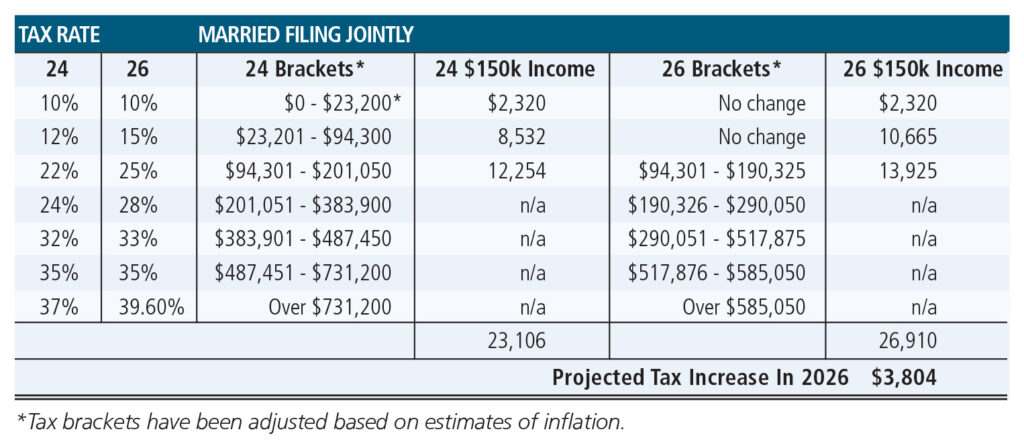
In this scenario, a taxpayer making $150,000 in both 2024 and 2026 will be paying in almost $4,000 more in tax in 2026.
- Expiration of Section 199A: Section 199A, also known as the qualified business income deduction (QBID), is a 20% deduction for income that individuals receive from business activities. Unless later extended or made permanent, this 20% deduction will no longer be available after 2025. A taxpayer with $150,000 in business activity income will have their taxable income and tax due increase approximately as shown below starting in 2026:
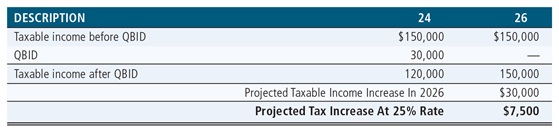
- Estate Tax Exemptions Decreasing: American taxpayers with considerable estates benefit from larger exemptions under the TCJA. The TCJA doubled the estate and gift tax exemption for individuals, from $5.49 million in 2017 to $11.18 million in 2018. Adjusted for inflation, the exemption was $12.92 million in 2023 and it increased to $13.61 million in 2024. This means an individual can now pass on up to $13.61 million in assets without being subject to Federal estate or gift taxes. For married couples, this effectively allows a combined exemption of $27.22 million. In 2026, the exemption amounts are set to decrease back to pre-TCJA inflation adjusted amounts.
Estate lawyers are busy assisting farmers that will be impacted by this change in establishing plans to utilize the higher exemption amounts yet in 2024 and 2025 before the sunset occurs. It is best to plan ahead if you think your estate may trigger estate tax at the lowered exemption amounts.
Other items with less consequence, but still impactful are that the standard deduction is set to decrease, the child tax credit could be reduced and phased out based on taxable income levels, and the alternative minimum tax exemption amounts will be reduced.
So what should you do? Understand how the above items impact your income tax position. Discuss these changes with your tax accountant. Consider pushing more income into 2024 and 2025 if possible at lower rates. If you believe you will have a taxable estate after 2025, act now; do not wait until closer to the deadline.
Reach out to your local GreenStone tax and accounting professional if you need assistance with any financial related services. Our team of experts is ready to help!
To view the spring 2024 issue of Partners magazine in its entirety, click here.
We love when our customers visit our branch locations, but we also understand that time is your biggest asset, and that’s why we offer convenient resources to help you manage your account from the palm of your hand.
We understand that our customers have unique needs, require secure options, and that not all resources are a one-size-fits-all solution, and that’s why we offer a full suite of options so you can find the tools that work best for you and your operation.
Let’s take a closer look at each of these resources available to you:
Online Banking Mobile App and Mobile Deposit
Using your My Access account, GreenStone’s online banking app allows you to manage your account in the palm of your hands. You can make a payment from your linked bank account, deposit checks into your operating loan, transfer funds between accounts, make or schedule disbursements and monitor account balances and upcoming deadlines.
Bill Pay
If you have a My Access account with GreenStone, you can take advantage of our new bill pay feature! This service allows you to set up automatic payments for bills and manage your payments to all your vendors in one place to make it easier to track what has and has not been paid.
Positive Pay
When you write a check, you expect the vendor or individual to cash the amount you penned. Unfortunately, check fraud is on the rise, and sometimes fraudsters can change the amount of your check, or it could end up in the wrong hands. With Positive Pay, you are able to submit check numbers and an amount into the system, and if someone tries to cash a check from you that doesn’t align with your list, you receive a notification. This way the money cannot come out of your account unless you approve the transaction.
Check Scanners
Remote check deposit through the app is a great option for those needing to deposit a minimal amount of checks at once. If you’re a business taking in multiple checks in a day, a check scanner may be an even better option. A check scanner allows you to process multiple checks in just moments, similar to taking them to your local bank without the inconvenience of the trip. A check scanner’s initial equipment fee can be easily worked into your operation’s budget.
Advanced ACH and Wires
Our branch staff are happy to perform a wire transfer for you at one of our 35 locations for $20, but the online banking Advanced ACH option through your My Access account allow you to perform a transfer for free or wires at half the price from the comfort of your home or business.
Additionally, if you decide to stop a payment using online banking, you can take this action for free, as opposed to the regular $15 fee for an in-person request through your local branch.
Farm Cash Management
Integrating your operating loans with short-term investments through a Farm Cash Management account gives you the dual benefit of easy access to operating funds while potentially minimizing your net interest costs. When you have available cash in your Farm Cash Management account, your operating loan is paid first. Any excess funds are then invested in an account of short-term investment bonds, which generates a return, similar to a money market account.
Paperless Bills and Statements, and eConsent
Opting into paperless bills and statements allows you to view your bill and statement in the palm of your hand through GreenStone’s mobile app or your My Access account. Signing up for eConsent allows us to provide necessary documents and disclosures to you electronically, including those requiring a signature using DocuSign. You can sign up for both of these options right from your My Access account.
Convenience Starts Now
GreenStone is proud to offer these convenient options to save you time, and help take your operation to the next level. Finding the best online tools and securities for your business can open more doors for you – so let us help.
Reach out to your local branch to learn more about this suite of online options and get signed up today!
To view the spring 2024 issue of Partners magazine in its entirety, click here.
If you’re looking for some Spring Flings this year, as an angler you will have a tough time finding a state with more opportunities than Michigan. By “Spring Fling” I mean a fishing trip in one of our beautiful peninsulas.
Let’s start in the southern zone where the spring season is home to some of the best fishing in the entire state. If you are even a relatively avid angler, you have probably tried or heard of the walleye run on the Detroit River. This annual draw is quite the event to behold. Boats from every corner of our state make the pilgrimage to the Big D to chase this fine tasting fish. April and May seem to be the heaviest months, but walleye can be caught starting in March all the way through July. Vertical jigging is the preferred method of take, but other methods are employed as well. My advice for the first timer is this: hire a guide and have them show you the ins and outs of this style of fishing. Boat control is key and with so many boats on the water it’s important to be familiar with both your equipment and the river. A quality captain to show you the way is well worth the money spent. If possible, try to set aside a couple of days for the best results, as the river and the weather can be a little temperamental this time of year.
If you’re not into walleye fishing or are simply looking to try something else, try heading west. It’s not Gold you’re looking for – its silver! Silver fish! Specifically, the coho salmon. As the shallower end of Lake Michigan starts to warm, bait fish begin to congregate in the southern portion of the lake and this triggers a push of coho salmon. It creates a great opportunity for anglers to target what is arguably the best table fare in our state. This is typically done in shallower water, meaning 30-60 feet, and done by trolling as many rods as you feel comfortable running. One word of caution, when this kind of fishing is hot, you can barely keep your rods in the water. Although these coho don’t always put a huge bend in the rod, they are almost unbeatable on the dinner table. Another fun thing about spring fishing for coho is every once in a while you can find a stray king salmon in these same waters, and those will definably put a bend in your rod!
If you’re looking to get out of southern Michigan, there are several other opportunities to the north. Although there’s a lot of water to chose from, it’s pretty hard to beat the Leelanau Peninsula. It’s a spring angler’s paradise with many lakes in a relatively small area. If I had to pick one species to target, I would recommend you spend some time chasing smallmouth bass on East and West Grand Traverse Bay. If you can time your trip to when the fish are spawning, you will witness some of the most entertaining fishing that Michigan has to offer. A wacky worm, a ned rig, or a tube and a pair of good polarized glasses is all you will need for a great day on the water! These fish aren’t the best for the table but pound for pound no fish fights harder. Oh, don’t forget to leave room for some wine tasting as well!
In Michigan, there’s almost too much to choose from when it comes to spring fishing. In addition to locations mentioned above, there’s also great fishing for trout, pike, largemouth bass, bluegill, and many other species around the state. We are truly fortunate to live in such a wonderful place! Good luck, and may your Spring have a few Flings this year!
To view the spring 2024 issue of Partners magazine in its entirety, click here.
There appears to be some relatively good news as it relates to environmental regulatory pressures on agriculture. This anticipated relief comes from a federal agency that may have been under your radar – The Security and Exchange Commission (SEC).
What does the SEC have to do with environmental protection? If you said, nothing, you are in agreement with at least one SEC board of governors. SEC Commissioner Hester Peirce has been vocally opposed to involving the SEC in environmental regulations.
Here is the background. On March 21, 2022, the SEC proposed a rule, “The Enhancement and Standardization of Climate Related Disclosures for Investors.” This proposed rule requires extensive climate disclosure by public companies, including their supply chain. The proposed rule is 510 pages with over 1,000 technical footnotes.
According to the SEC, the required information about climate-related risks would “…include disclosure of a registrant’s greenhouse gas emissions, which have become a commonly used metric to assess a registrant’s exposure to such risks.” Those supporting the proposed rule believe the risks associated with climate can put the security of companies at risk.
Scope 3 and Agriculture
What does this have to do with agriculture? Greenhouse gases are defined globally as Scope 1, Scope 2, and Scope 3 emissions. Scope 1 are a company’s direct emissions. Scope 2 are indirect emissions such as greenhouse gases (GHGs) produced by the utility that is supplying power to a facility. Scope 3 are indirect emissions by suppliers.
The Environmental Protection Agency defines Scope 3 emissions as, emissions that are the result of “activities from assets not owned or controlled by the reporting organization, but that the organization indirectly affects in its value chain. Scope 3 emissions include all sources not within an organization’s scope 1 and 2 boundary.”
The American Farm Bureau stated that reporting Scope 3 emissions not only “directly affects farmers’ and ranchers’ operations, but could create several substantial costs and liabilities, such as reporting obligations, technical challenges, significant financial and operational disruption and the risk of financially crippling legal liabilities.”
Reporting Scope 3 emissions requires that reporting be expressed as “carbon dioxide equivalent” of each GHG: carbon dioxide, methane, nitrous oxide, nitrogen trifluoride, hydrofluorocarbons, perfluorocarbons, and sulfur hexafluoride. These are data not likely at the fingertips of most in agriculture unless you happen to have a software package designed to track these individual constituents.
Privacy Concerns
Complications aside, there are concerns over privacy. The American Farm Bureau wrote of these concerns, “In addition to the massive amount of business data this SEC rule could potentially ask of farmers and ranchers, there is also the issue of data privacy, particularly personal identifying information. Unlike public companies and corporations, farmers work and raise families in their place of business. There remain many questions about how their privacy will be protected.”
SEC Looks to Back Down on Scope 3 Emissions
At the time of this article being drafted, there are reports by groups such as Bloomberg Law that the SEC, after two years of delays on the reporting rule, will back down and not require Scope 3 reporting for those entities that report Scope 1 and 2 emissions. Assuming this is true, it is also reasonable to expect that environmental groups will consider their legal options to force Scope 3 reporting. Further, once the dust settles after the elections this fall, this issue may rise to the top again.
PFAS
Updating another big-picture environmental issue is a look at regulatory developments regarding per- and polyfluoroalkyl substances (PFAS). For additional background on PFAS, see the October 2023 issue of Partners.
The ubiquitous nature of PFAS has been well documented. Manufactured as far back as the late 1930s, this group of chemicals is found in human blood serum and in the environment virtually everywhere on the globe – even in polar bears in the Arctic.
While found globally, there remains disagreement regarding “safe levels” of PFAS. For example, one of the most studied PFAS’s is Perfluorooctanoic acid or PFOA. According to an article in Environmental Science and Engineering, The World Health Organization “proposed provisional guidance values of 100 ppt individually for PFOA” in drinking water (Environ. Sci. Technol. 2023, 57, 18, 7103–7105). In 2022, the United States Environmental Protection Agency proposed a maximum contaminant level of 4 ppt for PFOA.
For reference, one part per trillion is equivalent to one second over 320 centuries or one drop of water in a pool covering a football field to a depth of 43 feet.
This wide disparity and continued lack of scientific consensus is causing increased confusion regarding PFAS regulation.
PFAS and Future Transactions
We know some agricultural land has been impacted (through biosolid application, impacted groundwater from military bases and airports, etc.). What we don’t know is what it means. Further, as agricultural land changes hands in the future, either to continued agricultural use or other uses, lenders involved in these transactions are likely to require an assessment for the potential presence of PFAS. If found during a transaction, this could, pending some legislation, trigger Superfund liability.
The pending legislation that would designate certain PFAS as hazardous substances under Superfund is something we continue to monitor.
For the time being, Scope 3 emissions look to be on the chopping block (nothing is final until it is final and maybe not even then – think Waters of the United States rule changes) and PFAS remains a pending liability concern. Keep a watchful eye out for future environmental regulatory developments that can affect agriculture and your operations.
About the Author
Alan Hahn is an Environmental Professional and Business Development Manager at The Dragun Corporation in Farmington Hills, Michigan.
The opinions stated herein are not necessarily those of GreenStone Farm Credit Services.
To view the spring 2024 issue of Partners magazine in its entirety, click here.