

Searching for a new home or piece of recreational land can be exciting, but before you sign on the dotted line, it’s important to know that just because you qualify for a certain loan amount doesn’t necessarily mean it’s right for your budget. Here’s some advice to help you determine the loan amount that works for you.
The Pre-Qualification Mortgage Process
When our team works with the customer on a loan, we evaluate a borrower’s total income and any debt they have, the insurance they may have to pay on the new home and any property taxes they may take on before determining how much you could qualify for. This does not take into account every single bill you have to pay like your internet, cell phone, gas, or utility bill. That’s why it’s so important to know your own budget.
Managing Your Budget
Figuring out if you can take on the monthly payment of a new loan is on you, the borrower, but there is plenty of support to help you make an informed decision about your finances.
You can use online tools, or just do it the ol’ fashioned way: take a pad of paper and list all of your monthly bills out (and don’t forget things like gas expenses and groceries), and subtract them from your monthly income. After you see how much is left over, see how much more you can give each month towards a loan while saving enough for an emergency fund. With both pieces of financial information in mind, our team will work with you to adjust your loan from the pre-qualified mortgage amount if necessary to best fit your individual scenario.
Other things to consider with the pre-qualification of your loan
If you are currently renting or own a home, think about your current rental expense or mortgage payment. If your pre-qualification mortgage payment is similar to your current monthly payment, it more than likely fits within your current budget, unless your ultimate goal is to reduce your monthly living expense. Also, if you are renting, there are other expenses that come with owning a home. These include property taxes, homeowner’s insurance and home repairs.
Another thing to think about is long-term financials. Your pre-qualification is based off your current income and debts. Be sure to consider any future financial changes that may impact your repayment capability.
Ask For Help
Figuring out your budget and what you can actually afford can be tough. Before you accept a loan, talk to the financial service officer and discuss your questions and concerns! Our team of industry experts are happy to walk through your budget to help you figure out what the best option is for your situation. Remember, just because you qualify doesn’t mean you should spend that amount, you can always adjust your loan to a lower amount you feel most comfortable with.
When it comes to choosing the right lender for your needs, consider these loan details for pre-qualified mortgages outlined here in this article.
As the year comes to a close, it’s the perfect time to start setting goals for the new year. If one of those goals is adding to your key ring and purchasing a new home, there are some things you need to take a look at, and some habits to start building.
Look at Your Debt
There are two main things a lender will look at when deciding whether to approve your loan request: your gross income and your debt ratio. The debt ratio is calculated by adding up all debt that shows up on your credit report along with any taxes and insurance on real property and dividing it by your income. GreenStone requires a debt ratio of 40% or less. That’s why it is so important to know how much debt you have outstanding on your credit report and how much any real estate taxes and property insurance may be so you can determine if it’s a feasible time to take on more debt, and if you will qualify for a mortgage loan.
To figure out how much debt you have accrued, you can download your report from each of the three credit bureaus for free once a year at https://www.annualcreditreport.com/index.action. We recommend downloading a report from one bureau every four months, as opposed to downloading all three at once. This allows you to monitor your credit and open accounts throughout the year to make sure there are no surprises at year-end.
If your debt ratio isn’t favorable and could be worked on before applying for a loan, make that a goal for the new year. Set aside money from each paycheck to chip away at your current debts before taking on more.
Evaluate your Savings
When buying a home, you will need a down payment to secure a loan. If you are able to put down 20% or more to your lender for a primary residence, you can avoid paying Private Mortgage Insurance, or PMI. PMI is required by almost all lenders if you are putting less than 20% down minimum on a primary residence purchase. If you are unable to provide a 20% down payment at signing, you will need to tack on the expense of PMI, which can be up to a couple hundred dollars per month additional on your monthly mortgage payment.
The easiest way to start building your savings for that down payment is simply by paying yourself first. Determine how much you can afford to pay yourself from each paycheck, put that money aside in a separate bank account you don’t regularly access every time you are paid, and do your best not to withdraw funds from it. For example, if you know you need $12,000 by the end of the year to secure a loan the following year, and you’re paid bi-weekly, put about $462 away each paycheck into that separate account.
It’s also a good idea to deposit any additional income you may get into that account including gift money, cash from a side hustle and bonuses from work. The faster you get to your savings goal, the faster you will be unlocking the front door to your dream home.
It’s important to note: PMI is not available for secondary residences and recreational land. If you plan to make this type of purchase, you will need the full down payment of 20% minimum in full no matter what.
Other Things to Consider
As you plan for the exciting step of acquiring a new home, before you book the moving truck, there are some other things to think about and plan for:
- If you’re currently renting, you should know that just because you are paying $1,500 a month in rent does not mean you will automatically qualify for a $1,500 house payment. That’s because mortgages are regulated by the federal government, and rent prices are not. All federally regulated lenders are required to run an affordability test for mortgage payments when you are purchasing a home. Landlords are not required to go through an affordability test for rent.
- There are additional costs to add into your future budget on top of your house payment, like homeowners’ insurance and real estate taxes.
- Talking to a lender, even before you’re ready to apply for a loan, is a helpful step to set expectations for yourself and plan for your goals.
Your Future Starts Now
GreenStone is here to help you strategize for your long-term ideas and goals. Reach out to your local branch to get connected with one of our experienced and knowledgeable financial services officers. They can take a look at your individual situation, walk you through what to expect from the loan application process, and let you know what to have ready for submitting a loan request.
As you prepare for the end of the year, there’s an IRS change that we want to make you aware of that may impact you when it comes time to prepare your 2023 year-end forms. The IRS has lowered the threshold by which it mandates you to file year-end forms electronically to a total of 10. This change has implications for employers and taxpayers, as it affects the way tax-related information is submitted to the IRS. This message summarizes the amendment and lays out what you need to do going forward if you will have more than 10 forms this year and prepare your own year-end forms.
What changed?
On February 23, 2023, the Treasury Department issued Treasury Decision 9972, amending Regulations Section 301.6011-2. This amendment specifically targets the threshold for electronic filing of information returns—once a business exceeds a certain number of returns, the business is required to file the returns electronically. The new threshold is now 10 returns. The new threshold goes into effect next year, which means that tax year 2023 will fall under the new rules—some of which are required to be filed no later than January 31, 2024.
Why is it changing?
The IRS has given the following reasons for the change:
- Enhanced Efficiency: Electronic filing is far more efficient and less prone to errors than paper-based filing. Lowering the threshold encourages employers to utilize electronic filing, thus contributing to smoother tax processing.
- Cost Reduction: Electronic filing can be more cost-effective for employers in the long run, eliminating the need for paper forms, postage, and manual data entry.
- Reduced Environmental Impact: Encouraging electronic filing aligns with efforts to reduce paper waste and promote environmentally friendly practices.
- Timely Filing: The amendment ensures that information returns for tax year 2023, specifically Forms W-2, are filed electronically by January 31, 2024, allowing for timely and accurate processing.
Not that this will be fun for those of you impacted by it and now required to e-file forms when you have not in the past – but at least you know why the IRS is making these changes.
What forms are affected by these changes?
The following returns fall under this new threshold:
- Forms W-2,
- All 1099 Forms, including but not limited to NEC & MISC
- Form 1042-S
- The Form 1094 series
- Form 1095-B & C
- Form 1097-BTC
- Form 1098, C, E, Q & T
- Form 3921
- Form 3922
- The Form 5498 series
- Form 8027
- Form W-2G
Filers should add together any of the above forms they need to file and if it exceeds 10, they are required to file all forms electronically!
How do I get my forms e-filed?
You always have options – when the IRS enacted this amendment, they created a free portal for businesses and individuals to E-file these returns called IRIS. This website summarizes much of what is in this message and talks about the steps to be completed to be enrolled as an IRIS user.
It should be noted that you will need to get an EIN – you cannot use an SSN when using IRIS. Obtaining an EIN is quick and easy. You also need to file for an IRIS Transmitter Control Code (TCC). This apparently can take up to 45 days – we’re hopeful the IRS will process these applications quicker. The provided links walk you through the entire process.
If all of this seems all too overwhelming, contact your CPA or a local GreenStone tax accountant. GreenStone offers a full array of accounting services for farmers and other business owners and are ready to assist you with your year-end reporting needs!
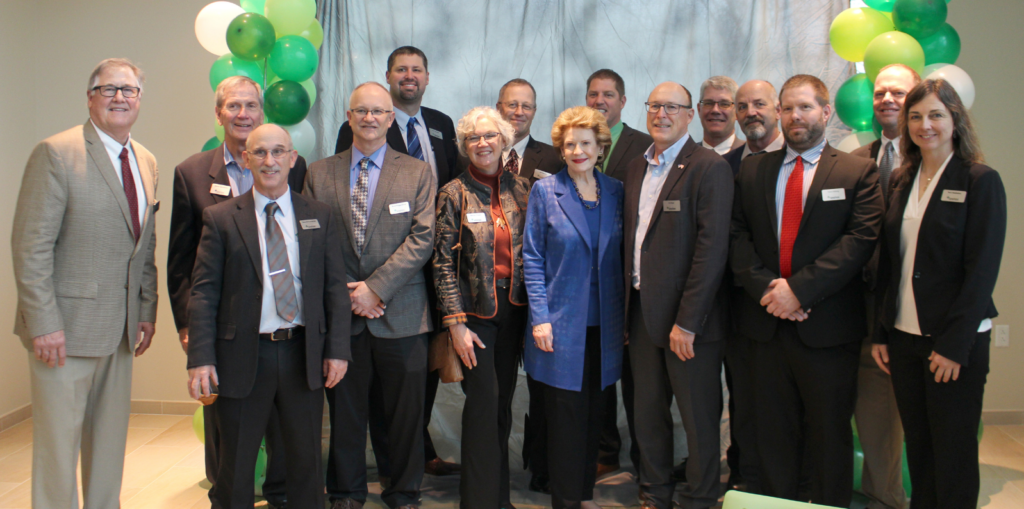
During a ceremony at GreenStone’s headquarters, the AgriBank District Farm Credit Council (ADFCC) presented its 2023 Friend of Farm Credit Award to U.S. Sen. Debbie Stabenow of Michigan. Stabenow, Chairwoman of the Senate Committee on Agriculture, Nutrition and Forestry, received the award for her distinguished leadership in Congress in helping to ensure that agriculture and rural communities across the country can continue to thrive.
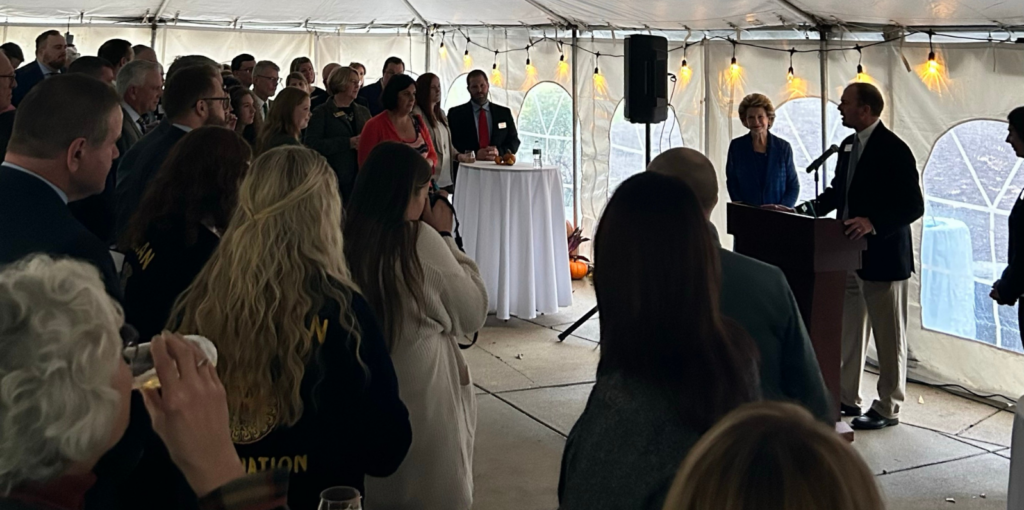
“It goes without saying that Chairwoman Stabenow has been a leading voice for farmers, ranchers, and rural America, and for that we owe a debt of gratitude,” said Jed Welder, a farmer from Montcalm County, Mich., and GreenStone Farm Credit Services board representative on the ADFCC. “We also are grateful for the strong, steadfast support she has demonstrated for the Farm Credit mission. She is leaving a legacy that agriculture and rural America will benefit from well into the future. We are honored to celebrate her as an AgriBank District Farm Credit Council Friend of Farm Credit and a friend of agriculture and rural America.”
To honor the senator’s long dedication to advocating for agriculture and America’s rural communities, GreenStone partnered with a number of agricultural organizations to donate $5,000 to both the Michigan FFA and Michigan 4-H in Senator Stabenow’s name.


“Senator Stabenow has been a fierce supporter of agriculture in the senate for years and has been instrumental in making sure Michigan is a central focus in the Farm Bill,” said GreenStone President and CEO Travis Jones. “We are proud to present not only this award to her, but also these donations in her name to help equip the next generation of farmers with the tools they need to thrive.”
“I’ve always had three goals for the Farm Bill: keep farmers farming, keep families fed, and keep rural communities strong. Farm Credit is about all of that. The role of Farm Credit cannot be replaced, and it’s incredibly important,” Senator Stabenow remarked. “I’ve said it a thousand times: You don’t have an economy unless someone grows something and unless somebody makes something, and that’s what we do in Michigan.”
GreenStone Farm Credit Services is one of the local Farm Credit Associations that comprise the AgriBank District along with AgriBank. The ADFCC represents Farm Credit farmers and ranchers in a 15-state area from Wyoming to Ohio and Minnesota to Arkansas. About half the nation’s cropland is located within the AgriBank District.
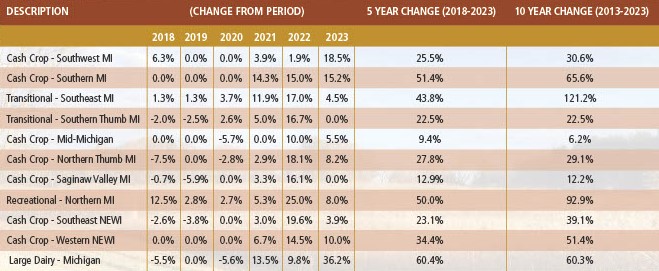
GreenStone’s appraisal team has completed a yearly land benchmark study, and the results ring positive for land owners in Michigan and northeast Wisconsin. Each year, GreenStone re-appraises the same eleven parcels of land representing local market areas across the geography. These re-appraisals are then compared to the prior year appraisals to understand value trends in cropland, transitional land, recreational land and dairy improvements.
For the third year in a row, none of the eleven parcels of land we measure saw a decrease in value as outlined below.
How GreenStone Determines Land Trends
As a part of this annual evaluation, research is also done to understand why these values are increasing or decreasing. A rise or decline in commodity prices, input costs, interest rates, weather, tourism and labor availability can all play a role in determining the market value of real estate, as outlined in more detail below.
Other land value reports, like the USDA, often rely on the recollection or thoughts of agricultural lenders reported by survey. This survey method, while useful for general market awareness, lacks the extensive research, analysis, and expertise that supports GreenStone’s benchmarking study. Additionally, by re-valuing the same property every year, GreenStone eliminates most of the inherent variance present in survey methods and is able to focus solely on market trends.
Cash Crop and Dairy
The Saginaw Valley cash crop land did not see an increase in value for 2023, after seeing a more than 16% jump in value last year. It represents a historically strong agricultural area; this surprising stagnation may be an early indication of plateauing land values to come in other agriculturally rich communities.
All other cash crop focused trends saw the anticipated increases. While other factors are present, land scarcity and competition are the primary drivers of increasing values in these areas. For instance, the property located in western northeast Wisconsin is located in the western part of GreenStone’s northeast Wisconsin territory. This area is strongly influenced by the dairy market, producers are always looking for opportunities to expand their land base. This expansion increases competition for land and thus, increases land values.
The benchmark representing a CAFO sized dairy operation saw the largest year-over-year increase in value. Our team attributes this jump to increased construction costs and a stronger dairy market than in past years.
Transitional and Recreational
Transitional land, which is typically considered agricultural land being converted to urban development, saw a small increase in Southeast Michigan as indicated in the chart. However, the same land category in Michigan’s Southern Thumb benchmark property saw a plateau. After a significant increase in recreational land value last year, the northern Michigan benchmark this year indicates things are settling down in that area, as well. Given these results, it may be plausible that the boom in rural land buying during the COVID-19 pandemic is softening as a result of increasing interest rates.
These results benefit you!
While the price to acquire land is now higher, your existing land assets are also likely worth more today than last year. That is good news for current land owners, but presents challenges for those looking to purchase land in the future. Regardless of current buying complications, history has proven that the purchase of land is a solid investment into your future.
Tracking this data annually keeps both our customers and our staff aware of where values are headed and prevents any big surprises year after year; and informs our property appraisers to help accurately value land. GreenStone’s team of lending experts are here to help you navigate the fluctuating market and find solutions for your dreams!
Are you ready to start living your country dreams? Maybe the thought of slowing down, getting back to nature, and enjoying everything the rural lifestyle has to offer is calling your name. If you’re curious about making a home for yourself in the country, here’s what you need to consider when weighing the different options GreenStone provides for country living loans.
Ready to Call the Country Home?
Perhaps you’re a DIY-enthusiast, ready to take on the challenging yet rewarding experience of building your own home from the ground up. Maybe you’re looking for the dream plot of land that your family will enjoy for generations to come and will be the site of your dream home. Or maybe you’re just ready to get outside of the city limits and trade the highway for winding dirt roads. Either way, GreenStone has a variety of loan options to fit your unique needs.
Home Construction Financing
Our home construction loans give you the ability to be your own contractor- or not! Whatever part of the building process you want to DIY or contract out, you decide. Build your own home completely yourself, contract everything out to a builder, or anything in between! The choice is yours.
Home Site Vacant Land Financing
When it comes to securing your dream property, you shouldn’t have to worry about stipulations around when you are going to build on it. Good things take time, and we think you should have the ability to say when you’re ready to break ground on your forever home-it’s your land after all! Our home site vacant land loans are ideal for those who want to build in the future, but don’t know exactly when.
Country Home Financing
As the experts in rural financing, we can help make your vision of purchasing the ideal country home come to life. What qualifies a property as a country home you might ask? To finance a home through GreenStone, the property must be located outside of city limits. The home can be located within a neighborhood or township, and there is no restriction to the amount of acreage the home can be on.
For those looking to purchase a country home on more than five acres, there can be significant benefits. Here is one example: A customer who currently has a loan with GreenStone on a 20-acre property would like to purchase an additional 40 acres. They don’t have the 20% down payment required for the land, but instead they have the option of getting an appraisal done on their current property and the 40 acres they would like to purchase.
This is called an add-on loan and can be an option for GreenStone customers who are financing a property over 5 acres. The existing property can be used as collateral to receive funding for the full purchase price of the new land. The customer would even be able to keep the debt of the existing and new property separate given they have different interest rates. Leveraging the equity they have on their current property gives them the opportunity to purchase more land and free up capital by not requiring a hefty down payment.
More Benefits to Living the Country Life
As the experts in rural financing, there are even more benefits to financing your country home through GreenStone in addition to the flexible loan terms, fixed interest rates, and easy re-amortization options we offer. As a GreenStone customer, you are a part of a member-owned cooperative that’s owned by and shares profits with the homeowners, landowners, and farmers we are fortunate enough to serve. Profits are returned to qualifying customers in the form of a check each year on Patronage Day. Think of it as a house-warming gift!
GreenStone’s team of experienced experts are here to help you live your country dreams. No matter which country living loan is best for you, our team is ready to help you put your plans into action. Contact your local branch today to get started!
First: Find the right lender
Finding the right lender can be challenging and can also require some legwork when considering what is important to you when seeking financing. While interest rates are often a driver of decision, there are other factors such as fees, location, willingness to work with non-traditional properties, what happens after the loan closes, and the people you will work with that can make the process easier. Local realtors and other recent homebuyers are often good sources of reference for lending options.
Second: Check your credit report and work to improve it or keep it stable
Knowing your credit rating is an important part of the financing process and can affect the type of rate you may be eligible for. It is important to know what things can impact your credit rating. Excessive credit card balances, late payments, credit history and collections are all areas in which your credit score could be negatively impacted. You can, however, do things to improve your score such as paying down credit card balances, taking care of collections and catching up on late payments.
Third: Know your down payment options
Be sure to check with your lender on what down payment options are available. Do you need to put 20% down? Can fees be financed? Is there an opportunity to put 5% down with private mortgage insurance? Are there short-term loan options to offset the down payment requirement? Most lenders have options for borrowers to help assist with down payment requirements.
Fourth: Determine your budget
Knowing how much you can afford in a house payment, is often times different than what you are preapproved for. Establish a household budget so you know the appropriate price range of your new home.
You may also want to consider bi-weekly payments as a way to lower the amount of overall interest you will pay over the life of the mortgage. By setting up bi-weekly payments, you can cut 6 years off a 30-year mortgage.
Five: Obtain Life Insurance
Some lenders may require you to have life insurance at a value sufficient to cover the mortgage. Regardless of the requirement, life insurance can be important in ensuring your family’s future in the event of a tragedy.
For more than a decade, my colleagues and I have written for GreenStone on environmental issues that affect agriculture. When driven by science, the awareness and appropriate response and management to these issues can help protect human health and the environment. Science-based management also provides appropriate regulation. However, as evidenced below, environmental issues are not just matters of science – they include legal, political, and emotional components as well.
Waters of the United States (WOTUS)
Earlier this year, the Supreme Court of the United States (SCOTUS) issued a decision on the Sackett II case regarding the Waters of the United States or WOTUS. While many legal pundits were anticipating the ruling in favor of the Sacketts, few expected the unanimous decision that a wetland is not a jurisdictional water. Further, SCOTUS rejected the “significant” nexus definition as too vague.
With this SCOTUS ruling, the WOTUS rule issued on December 30, 2022, and published in January 2023 was now in need of revision. The Biden Administration set out to offer an updated WOTUS rule by September 1, 2023. Upon initial review, the newly-issued WOTUS rule (August 29, 2023), appears to be straightforward.
The new WOTUS rule revises the January 2023 text to remove all language pertaining to significant nexus. It deletes interstate wetlands from the category of interstate waters. It also amends the definition of “adjacent” to mean “having a continuous surface connection.”
At the time of writing this article, legal and technical reviews from those likely or potentially regulated under WOTUS seem to be generally pleased with the revised WOTUS rule.
A Note of Caution
One note of caution came from former Assistant Administrator for Enforcement and Compliance Assurance at the Environmental Protection Agency, Susan Bodine. Ms. Bodine, now a lawyer at B&W Law, notes: “Many concerns of the regulated community arise from interpretations found in the preamble to the January 2023 final rule. 88 Fed. Reg. 3004 (Jan. 18, 2023). The preamble instructs the agencies on how to identify a ‘tributary,’ a ‘relatively permanent’ water, and ‘a continuous surface connection,’ none of which is defined in rule language.”
PFAS
The potential presence of per- and polyfluoroalkyl substances (PFAS) in the environment is a growing concern, not just for typical manufacturing companies, but for everyone – including agriculture. Their widespread use in a host of industrial and consumer products has resulted in their presence around the globe in humans, animals, water, and soil.
PFAS are a concern because some of the PFAS compounds (there are thousands of PFAS compounds) are suspected of causing adverse health effects at very low levels (parts per trillion). However, there remains considerable uncertainty regarding which compounds and at what concentrations the effects are manifested, as toxicological studies are still not complete. In fact, if you go to the EPA’s PFAS website (epa.gov/pfas/pfas-explained), the agency states that one of the things they don’t understand concerning PFAS is, “How harmful PFAS are to people and the environment.”
PFAS in Groundwater
There are two main ways that farms may be at risk of being impacted by these chemicals. First, groundwater can be impacted by military bases (and commercial airports) that used certain fire suppressants known as Aqueous Film Forming Foam (AFFF). This was the case for a dairy Concentrated Animal Feeding Operation (CAFO) in New Mexico. The farm, which used groundwater for crop irrigation and cow hydration resulted in the farm and the nearly 4,000 cows becoming an environmental liability, not an asset. The cows were subsequently euthanized.
Attorney David Crass (Michael Best) recently wrote, “Since 2021, the US Department of Defense (DOD) has notified nearly 4,000 agricultural operations of the potential for PFAS contamination in aquifers associated with military installations, adding nearly 400 new notifications in its most recent update.”
There has been some movement under the National Defense Authorization Act (NDAA) to allow for government funding to compensate farms impacted by environmental releases at military bases.
PFAS in Biosolids
Second, and the more common way farms have been affected is through land application of biosolids. Publically-owned treatment works (POTWs) that treated effluent from industrial dischargers that used PFAS (e.g., plating companies, paper companies, semiconductors, and more) may have PFAS in their biosolids. These biosolids in many cases have been land applied to farms – in many instances for decades. This was the case for several farms in Maine that unknowingly accepted PFAS-impacted biosolids. Because PFAS are extremely chemically stable compounds, they can persist for decades and even much longer. Thus, the nickname: forever chemicals.
In 2022, Maine became the first state to ban the land application of biosolids.
PFAS as Hazardous Substances
Finally, the pending federal legislation to make certain PFAS chemicals “hazardous substances” under the “Superfund” program could potentially have wide-reaching impacts. If finalized (it was delayed until February 2024), it may result in sites with the specific regulated PFAS above threshold quantities being labeled hazardous and would potentially establish liability and remediation obligations for current and former owners of these sites.
It appears that we are much closer to a final definition of a WOTUS but we will have to let some more dust settle before saying this with any certainty. The PFAS issue is more complicated and potentially more consequential. The regulated community needs a robust evaluation of the real human health and environmental risks associated with PFAS sooner than later.
These and other environmental regulations are becoming increasingly far-reaching and require close attention.
To view the article in the online 2023 Fall Partners Magazine, click here.
In this behind the scenes, three GreenStone employees share how their role allows them to support rural communities and agriculture.
Anthony Pegley
6 years of service
Senior Financial Services Officer
Saginaw, MI

Describe how your role carries out the GreenStone mission of supporting rural communities and agriculture.
We offer some unique products that other institutions don’t, such as DIY home construction financing, contractor construction loans, and vacant land financing for up to 30 years. I think there is a lot of demand for these types of financing and it’s great to work for a company that can fill these needs.
What do you enjoy about your role?
The most enjoyable part about my job at GreenStone is getting to interact with so many people with various backgrounds and goals. Everyone is different and it’s always fun and interesting to understand people’s personal goals and then to watch them accomplish them.
What changes have been incorporated in your role to meet evolving customer needs?
Since COVID, people seem to be more comfortable communicating and working electronically. Utilizing secure messaging and our online loan request system has allowed us to better fit customer schedules. They are able to use these features at their own convenience and has also has increased our turnaround time in some areas. I see this as being a big benefit for everyone going forward.
What do you enjoy doing in your free time?
I enjoy hunting, fishing, and woodworking in my free time. My wife and I have 4 and 6 year old boys that keep us very busy as well!
Joel Arends
7 months of service
Financial Services Officer
Grand Rapids, MI

Describe how your role carries out the GreenStone mission of supporting rural communities and agriculture.
My role as a Traditional Financial Services Officer gives me the opportunity to form and build relationships directly with members. Our members are unique and deserve to have a tailored approach when analyzing their business and credit position. Everyday I strive to make GreenStone’s financial services available to all of rural West Michigan.
What do you enjoy about your role?
Agricultural businesses are extremely unique. From apples to zucchini our members have very different business plans that make their profession successful. Discovering the details behind what it takes to get products to market and all the service industries that support them, give me a lot of confidence in the American food system. I am truly grateful to all the hard-working men and women putting food on our tables.
What changes have been incorporated in your role to meet evolving customer needs?
In just the half year I’ve been with GreenStone I have noticed customers continuing to evolve and embrace technology. Using online or digital platforms for communication or electronic signature platforms are something we do more of every day. At the same time, face to face customer interaction is still second to none. Making farm visits is an important part of the job.
What do you enjoy doing in your free time?
In my free time, I love spending time with family and friends. My wife Elena and three young children are a tremendous blessing to me. Experiencing the beautiful outdoors of Michigan through hiking, biking, kayaking and snowmobiling are some of my favorite past times.
To view the article in the online 2023 Fall Partners Magazine, click here.
Most would argue that raising a ten-month-old baby is no walk in the park. Operating a cattle operation, on-site creamery and farm store is no easy feat, either.
Heidi Hendrickson, a young farmer in Coopersville, Michigan is doing all of those things — simultaneously. And she’s doing them well.
Heidi says the secret to juggling it all is having the drive and vision for what you do.
“I believe that whatever you’re passionate about, you can do,” Heidi explained. “If there’s something you want to do, it is possible to do it. The only thing that is holding you back is yourself.”
Nothing is certainly holding Heidi back. She bought Green Vale Farm just last year after leasing the farm from her father for five years prior. The farm is rooted in rich history – founded more than 100 years ago in the 1920’s as a hobby farm for a banker. Now, the barns are filled with 550 cows along with pigs and chickens.
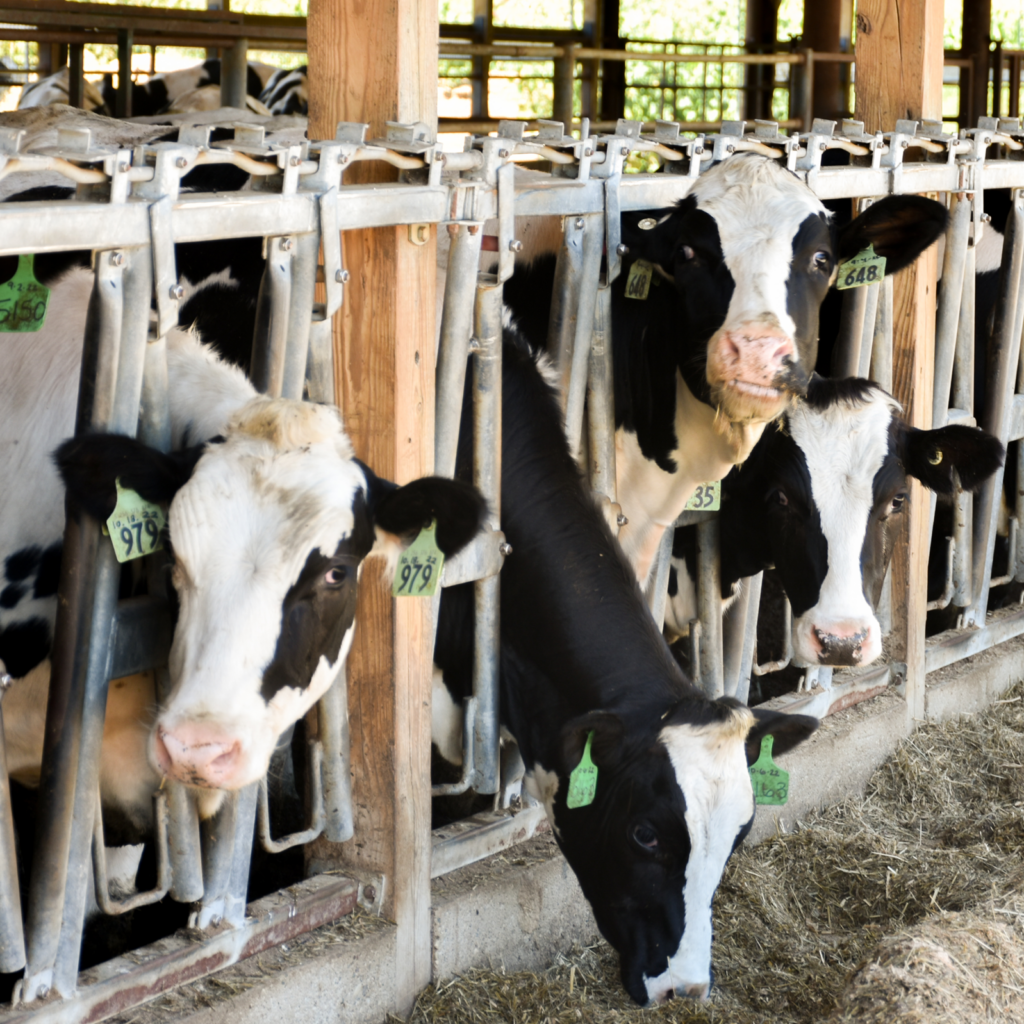
Heidi has a rich history in agriculture, too. Since she can remember, she was helping out on her father’s dairy farm milking cows.
“I grew up on the farm riding shotgun in my dad’s pickup truck. From as young as I can remember, I was working on the farm,” said Heidi.
That experience on the farm, along with some other opportunities in her youth, prepared her to take on such a large operation at a young age.
Heidi utilized GreenStone’s CultivateGrowth program, which is uniquely designed for young, beginning and small farmers, to take advantage of more flexible loan terms to help her get started. Her financial services officer, Joel Arends, noticed her devotion to success almost instantly when they met.
“She’s extremely hardworking,” said Joel. “If I have a question for her, she’s always willing to take time out of her busy schedule to talk about whatever is at hand. She has been very personable and easy to get acquainted with.”
“My dad raised all of us seven kids with a very strong work ethic. We learned you do the job right and you do it until it’s done. There was a bar, and we were expected to live up to those standards,” Heidi explained. “Between my five part time jobs in high school, I was in some different work scenarios. I always knew that I wanted to work with something that was agriculture-based, yet something I could organize, make things, build things, and market things.”
Now, she’s doing all those things, but even with agriculture in her blood, leasing, and later owning, the farm came with some learning curves.
“I knew how to raise cows and do that side of things, but I had no experience running a business and very little experience with customer service,” said Heidi. “Learning new things is one of my favorite parts.”
Since taking over the farm, she has had the barns updated, expanded the storefront’s product line and hours, and makes cheese on-site.
“The cheese plant existed from the previous owners, but it wasn’t up to code. My cousin decided he wanted to update the equipment and make cheese. That eventually fell through, but then my mother and I decided to get licensed and begin making cheese on our own and sell it at the storefront.”
After seeking advice from some other cheesemakers in the industry, that journey began. Now, the storefront offers an array of products – from blocks of cheese from her plant, to cheese curds, eggs, steak, beef sticks and sausage – all from the dairy and beef cattle on her farm.
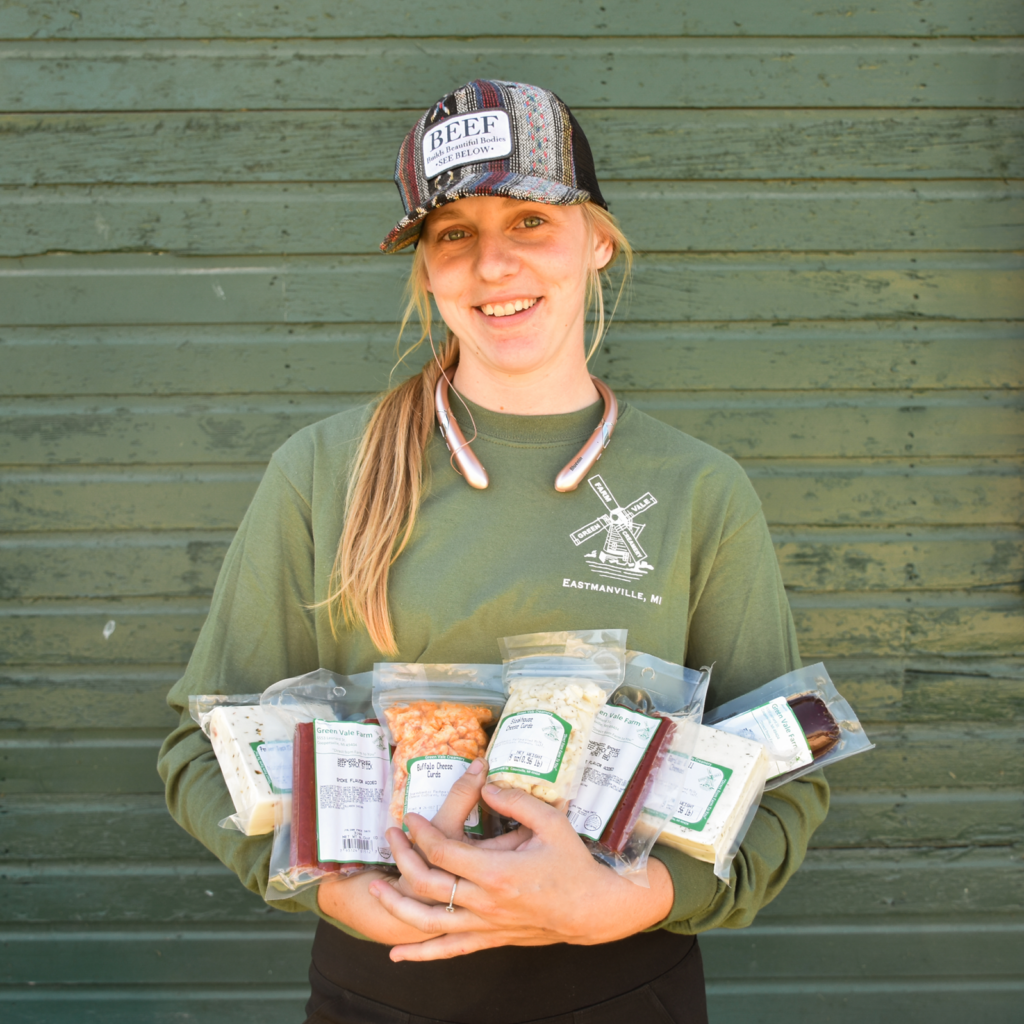
The store also sells fresh ice cream from another local dairy farm, and during the autumn season, she raises turkeys to sell for Thanksgiving dinner.
The storefront and farm have been received positively throughout the community – which is important to Heidi, who takes her operation’s brand and image very seriously.
“Once I opened the store, I learned I loved customer service and marketing and presenting my products well,” said Heidi. “This is my image and my businesses’ image. I never want someone to see something and think poorly of me or my family.”
Heidi works extremely hard day in and day out, but she understands she cannot do it all without some help. Her three part-time employees, husband Tyler, parents, and even her retired neighbor all pitch in to help make Green Vale Farm a huge success.
“My neighbor became my adopted grandpa. He was across the street and knew I was working early in the morning and wanted to make sure I was safe being out there alone milking cows. He’s a retired cop and gave me his number and we hit it off from day one. He’s one of the best people in my life,” Heidi shared.
Another big part of her network are other young farmers. Heidi is part of a Farm Credit peer-to-peer group made up of young, beginning and small farmers in the Midwest financed through Farm Credit institutions. It’s those connections that help answer questions, share ideas and push through challenges.
“When you have something in common with somebody, and you are passionate about the exact same things, it makes everything one hundred times more enjoyable,” said Heidi. “I love meeting people and hearing about their businesses and learning new ideas.”
We can’t forget another extremely important part of her farm team – her and Tyler’s ten-month-old daughter, Sage, who tags along during the day-to-day operations of the farm and is a welcoming face in the storefront.
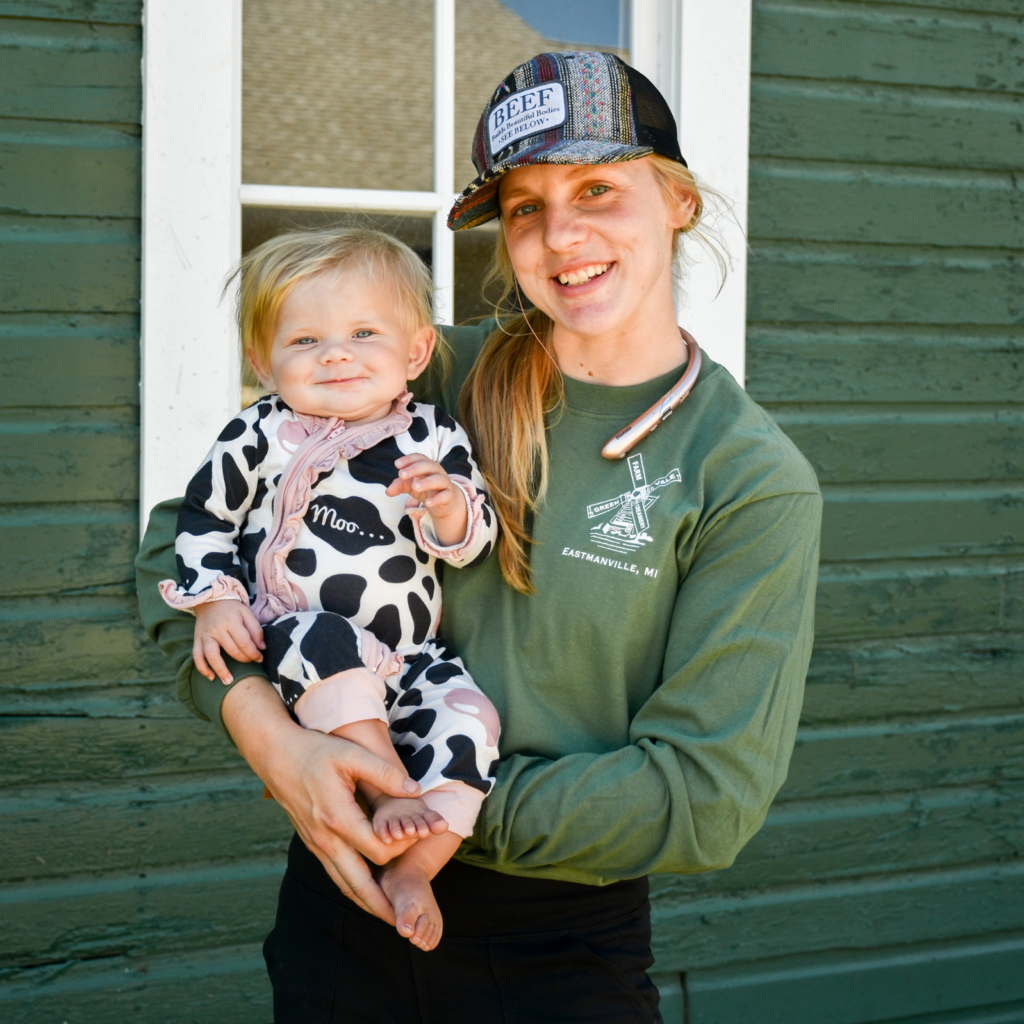
“My farm and my business were my first baby, but my actual child is now my number one priority,” said Heidi. “If I can’t farm with my kid, I’m not going to farm, but I can’t ever stop farming, so I take my kid.”
GreenStone is proud to be a part of this important team, too.
“It really just comes down to relationships and getting to know the individuals,” said Joel. “It’s not just part of what my job is, it’s part of who I am. I like to get to know people and their successes and hardships to be a partner of their business and help them achieve their goals and ambitions.”
We know Heidi has many more goals and ambitions to achieve in the years to come, and GreenStone will be there every step of the way.
“I think she is the type of person that will always continue to be moving forward and growing over the course of her business life,” said Joel. “She does a really good job and is very personable when working with other people.”
“If I look back to where I started, I have a lot to be thankful for,” Heidi reflected.
To view the article in the online 2023 Fall Partners Magazine, click here.