


One mission, two associations, endless value. In August, GreenStone’s board of directors and executive team held a joint board meeting with neighboring association Farm Credit Illinois. The goal – collaboration, networking and learning. The result…read on to hear about the value of the experience from four of your board members.

Collaboration = “the act of working together.” This is the reason that the board and management of GreenStone and Farm Credit Illinois held a joint session in August as a part of our 2024 planning process. It was an opportunity to share our business model, including the unique technology tools that are available to our customers. Farm Credit Illinois informed us on how they operate in their marketplace. An outside speaker also gave a thought-provoking presentation on the future state of lending.
GreenStone exists to be America’s first choice for financial services. Farm Credit Illinois also does an excellent job of meeting their customer’s needs. Even though there are some differences in commodity concentrations, business practices, etc., it was very clear that both organizations are committed to being the very best in their individual marketplaces.
These types of joint sessions are very valuable. We can learn from others which may ultimately benefit our customers and, likewise, can offer some of our insights to other organizations. The opportunity of getting to know other association board members was also great. Each farm operation has its own challenges and opportunities and I gained beneficial information from such conversations. Hopefully, we can have additional joint sessions with other associations in the future.
We are all working diligently for a common cause!

When this joint meeting was first announced, I honestly wasn’t certain if we’d get value out of it. After we did meet, it was very enlightening! We have a lot in common and yet different in many ways. GreenStone is more diverse in our customer’s commodities and farming practices. We both put a lot of effort in supporting young, beginning, and small farmers. Also, both associations prioritize giving back a portion of our earnings to our members through Patronage dividends annually. And opportunities were identified to possibly collaborate on technology or other areas down the road. Overall it was a good meeting get to know the other directors who hold the same goals in mind as we do – to do the best we can for our fellow borrowers.

It was an excellent joint board meeting between Farm Credit Illinois and GreenStone. The opportunity to share common issues and solutions to those issues doesn’t happen as often as we would all like, and focusing on just two organizations over the two days allowed extra scrutiny on certain commonalities.
Although my interest was piqued due to Illinois board members being from towns near my hometown, drawing on their strength and common experiences with our board members enhanced the two days. I feel even more confidence in the Farm Credit System and in GreenStone.

I imagine we have all had a person in our lives who we would like to learn from or find out what makes them successful; Farm Credit associations are no different. GreenStone does look at how other associations meet the needs of their customers while fulfilling the Farm Credit mission. We recently met with Farm Credit Illinois for that purpose. Our board of directors and executive teams had an opportunity to meet and discuss the challenges each association faces, share ideas, and see how each of us returns value to our members. Both associations have strong financial positions, high customer satisfaction scores, and work hard to help young, beginning, and small farmers. Farm Credit Illinois had some particularly innovative ideas for helping the young and beginning farmers they serve.
Similarities aside, the associations achieve this success while maintaining quite different loan portfolios. One of GreenStone’s strengths is the diversity of our loan portfolio. While meeting the financial needs of a diverse customer base is challenging, it provides stability to the association by limiting the fiscal impact of cycles in any one industry. Developing new software and integrating it into the workforce to improve efficiency is a challenge that both associations face. GreenStone has been a leader in this area. Our information technology department has been working to develop software that will improve the efficiency of GreenStone and to keep the costs down has partnered with several associations to share the cost of these software enhancements.
At the close of our meeting time together we all agreed it was beneficial and would look for opportunities to meet again. . . there is more to learn.
To view the article in the online 2023 Fall Partners Magazine, click here.
GreenStone is proud to be a national leader in providing customers a risk management option through Micro Farm Crop Insurance. This policy provides specialized small farmers and specialty crop producers a safety net.
Recently, a group of GreenStone employees hosted representatives from the USDA Risk Management Agency, Congressman John Moolenaar, and the Farm Credit Council on two farm visits. Both farms utilize Micro Farm Crop Insurance through GreenStone and were able to share the success of their business, value of the new coverage option for their unique farm, as well as outline ways to better the policy.
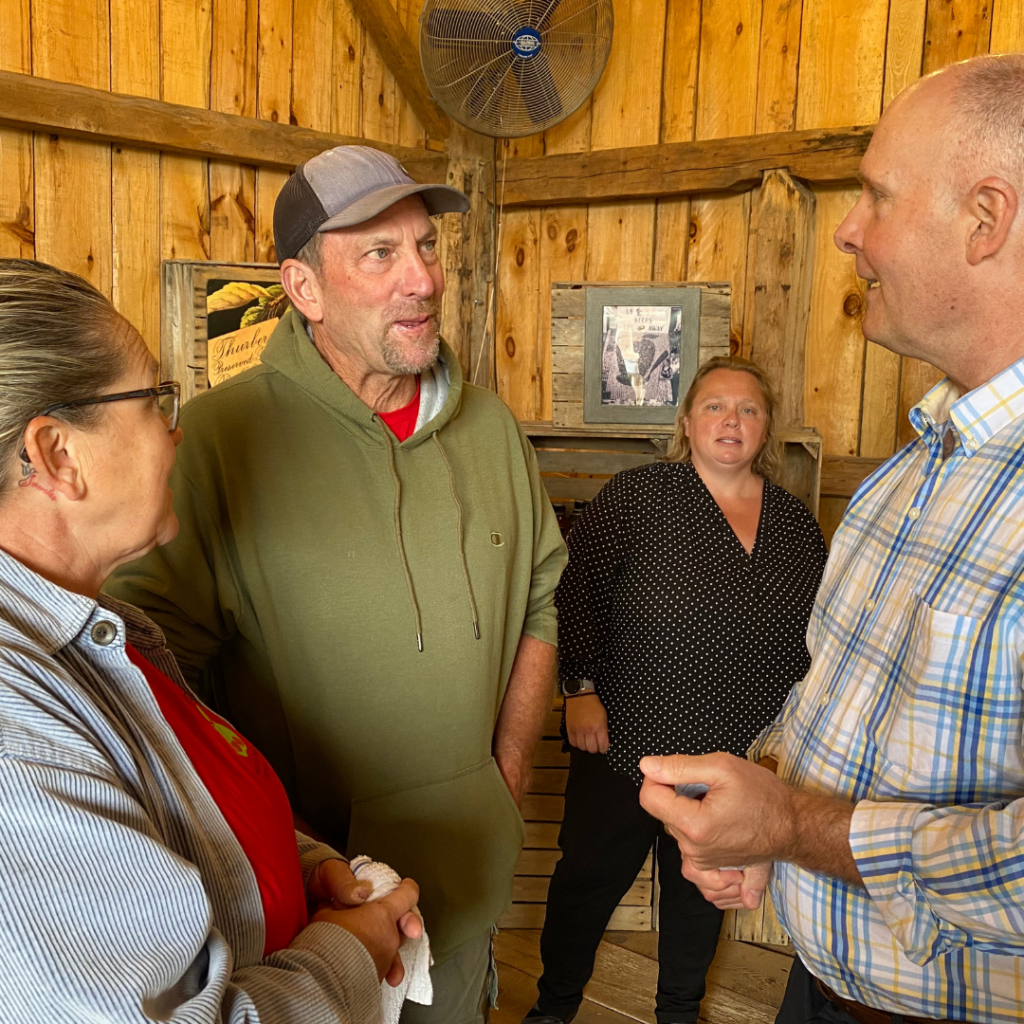
The group started their day at Rasch Cherry and Apple Market in Conklin, Michigan. This farm offers customers a full-scale farm experience with you-pick cherry and apple options. Their farm store is stocked with baked goods, doughnuts, cider, and more much – all insured through this policy.
In the afternoon, the group was able to meet at Organic Blueberries LLC, a fourth-generation family farm in West Olive, Michigan. With almost 20 acres of blueberries, the farm allows customers to pick their own or choose from a selection of pre-packaged berries.
The USDA Risk Management Agency makes decisions about the guidelines for crop insurance in the United States. GreenStone understands the importance of getting them in the same room as producers, members of Farm Credit, and lawmakers to have a productive conversation about important changes to benefit you, the customer. We are proud to lead the charge with Micro Farm Crop Insurance, and we are committed to pushing for crop insurance standards to meet your needs.
Fast Facts about Micro Farm:
- Micro Farm Crop Insurance covers both revenue from commodities and revenue from some value-added products like lotions from lavender or wine from grapes.
- GreenStone wrote 45% of the total Micro Farm policies in the United States, and 89% of policies in Michigan.
If you think your operation could benefit from a Micro Farm policy, contact your GreenStone crop insurance specialist today!
To view the article in the online 2023 Fall Partners Magazine, click here.
GreenStone operates on a set of four core values – one of which is “Deliver Quality.” By putting an emphasis on engaging and developing our employees, we are able to be the best team possible for our member-owners and do just that – quality work.
Having a Pulse on our People
Like our customers, it’s difficult to know how your employees are doing without listening to them and gathering their feedback. One major way GreenStone is able to do this is through our employee engagement survey.
The survey measures how satisfied our employees are with the direction of the organization. Although many companies do similar surveys every two to five years, GreenStone finds importance in utilizing this survey annually to track any changes timely to ensure the consistent satisfaction of our employees.
This survey has allowed us to make adjustments to best suit our workplace. Recently, when the COVID-19 pandemic shifted the way we worked, our leaders were equipment with real time employee information to be able to make changes on the fly that they knew would best suit our employees based on feedback from the survey.
In our recent employee engagement survey, 92% of respondents indicated that GreenStone’s culture and values are favorable.
When asked in the survey if GreenStone is a great place to work, our employees’ responses have always kept us in the 99-percentile compared to other organizations – and that’s something we’re deeply proud of.
Everyone’s a Leader
At GreenStone, we believe everybody, regardless of their job title, has the capacity to be a leader and an expert in their field. We offer an array of professional development opportunities internally to help our team become equipped to be the best they can.
Employees are invited and encouraged to participate in different development pathways throughout their time at GreenStone to hone in on skills like business writing, public speaking, teamwork, leadership and business etiquette. Some pathways are geared to prepare employees for a managerial position in their future, and others work to provide the skills to be an empowering teammate in their current position.
GreenStone employees are also supported in their desire for promotions. In fact, a majority of GreenStone’s leadership team started in other positions and made their way to the managerial positions they hold today. GreenStone’s robust internship program also helps us find skilled and talented teammates that stay on full-time after their schooling has ended. In fact, GreenStone’s recently retired CEO, Dave Armstrong, began at the cooperative as an intern!
Engaging Our Team
Keeping a team satisfied starts with engagement. GreenStone has a volunteer committee, the Employee Engagement Work Group, made up of employees in almost every single department. Their goal – to be a sounding board for what works best for the people of GreenStone.
The team helps organize mentorship opportunities for newer employees, coordinates the employee engagement survey, manages GreenStone’s employee recognition program and records a monthly internal podcast giving the spotlight to our staff to share their vast knowledge.
The committee also meets and brings ideas to our leadership team about techniques to make the workplace even better – everything from dress code recommendations to alternative work arrangements.
Nobody on this committee has to do this work. They do it voluntarily to help make GreenStone the best workplace it can be – a testament to the culture of the co-op.
Investing in You
Earlier we stated that one of GreenStone’s core four values is “Deliver Quality.” Another one of those values is “Customer First.”
We believe when our employees are engaged and consistently bettering themselves, they are able to put you, the customer, before anything else. You are the reason we put an emphasis on investing in our employees.
By being experts in our field, we can help provide you with professional service and solutions to your unique needs.
When our people are happy, we can do everything in our power to make you happy, too.
To view the article in the online 2023 Fall Partners Magazine, click here.
Every new job comes with some learning curves, and GreenStone’s President and CEO, Travis Jones, has taken the challenge head-on. Jones was appointed CEO last summer and took the reins of GreenStone in August after serving as Chief Financial Officer for 15 years. Now, one year into the top job, Jones is reflecting on all that he has learned and is looking forward to in the future.
Q: What has been your favorite memory so far as President and CEO?
The last year has gone very fast and I can’t think of just a single favorite memory. GreenStone is doing very well, and I get to brag about our successes which makes my job easy. I have been lucky enough to visit a large number of customers on their farms and at their businesses, which I really enjoy. Very few CEOs get to visit such a diverse range of customers. I have visited cash grain farmers, apple growers, pork producers, dairy farmers, and sugar beet, blueberry and potato growers to name a few. Everyone’s operations are different, yet everyone is working hard not only to support their families but to also provide food, fuel and fiber to the world.
Q: What has been your biggest challenge as CEO?
Probably the biggest challenge we face is trying to always do the right thing for our members and our employees. With 28,000 customers and more than 600 employees, we don’t “bat a thousand” every time, but we never stop trying. We strive to have very satisfied, engaged employees and hope that turns into very satisfied customers. We have been pretty good at striking the right balance in the past, and it’s imperative that GreenStone continues to strike the right balance in the future.
Q: Do you still turn to former CEO Dave Armstrong for advice?
Dave and I have breakfast once a month. My wife Sue and I have probably had dinner with Dave and his wife Debbie three times in the last year. I can ask Dave anything. He was the best boss in the world and now he is the best unpaid consultant in the world. Actually, I cover breakfast, so his advice isn’t totally free, but close! When he was at GreenStone or just during breakfast this past year, I have always tried to soak up his knowledge and advice. I listen to everything he has to say except for when he starts talking about Spartan football or basketball. When a game against Michigan is coming up for instance, he will always say he doesn’t expect much from Michigan State. However, if the Spartans win, it’s very hard to put up with the gloating.
Q: You said last year that GreenStone is where you want to spend the remainder of your career. Does that still ring true?
Absolutely! This is just a really special place; I knew it when I interviewed here 16 years ago for the Chief Financial Officer position and I still believe it today. You can’t find another organization like Farm Credit. GreenStone is a $14 billion financial institution, yet we are a cooperative. We are owned by our members. Fourteen of our 16 board members are members. Our employees understand why we are here. Our mission is to “Promote the business success of our customers and the rural community by being the best at providing credit and financial services.” My teammates follow our mission every day, and we have the greatest member base in the country. Why would I want to work anywhere else?
Q: What are you looking forward to most in the future at GreenStone?
GreenStone has such a strong staff. I am spoiled as a CEO to have such great teammates. Some have a ton of experience, and some are strong, young leaders. GreenStone will be very successful in the future because of the bench strength of our staff, at every level.
To view the article in the online 2023 Fall Partners Magazine, click here.
During the holidays, it is easy to get wrapped up in the ribbons and bows and forget the importance of giving back. Here are five easy ways that you and your family can give back to your community during the holiday season:
- Donate unwanted items: During your fall cleaning, clean out your closet of those unwanted coats, jackets and donate them to your local community closet! Do you have extra canned goods and non-perishables sitting in your cupboards? Donate them to your local food bank! It is an easy way to turn your extra or no longer useful items to value for those in need.
- Give back to the service providers: Don’t forget to give back to those who are working hard to make sure your grocery orders or holiday presents get delivered on time! Create a little thank you basket for your local delivery workers this season. This can be just as simple as a granola bar or a bottle of water to help them get through their deliveries!
- Visit a local retirement home: Not everyone has a family to visit them around the holidays. Take the time to visit someone in a retirement home by playing games, creating a craft, or simply just hanging out with them. If you are not able to visit a home, think about sending some homemade cards. It is a simple way to make someone’s holiday season a little brighter!
- Send a care package to someone in the military: There are several organizations all across the country that will send your care package to those overseas. Spend time with your family to make homemade food or create a handmade card for someone that may not be able to come home for the holidays. This is just a special way to say thank you for your service!
- Volunteer at a soup kitchen: Give back to your community by handing out food to those in need. Volunteer time at your local soup kitchen or food pantry to help out. The best holiday gift you could give yourself is the satisfaction in helping someone else!.
To view the article in the online 2023 Fall Partners Magazine, click here.
Last year, my wife and I were able to purchase our dream property, thanks to a very generous land owner and the folks at GreenStone Farm Credit Services.
It was a realization of a lifelong dream of mine and something I’m thankful for every single day. In southern Michigan, purchasing land can be difficult, especially hunting land. There’s not much for sale and plenty of potential buyers. So, to end up owning a chunk of premium hunting ground seemed like a dream for most of my life, and still does to some extent. I’m not sure if I realized it when we signed the papers, but this was the beginning of new adventure for our family.
This particular piece of property is one that I’ve hunted for nearly 15 years and have enjoyed countless experiences on. In recent years my wife and I, along with our two children, have enjoyed spending time there throughout the year doing a wide variety of outdoor activities. That being said, the deer hunter in me is always thinking about fall. I find myself constantly wondering what the next deer season will bring or reflecting on previous seasons. Heading into this year my mind was racing with anticipation of what was to come. For the first time in my life, my primary hunting spot would be my own.
Once the snow was off, I found myself wandering around the property thinking about what improvements I could make to the current habitat to enhance it for wildlife. It was a strange sensation to realize that I no longer needed to dream about what I wanted to do, instead, I could actually do it. In a way, it was also somewhat daunting. The possibilities seem endless when it comes to property enhancements.
As spring progressed into early summer, I started to cross off some of the things I had planned out early in the year. I added a few new blinds, hung a few new tree stands, and planted three new food plots. It seemed like I spent pretty much all of my free time doing something around the property. Although it was a lot work, it hardly felt that way. The more work I did, the more I thought about the future. I would think about things like planting trees and what they might look like down the road, what they might look like when my kids were older. With or without any changes I might make, the property is beautiful and I find myself constantly in awe of what we own.
Here today, I’m anxious to see what this deer season holds. After a lifetime of dreaming of what could be, it’s time to enjoy what is. More than anything, I’m thankful to have a piece of property to call my own and I can’t wait to enjoy it with friends and family this fall!
To view the article in the online 2023 Fall Partners Magazine, click here.
Submitted by Victoria Carini, Organic Blueberries LLC
Crust:
- 2 cups graham cracker crumbs (16 crackers)
- 1/3 cup sugar
- 4 Tbsp melted butter
Mix crumbs with sugar and melted butter.
Butter 9-inch springform pan.
Press mixture on the bottom and sides of the pan.
Refrigerate.
Filling:
- 1 ¼ lbs softened cream cheese
- 1 cup sugar
- 4 eggs
- 1 tsp vanilla
Mix cream cheese, sugar, eggs and vanilla in a bowl.
Beat until smooth and light.
Pour over crust.
Bake at 375 for 50 minutes.
Top Layer:
- 8 ounces sour cream
- 2 Tablespoons sugar
- 1 teaspoon vanilla
Beat together sour cream, sugar and vanilla
Spread over the top of baked contents
Bake 10 minutes more.
Test doneness use the toothpick method.
Cool at room temperature and refrigerate.
Top with blueberry glaze when ready to serve.
Blueberry Topping Glaze for Cheesecake
- 1 pt (2 cup) Fresh or frozen organic blueberries, rinse and drain.
- 1 tsp cinnamon
- ½ cup water
- 2 Tablespoon cornstarch
- 1 Tablespoon lemon juice
Combine sugar, cornstarch and cinnamon in a saucepan, mixing well.
Crush 1 cup of blueberries, add to the mixture with ½ cup water.
Bring to a boil until thickened, add the other half of the blueberries and lemon juice. Cool for 30 minutes.
Spread over cheesecake.
Serve and enjoy!
To view the article in the online 2023 Fall Partners Magazine, click here.
Ryan Schomaker had a dream – to purchase his grandmother’s farm in Thomas Township, Michigan and raise a family in the farmhouse adjacent to the property.
When that home was not available for purchase, Ryan and his wife Taylor decided to take matters into their own hands and build a brand-new home on the farm property. In 2019, they turned the key, walked into their new home, and never looked back – but it took a lot of work to get to that point.
Six Months of Dedication
After purchasing the family farm in 2018, Ryan and Taylor were determined to build a home as quickly as possible so they could give their full attention to farming. They met with GreenStone Financial Services Officer Anthony Pegley who helped them secure the financing they needed to break ground and begin work on the farm. Sensing their passion to farm and give back to the community, Anthony was excited to help them make this dream a reality.
“Our purpose here is to help people pursue their passions and their dreams, and that’s the best part of the job,” said Anthony. “Ryan and Taylor are excellent people. They’re great for the community, very ambitious, and I don’t have enough nice things to say about them.”
“The application was very simple, being first-time home buyers,” said Taylor. “We went in, sat down with Anthony, and it was a very positive experience for us.”
Later that year, the two worked with an architect on the floor plan and were able to start their self-build. Living out of a camper on the property, they worked long hours outside of Ryan’s full-time job as a lineman to get their home completed.
“We would work on the house until two in the morning, and then I would get up a few hours later at six for work,” Ryan explained.
Ryan and Taylor not only spent long hours doing physical labor like laying flooring, but also researching and learning how to complete certain projects. Building a home was a whole new ballgame for them.
“We had a house before and did some basic remodel stuff, but that was it,” said Ryan. “If you watched us tackle this, you’d notice we don’t build houses every day.
“I grew up in the building industry, but neither one of us had done anything more than simple home repairs before,” said Taylor.

Home Sweet Home
Six months later, a beautiful three-bedroom home with an attached garage sat at the front of the 40-acre farm ready for Ryan and Taylor to make memories in.
Moving in to the home they spent countless hours building and perfecting was a reward of a lifetime.
“It feels good to be in the home we spent to many hours making,” said Ryan. “It’s sweat equity.”
“Building it from the ground up like that is awesome because you know all of the nooks and crannies of the house,” said Taylor.
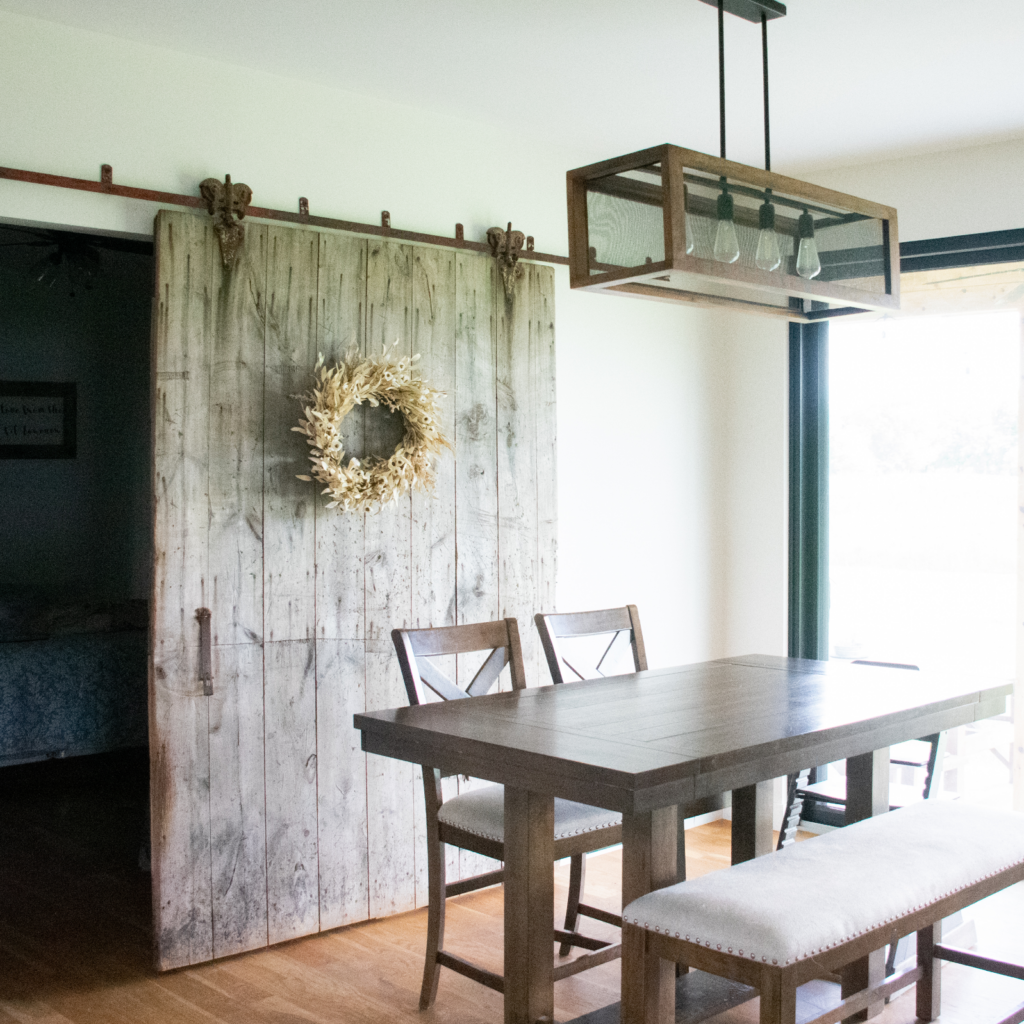
The home is equipped with an open floor plan, sliding wood doors, custom cabinetry, white oak floors, a stone fireplace and a black walnut staircase – just to name a few features. It’s the perfect place to raise their one-and-a-half-year-old son, Bennett.
“The fact that we built it ourselves makes it even more of a homestead,” Taylor remarked.
For Anthony, seeing the final product is one of the best parts of the experience.
“They’ve been great to work with throughout the process,” said Anthony. “They built a beautiful house, and it was great to watch it go up and see them move in.”
Trailblazers in Agriculture
Not only is the 2,000-square foot home the perfect place to make memories and share meals, but it’s the perfect operation center for their ever-growing farm. After completing their home-build, they dove head-first into making their farm a success.
The two have turned the traditional cash-crop farm into a produce operation – selling things like corn, tomatoes, peppers and onions to the community at their self-serve stand on the property and to some local restaurants. The couple also offers you-pick flower options throughout the property.
Although the farm is a staple in the Saginaw community now, it took some hard work to get there.
“We started with nothing,” Taylor explained. “The first year, we used a tractor that Ryan got from his grandpa. Every year we get a piece of equipment or two that will make it a little easier. It’s a huge undertaking, but it’s extremely rewarding to see it come to fruition.”
And they’re sharing that reward with the community. Ryan and Taylor founded the Thomas Township Farmer’s Market in 2022. The market houses about 20 vendors and serves nearly 1,000 members of the community.
“It’s definitely awesome to see people come out and support it,” said Ryan.
“It really inspires you to put your ideas in action to make a bigger impact,” said Taylor. “Seeing people come to your produce stand is rewarding, but when you go the next step and see the acceptance of your ideas outside of the farm and in the community, that’s a good feeling.”
The Schomaker family isn’t slowing down any time soon. They plan to keep expanding the farm, market and making core memories in their homestead for years to come – and we’re excited to support them as they grow.
“It’s fun watching people, over time, accomplish what they set out to do, and if we can help, that’s even better,” Anthony reflected.
To view the article in the online 2023 Fall Partners Magazine, click here.
Those who follow the political entanglements of our times have an uneasiness about the future of where some of our major policy issues may land. There are more questions and uncertainties than there are answers and clarity. There is a sense that emotions have overcome logic as leaders make efforts to settle on firm ground on many confounding politically charged issues, including food and agriculture policy.
Efforts to stay engaged with strong communication remain as a necessary constant demand. With broad engagement and leadership, our collective prospects for a bright agriculture future will endure. Reflecting on history, we have always found a better way forward with engagement.
The engagement of our political leaders takes some courage and patience, and input from our cooperative members who have feet on the ground and hands in the dirt. Collaborative groups have been formed across diverse interests to provide strength in communication. These collaborations have proved to be an essential tool to assist leaders understand the dynamics of the challenges in agriculture and food policy.
What is at stake if we do not get this completed competently is captured in a couple statements made by former President Hebert Hoover, who led the first worldwide humanitarian food effort during World War I. While educated and employed as a mining engineer, he was directed to lead the food aid effort in Europe because of his ability to get things done during that time. As head of the American Relief Administration with a mission to extend aid to famine-stricken Russia he reported, “Twenty million people are starving. Whatever their politics, they shall be fed.” Leading up to that moment there had been decades of struggle and debate over the role of USA to serve humanitarian aid. A way forward was found.
Yet today we still struggle over budget and policy to the point of gridlock. As we go and grow forward, we know agriculture of all kinds must be supported because the risk is hunger. As Hoover said in a radio address to the American people on May 17, 1946, “Hunger is a silent visitor who comes like a shadow. He sits beside every anxious mother three times each day. He brings not only suffering and sorrow, but fear and terror. He carries disorder and the paralysis of government, and even its downfall. He is more destructive than armies, not only in human life but in morals. All the values of right living melt before his invasions, and every gain of civilization crumbles.“
Don’t take agriculture and the miracle of a sound food system for granted. Together we need to maintain a consistent rhythm of engagement and communication to assist our leaders in making the best policies to serve us all. As we work together to overcome the politics of our time, our engagement awards us with being recognized the great humanitarian of this generation.
As timing for a new Farm Bill faces a looming deadline, Congress does not appear to be able to successfully meet the challenge to get through the finish line. It seems nearly impossible to get a Farm Bill under the circumstance of government shut down and budget disparity. There is no crisis in agriculture currently, yet there is need to maintain stability in agriculture policy as the supply chain remains fragile. Encourage broad communication and engagement while we can through this current political cycle, and together we will avert disasters of the past.
To view the article in the online 2023 Fall Partners Magazine, click here.
Throughout the course of the year, action has been taken through the PACs to disburse funds. This has allowed your GreenStone team, board of directors, and fellow members to be involved in dialogue with legislative leaders that are interested in and eager to support the agriculture industry. Discussion centers around building relationships, providing education on the structure and value of GreenStone and the Farm Credit System, and discussing our rural communities and agriculture.
In Michigan, close to 20 individual meetings have occurred with Senators and Representatives to introduce GreenStone to the new leaders in the legislative branch. In addition, in June a widely attended legislative lunch reception was held at the Capitol and was a huge success. Your GreenStone staff engaged with more than 200 elected officials and staff. The event was a great success and is evidence of the work done for many years to build relationships. Time was taken to educate legislators on the productivity and sustainability efforts of farmers and let them know our concerns with unnecessary regulation. GreenStone is a trusted resources in the constantly evolving political landscape, and your financial support provided through the MI GreenStone PAC is what makes that possible!
In Wisconsin, planning the Ag Huddle fundraiser for Senate and Assembly Agriculture committee is underway. The event was so successful last year that it is coming back by request and it is anticipated to keep growing in number of attendees and financial support provide to the committee members! Numerous legislative items are being tracked and discussed, including land ownership, agricultural road improvement funding, and fertilizer requirements.
Federally, over 20 meetings have taken place with U.S. Senators and Representatives to communication the importance of the Farm Credit System. The focus has been and is on the importance of the Farm Bill to the Farm Credit System, agriculture, and rural communities. A significant portion of the legislature has never voted on or provided staff support for a Farm Bill, and as a result there have been ample opportunities to education on why the Farm Credit System was chartered and how GreenStone and the other Farm Credit associations still carry out the mission in the ever changing business environment. In addition, a special Farm Credit marketplace reception will take place in DC this fall where two GreenStone customers products will be highlighted. Beef Sticks from Green Vale Farm in Michigan and dried cherries from Country Ovens in Wisconsin will be given out. It was a great opportunity to share products from customers, and more importantly share its contributions and challenges in the domestic and international trade economy.
As stewards of the Farm Credit System and partners in the agriculture industry, the highest importance is placed on communicating the importance of Michigan and Wisconsin agriculture to our communities, country, and world. This is not possible without your support and we thank you for it. Strong relationships will continue being built to help ensure support for rural communities and agriculture for years to come.
Heads up that the annual MI GreenStone PAC and WI Farm Credit PAC drives will be taking place in January. Be sure to look out for the voluntary pledge and contribution card at the end of December. If you have questions about getting involved with hundreds of your fellow members, contact your local branch.
To view the article in the online 2023 Fall Partners Magazine, click here.