


Located in Ellsworth, Mich., between Traverse City and Charlevoix, is Circle M Acres founded by Jeanna Michalek. They focus on equine education, horse boarding, riding lessons, and hosting small horse shows. The operation serves a wide range of participants, from children as young as 3 years old to adults in their 70s. Circle M Acres is designed to be both an educational and welcoming environment where people of all ages can learn about horsemanship, build confidence, and develop their skills around horses.
While growing up with horses, Jeanna was involved in 4-H, which played a crucial role in shaping her agricultural experience. During high school, she mentored younger 4-H members, taking them under her wing, which sparked her passion for equine education and mentorship.
Over the years, she built on that foundation through other hands-on experiences, and that’s when Circle M Acres officially came into fruition as a business in 2020. Now, the team cares for around 20 horses, half of which are a part of the business.
Jeanna used GreenStone’s CultivateGrowth Grant to expand her knowledge and services through equine first aid training. “At our facility, only four of our horses are under the age of 10, so a large portion of our herd requires specialized care and attention as they age. I couldn’t find a lot of resources to help me, so I decided why not take an opportunity to better serve not only us, but other horse owners in the community.”
Circle M Acres is financed through GreenStone, so when doing research for opportunities and resources for grant funding, it was the first place Jeanna looked. “Once I found it, the application process was very straightforward and approachable. It was easy to navigate and made me feel like it was a realistic opportunity, even for a nontraditional agricultural business like ours.”
After being approved, Jeanna was set up to start the self-paced Equine First Aid Training program and is currently working through it. So far, one of Jeanna’s biggest takeaways from the course was how much horse owners can do to be proactive in emergency situations. “The training reinforced that having the right knowledge and tools in place can make a major difference during an emergency. We covered a variety of scenarios, including eye injuries, trauma situations, and other common emergencies horse owners might face. It gave me confidence to respond to situations like checking vitals, using emergency tools, applying bandages, and assessing injuries until the veterinarian arrives.”
The training will help Jeanna to better support her horses, as well as her clients, while strengthening services offered at Circle M Acres. Jeanna says, “the biggest improvements it will bring is the ability to provide equine first aid education to others in the community, which adds another layer to our operations and helps diversify our income stream as well.”
Jeanna wants to encourage others, especially those involved in non-traditional agriculture, to explore opportunities like those through GreenStone’s CultivateGrowth program. “Grants like this can be incredibly valuable and accessible, and they’re a great way to invest in your operation, education, and future.”
If you are interested in exploring opportunities for a chance to invest in your future, click here to learn more about the CultivateGrowth grant and what it can offer you.
As a homeowner, you’ve probably heard of the term “home equity,” but are you familiar with what it means? Home equity represents the potential cash profit you would receive if you sold your home and paid off your remaining debt. Did you know you can leverage the equity you have in your home, and put it to work for you? Learn how to calculate your home equity, and how you can use it below.
How is home equity calculated?
Calculating your home equity is as simple as taking the current value of your home and subtracting the amount you still owe on your mortgage and any other liens you may have against the property.
For example, if your home is valued at $300,000, and you have a loan balance of $100,000, you will have $200,000 in total equity on your home. When working with your lender to calculate your home equity, they will conduct an official appraisal to get the most up-to-date valuation of your home.
From there, your lender will determine the amount of accessible equity you have in your home. Your accessible equity is what you can put to work for you. This is usually around 80% of what your home’s value is. So, for a home worth $300,000, 80% of that amount would be $240,000. After subtracting the $100,000 left on your loan balance, this leaves you with an accessible equity amount of $140,000.
What can I do with my home’s equity?
There are many ways to leverage your home equity. A home equity loan can help you finance major life expenses, such as college tuition, a wedding, or investment opportunities. It can also be used to fund home improvements or renovations, or purchasing an additional property, such as a vacation home, or land.
Your lender will need to approve the use of your home equity loan. They will also look at qualification factors such as your credit score, and debt-to-income ratio like they would for any other loan. It is important to note that to qualify for a home equity loan with GreenStone, your first mortgage must also be financed with GreenStone.
How to know if a home equity loan is right for you
Equity can be a powerful financial tool, but it should be used wisely. When determining the right way to utilize your home equity, ask yourself these questions:
- Can I afford to add a new monthly payment in addition to my existing mortgage?
- Are the interest rates for a home equity loan favorable?
- Is a home equity loan the best choice for my individual needs, or would an alternative financing option be better for me?
A home equity loan should be a strategic investment that makes sense for your unique goals. As an existing GreenStone home loan customer, our dedicated team of loan experts will walk you through each step of the process and ensure your goals are aligned with the funds accessible through a home equity loan.
How home equity loans work
When it comes to building equity in your home, the value of your home will generally grow naturally over time due to market appreciation and inflation. Investing in your home through home improvements such as bathroom or kitchen upgrades, or major projects like an addition or finishing a basement will also increase your home’s value. Making extra payments to the principal and simply paying down your mortgage over time are other ways to build equity, giving you the opportunity to use it to your benefit.
Home equity loans with GreenStone can be financed anywhere from five up to 30 years on a fixed interest rate. As an existing home loan customer with GreenStone, if you only have a few years left to pay on your mortgage, you have the option to keep your existing loan and finance your home equity loan separately. You may also have the option to roll your existing loan into a new one that includes your home equity loan, consolidating both into one loan. This is something your GreenStone financial services officer can advise you on. Your financial services officer will work with you after being approved to find the best structure for your home equity loan.
Refer to the experts
Understanding the equity you have built up in your home will help you make informed decisions on how to use it and how it can benefit you the most.
If you have any questions on how you can access your home’s equity and how you can put it to work for you, don’t hesitate to reach out to your local GreenStone branch and speak with a member of our lending team!
Damiana Andonova, originally from Bulgaria’s southwestern wine country, is exploring the development of a micro farm in South Haven, Mich. She envisions a small storybook-style micro farm where she plans to grow berries, mushrooms, and rare cut flowers, with an emphasis on regenerative practices and land stewardship.
Growing up in Bulgaria, Damiana’s great-grandmother raised chickens and goats, while she helped her family tend to a fruit garden. Those early experiences continue to spark her interest in cultivating food in a way that is sustainable and deeply rooted in tradition. She wants to honor those roots in South Haven.
Laying the Groundwork for Sustainable Growth
Her goal is to advance regenerative farming practices locally by offering crops that are uncommon in the area and well-suited for local soil. Although she’s taken coursework in soil science, a big turning point was retaining the services of an agricultural business consultant, Janine Aquino, with the help of GreenStone’s CultivateGrowth grant.
“It helped me build an integrated pest management plan and strengthen my business strategy,” said Damiana. She also worked with mentors through USDA’s SCORE program, which gave her access to local guidance that helped shape her plans.
The grant dollars also allowed Damiana to participate in the Four Star Mushroom Plant Tour in Chicago where she toured the facility, asked questions and learned how mushroom operations function at different scales. She noted it enabled her to understand how others are entering the market and how they are gaining and retaining clients.
“I was really blown away by the Four Star Mushroom Plant Tour with their resilience and the relationships they have built over the years. Seeing Joe and Sean’s facility and the controlled environment they have built for their commercial mushroom operation helped me clarify the direction I wish to pursue. The experience was beneficial for me to understand production methods, sanitation standards, and how to really grow smart to scale,” said Damiana.
Damiana found the grant from researching agritourism and Michigan agricultural resources. “As someone who was very early in the process of exploring what to do, it was great to find a grant that helps young founders feel supported in their journey to make their dreams real. That’s what made the CultivateGrowth grant stand out to me. From helping to identify and access early resources to get me on the right path and guide me on how to move forward, I felt supported from the very beginning.”
Looking ahead, Damiana plans to dig deeper with sanitation protocols, safety measures, and capital equipment planning. “I am thinking bigger about how to create a system that is safe, efficient, and aligned with organic and regenerative values, while still being realistic for a small operation. I want to build something meaningful that lasts.”
If you are interested in exploring opportunities for support through GreenStone, click here to learn more about the CultivateGrowth grant.
Registration for seminars are now closed. Be on the lookout for future seminars near you!
At GreenStone, we realize the journey of buying your dream home can be both exhilarating and overwhelming. Whether you’re just beginning to explore the home buying process, or you’ve already explored a few homes, navigating the purchasing process can be a daunting task. We are here to help you each step of the way!
To guide you through this process and empower you with the knowledge needed to make informed decisions, we extend a warm invitation to join one of GreenStone’s complimentary home buying seminars!
Led by experienced mortgage loan experts, each seminar is meticulously designed to provide a comprehensive understanding of the flexible financing options available to our members. Our experts will dedicate one hour to walk you through the entire home buying process, covering crucial aspects such as:
- Loan Approval Timeline: Gain insight into the loan approval timeline, ensuring you have a clear understanding of the steps necessary to secure your financing.
- Various Loan Options: Explore the diverse range of loan options available, tailored to suit your specific needs and financial preferences.
- Understanding the Loan Process: Dive into the unique steps of the loan process, giving you a comprehensive overview of what happens during the loan processing phase.
Our goal is to equip you with the insights and confidence needed to take the next steps in your home-buying journey. Register now for one of GreenStone’s home buying seminars – our dedicated team of lending experts are here to help make buying your dream home a reality!
We understand life is busy, which is why we are offering three different options for you to attend either an in-person or virtual seminar that works best with your schedule.
Each event is free to attend; however, registration is required. Sign up to attend the in-person or virtual webinar that best fits your schedule:
Sign up for a virtual home buying webinar
- Thursday, May 28 at 6:00 pm EST
- Tuesday, June 2 at 12:00 pm EST
Sign up for an in-person home buying seminar
- GreenStone Traverse City Branch
- 3491 Hartman Rd. Traverse City, MI 49685
- Wednesday, June 3 at 6:00 pm EST
Join us to gain the knowledge you need to confidently navigate the home buying process. Don’t miss this opportunity to take the next steps toward buying the home you’ve always envisioned. Register now for one of Greenstone’s home buying seminars and embark on your journey to homeownership with confidence!
Keeping open communication with your lender is one of the keys to navigating fluctuating market cycles. A downturn in commodity markets often creates challenges for many farmers across the country. It is pivotal to keep an open line of communication with your lender so that in the event of a challenging time, you and your lender can work together towards a mutually agreed upon solution.
GreenStone has over a century’s worth of experience helping our members work through a wide variety of challenges they may face. We pride ourselves in partnering with our members and maintaining healthy, long-standing relationships with our borrowers. When challenges arise, honest and transparent two-way conversations are critical to determine the right course of action. We encourage you to reach out to your lender at the first sign of any financial headwinds you anticipate.
Due to the uniqueness of each borrower, GreenStone typically discusses and evaluates every situation on a case-by-case basis. Based on our experiences, below are some tips to consider ensuring productive and healthy communication with your lender and the best solutions and outcome:
Develop a trusted lender relationship
Trust must exist both ways, between the customer and the lender. Establishing a trusted relationship requires honest, forthright and transparent conversations. At GreenStone, we build teams around each borrower so we can provide the best solutions and experience for all our customers.
Seek help early
If you feel you are not going to be able to meet an upcoming payment, or your working capital position is strained, it is important to reach out early. The earlier a problem is detected and diagnosed; the sooner the right solution can be implemented to solve the issue at hand.
Be transparent with your lender
All information needs to be shared that impacts your financial position. Withholding details critical to your financial position, such as a change in business structure, disagreements between partners or even personal situations that may stress the financial position of the business are all important for developing the right solution.
Keep good financial records
Maintaining high quality financial statements and records is critical regardless of your financial position. Being able to identify trends in these statements is paramount for your lender to be able to assess your situation and provide quality feedback. These should include a beginning and ending balance sheet with either tax returns or a high-quality profit and loss statement. For example, if you file a cash basis fiscal tax return for 2025, your lender needs a 12/31/2024 and 12/31/2025 balance sheet to understand the accrual earnings for that period. Your balance sheet needs to include accurate details for all assets and liabilities.
An accurate and detailed income projection is also critical to determine the right course of action in the future. Crop yield history and other production records are also beneficial to include in your financial information.
Develop a plan
An important part of your plan includes your goal for the outcome. Use your historical yield data and a marketing target. However, be realistic with yourself. If your 3-year average corn yield is 220 bushels/acre, don’t project 230 bushels/acre, especially if you are also projecting cost cutting in your input program. This is unfair to you and doesn’t give you a clear outlook on your potential to work out of the situation. If your plan includes liquidation of assets, research the true market value of that asset.
Overly optimistic plans can lead to a worse situation later. As we near planting season, connect with your lender ahead of planting to review your assumptions, discuss financing needs, and ensure your strategy is grounded in today’s market conditions. If your plan includes liquidation of assets, research the true market value—overly optimistic projections can lead to more challenges down the road.
Limit unsecured debt
Relying on credit cards and other unsecured debt can quickly escalate a short-term problem into an unreconcilable long-term problem. It can also hinder your ability to obtain other financing. If you need to use unsecured debt, be sure to have a repayment plan in place beforehand.
Keep an open mind
Often your plan you come to the table with needs adjustments to be feasible to both parties. An experienced lender will likely have practice in similar situations in the past. It is important to remain open to ideas through the process. An experienced lender likely has worked through a similar situation. Our role as a trusted advisor is to “facilitate” a high-quality conversation identifying financial options that are acceptable to both parties. Establishing trust in the lender – customer relationship will also pave the way for the best outcomes.
Build working capital
We’ve all heard the saying: “cash is king.” However, using cash to make capital expenditures can drain working capital in some cases. This should be kept in mind as you purchase assets. In some cases, you can improve your working capital position by rebalancing your debt stack, moving short-term liabilities down the balance sheet to an amortization that cash flows ideally.
Regardless of the situation, there is no “one size fits all” plan that fits every situation. GreenStone’s priority when working with our members is to develop the approach best tailored to your unique situation.
We encourage you to always maintain an open line of communication through all seasons with your lender to create an ongoing conversation around implementing the right solutions for your farm.
This article was originally published in Michigan Farm News.
As a member-owned cooperative, GreenStone is governed by members who have a vested interest in seeing GreenStone continue its successful mission of serving rural communities and agriculture. In that GreenStone is a member-owned cooperative, guided by a Board of Directors made up of individuals who are members and directly invested in our long-term success and our mission to support rural communities and agriculture. To strengthen oversight, the board includes six committees, each dedicated to key areas of the organization’s operations. In partnership with the GreenStone leadership team, these committees help maintain the cooperative’s financial stability, encourage responsiveness to industry changes and innovation, ensure regulatory compliance, and uphold accountability to both members and employees.
In the winter issue of Partners, three of our committee chairs (Audit, Finance, Technology) highlighted their perspective on their respective committees. In this issue, we feature the final three committees: Executive, Legislative and Public Policy, and Compensation. Here you’ll hear from these committee chairs and learn more on your cooperative’s strategic structure, focus, and leadership.
Executive Committee:

GreenStone’s committee structure allows the board to have efficient oversight and meetings. Generally speaking, we conduct Board meetings quarterly, with committee meetings occurring prior to the scheduled board meeting. The committee structure results in excellent utilization of the board’s skill set and time. It also requires a level of trust between board members knowing that others are “doing the work” on important facets within the organization. This efficiency is enhanced by allowing committee members to dig much deeper into critical topics for the association; then, each of the committees’ work is rolled up and reported to the rest of the Board during the full board meeting.
As board chair, one of my responsibilities is to chair the Executive Committee that consists of four members, including the Vice-Chair of the Board of Directors and two other Board members. The Executive Committee’s purpose is to assist the Board of Directors in fulfilling our responsibilities for association oversight. We work with our CEO Travis Jones and his executive assistant, Cheryl Motz, to review and discuss GreenStone’s direction including vision, mission, and strategic objectives. We generally engage in discussions to surface ideas or programs to bring to the board for review and action, including evaluations and recommended bylaw changes. We also set the agenda and schedule for the meetings.
Other responsibilities of the committee include reviewing and setting board policies, regulatory changes, and other governance-related activities; executing board and CEO evaluations; reviewing committee structures and assignments (we recently added a Technology Committee as highlighted in the Winter Partners issue); and overseeing the director election process including review of nominating regions … just to name a few!
To summarize, the Executive Committee has been chosen by our fellow board members to help guide strategy and vision in a deeper dive with our CEO. Each and every committee provides critical insight and vision for our cooperative. I’m thankful for the great group of people that guide our association and hope you are proud to be a member of GreenStone!
Compensation Committee:

Committees play in GreenStone’s success. Our committee focuses on ensuring fair and competitive compensation for leadership positions and staff, aligning pay structures with performance and member value. This work is critical because it helps attract and retain talented leaders who drive the cooperative forward.
As Compensation Committee Chair, I lead discussions that balance financial responsibility with the need to reward excellence. We review market data, evaluate performance, and make recommendations that reflect both industry standards and GreenStone’s mission. It’s a thoughtful process that requires collaboration and transparency.
Committees like ours allow the board to dive into specialized areas, providing informed guidance that strengthens overall governance. Members might be surprised by how much teamwork goes into these decisions—board members and staff work closely to ensure every recommendation is practical and fair.
I’m proud to serve in this capacity because it supports GreenStone’s long-term stability and member trust. By focusing on fairness and accountability, we help create a structure that benefits everyone. Committees aren’t just about oversight—they’re about building a foundation for continued success.
Legislative and Public Policy Committee:

The GreenStone Legislative and Public Policy Committee was formed to advocate for our Farm Credit members with governmental leaders. As farmers and rural consumers, all of our operations are different but we share a common goal of being profitable and sustainable for our families. This requires us to be active at the capitals in Lansing, Mich, Madison, Wis., and Washinton, D.C., as farm programs and legislation are brought forward that impact us.
As the committee chair, I am blessed to have incredible GreenStone staff that do the hard work day-to-day monitoring what may impact our members. In addition, the other board members that serve on the Legislative Committee bring decades of experience that make it easy to share our story and our members’ focus when we visit with congressmen and senators.
Having a committee solely focused on political actions like the Farm Bill in Washington, D.C., or CAFO legislation in Lansing allows us to report back to the entire board and our members before these matters impact our farms and rural communities.
To view the article in the online 2026 Spring Partners Magazine, click here.
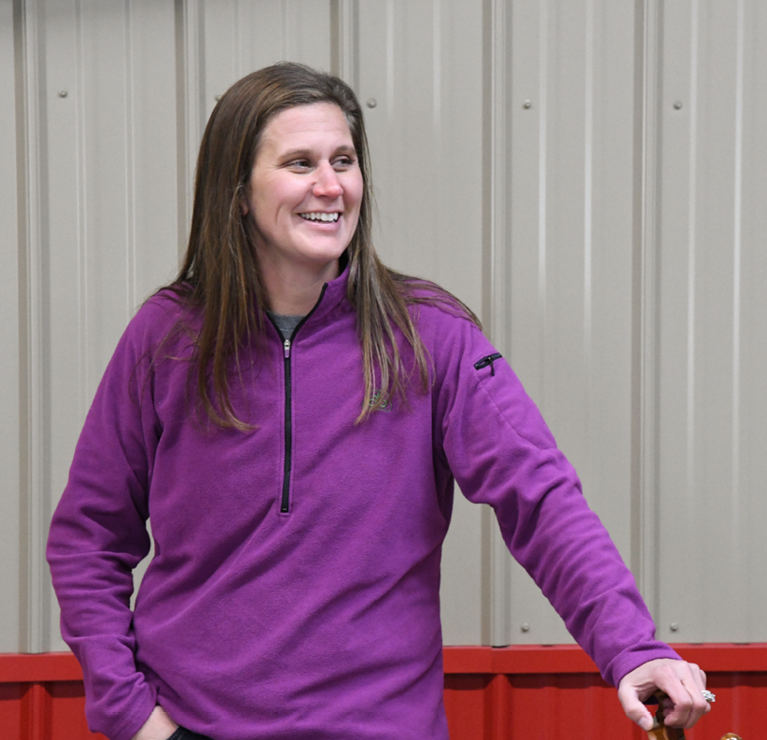
For Cassie Hribek, farming was never a career she had to choose. It is who she is.
A fourth-generation farmer from Bay County, Michigan, Cassie grew up immersed in the rhythms of her family’s farm, working alongside her dad from an early age.
“I started working with my dad as a toddler,” said Cassie. “Farming just always felt natural to me. It’s what I grew up around, and what I love to do now.”
Many of her peers experienced the common cases of existential uncertainty as they transitioned from high school to the real world, struggling to choose which path to take. Cassie never hesitated.
“Farming was never really something I had to decide on,” she said. “I just knew that’s what I was going to do.”
Honoring Family Tradition While Building Something New
Cassie’s family farm has been in operation for four generations, and she grew up right where it all started. Today, she still lives close to home — so close, in fact, when she looks out the window of her living room, she can see the farm where she was raised.
Honoring her family’s legacy has always been important to her, but Cassie was also determined to carve out her own unique place within it.
Cassie began farming immediately after graduating from high school. She gradually acquired land and began building her own operation. Early on, getting access to enough land to support a profitable farm was difficult — even for a fourth-generation farmer with family support and a strong knowledge of the industry.
“You think you’ll never get enough (land) to make a go of it,” said Cassie. “But it does happen. You just pick up a little more here and there.”
Credibility through Experience
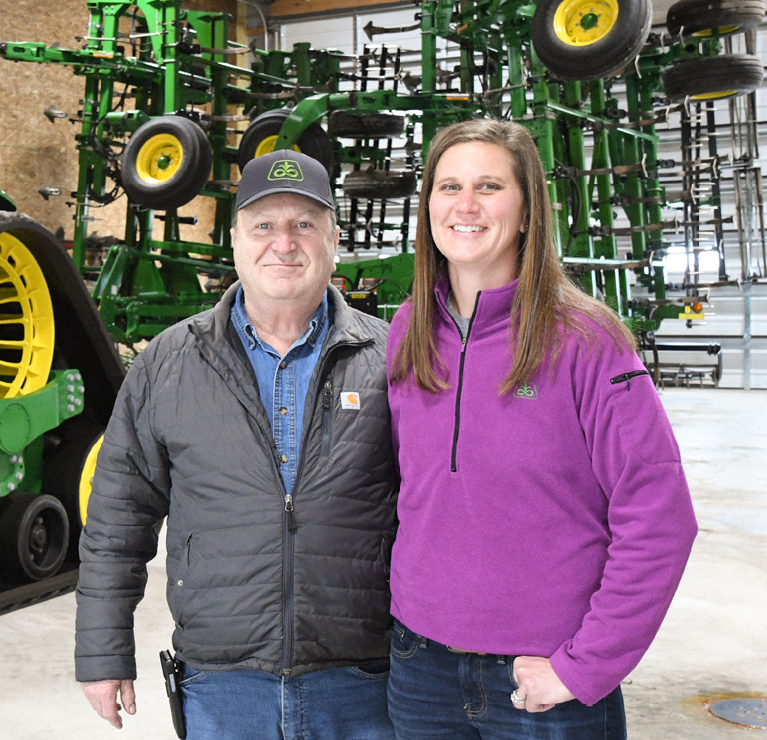
Cassie is part of a growing generation of women in agriculture. While she’s quick to acknowledge there are many women farmers today, she recognizes running her own independent operation still sets her apart.
“Sometimes people don’t take women quite as serious as they take men,” she said. “But once people get to know you and your operation, the respect is there.”
For Cassie, credibility has come from experience, consistency, and results — not from trying to prove a point. Over time, her relationships have grown stronger, and her operation speaks for itself.
“Cassie embodies the very spirit of a woman in agriculture. While she works alongside her dad, and is also married to a full-time farmer. What truly stands out is the strength and pride she brings to running an operation entirely her own,” said Mike Schwab, VP of lending at GreenStone’s Bay City branch. “Cassie’s natural leadership is unmistakable. I look forward to supporting her as she becomes the next generation of her family’s farming legacy.”
The Desk is as Important as the Tractor
Like many producers today, Cassie knows modern farming requires just as much business acumen as it does time in the field. Rising land values, high equipment costs, and fluctuating commodity prices make every decision count.
“Everything costs a lot,” she said. “If you want to be successful, you definitely need to spend some time at the desk.”
Strategic decisions — such as purchasing late-model used equipment instead of buying brand new — have helped Cassie and her family’s operations continue to grow while managing costs.
Despite the stress and uncertainty that can come with farming, Cassie finds deep fulfillment in her work.
“It can be pretty stressful at times,” she said. “But it’s also very rewarding.”
Partnering with GreenStone
When Cassie took her first steps toward running her own operation, having the right financial partner made all the difference. When the time came to purchase farmland, she turned to GreenStone — leaning on her family’s long standing relationship with the cooperative. “GreenStone is a great fit for beginning and young farmers,” said Cassie. “They just get it.”
Cassie’s experience reflects the mission of GreenStone’s CultivateGrowth program — to support young, beginning, and small farmers as they establish and grow their operations. From land financing to crop insurance and Patronage dividends, GreenStone has been a steady partner throughout her journey.
“They make it easy… Everything is there, and you don’t have to explain farming to them,” said Cassie. “The Patronage program has been very beneficial — it’s nice to get something back that supports the financial health of your operation.”
Farming for the Next Generation
Looking ahead, Cassie’s goals extend beyond her own success. She and her husband, Jason, who runs his own farm operation, have two young sons, Dean, 5, and Eli, 4. Her hope is to grow her operation and make it viable for years to come — should her children choose to enter the family business and take over where she left off.
“Farming is just a way of life,” she said. “It’s something that’s born into us. One day, it’d be nice to help them farm and let them be the boss.”
For Cassie Hribek, farming is about patience, persistence, and pride — honoring the generations that came before her while building something sustainable for the next. Rooted in tradition and driven by determination, she’s proving that with the right support and a clear vision, young farmers can still grow their dreams.

To view the article in the online 2026 Spring Partners Magazine, click here.
The phrase “Laws are like sausages, it is better not to see them being made” is a well-known often misattributed aphorism that describes the chaotic, messy, and compromise-driven nature of the legislative process. This phrase suggests that while the final law product may be necessary and beneficial, the process of creating them is unappetizing, involving intense political maneuvering, lobbying, and backroom deals. This is not considered a pleasant job when the guts of the drafts are on the table, and it has been going on for centuries, in some cases creating divisions throughout history.
Actual sausage making is a natural outcome of efficient butchery which has been practiced for centuries. This also is not a pleasant process that requires strength but was necessary to have humanity survive. There are thousands of types of sausages worldwide, Germany alone boasts having over 1,200 types. With countless variations in spices, meat types, and curing methods, the total number of sausages is almost immeasurable.
Like sausage, there are thousands of laws that have been enacted over time. These enumerable laws have sustained humanity similarly to the ingesting sausage. Some sausages taste better than others. Call out your own favorite sausage or favorite law and good luck getting a room full of people to agree on either choice.
What is long underway is the creation of a Farm Bill to replace the expired and outdated 2018 Farm Bill. While many laws impacting agriculture were addressed in the One Big Beautiful Bill, more updates are necessary in what is being referred to as Farm Bill 2.0. Sausage making is currently underway in both chambers of Congress.
While all 12 titles of the Farm Bill are being addressed by Congress, there are aspects of Title 5, Credit, which are particularly relevant to the Farm Credit System impacting GreenStone.
- Farm Credit’s top priority: Pass a strong Farm Bill.
- Producer & Agricultural Credit Enhancement Act: Increase loan limits on FSA direct and guaranteed loan programs to better reflect the increasing costs of purchasing land and operating farms.
- Farm Credit Administration Independent Authority Act: Ensure the Farm Credit Administration is the primary regulator of Farm Credit System institutions.
- Investing in Rural America Act: Clarifying Farm Credit institutions’ authority to finance rural community facilities projects and encouraging partnerships on these projects with community banks.
- FARM Home Loans Act: Modest proposal in line with the spirit of the Farm Credit Act by allowing Farm Credit institutions to serve rural communities with a population of 10,000 or less.
- USDA Loan Modernization Act: To expand eligibility for direct loans to individuals or entity members that hold at least a 50% interest and that are or will become bona fide operators of the farm real estate acquired, improved, or supported with farm ownership, operating, or emergency loans.
The expression that laws, like sausages, cease to inspire respect in proportion to how they are made, was popularized in modern context by the industrial, sometimes controversial imagery in Upton Sinclair’s “The Jungle”. Laws have been upgraded as has been called for overtime. The Farm Bill 2.0 is one that needs upgrading.
The comparison to sausage making highlights the fundamental reality of democratic governance to achieve results. Politicians must trade votes, accommodate special interests, and revise initial proposals, sometimes to a point where what comes out is unrecognizable, much like grinding various meat scraps into a single sausage link. As one nation under law, indivisible, with liberty and justice for all, sausage making to make the laws remains fundamental, and our voices matter in making them.
To view the article in the online 2026 Spring Partners Magazine, click here.
The United States labor economy started off 2026 in a positive direction with 126,000 jobs added in January. This dropped the unemployment rate to 4.3%, an improvement from the last reported information from December 2025 of 4.4%, according to the U.S. Bureau of Labor Statistics. Unfortunately, and somewhat unexpectedly, recently released data from February showed the loss of 92,000 jobs and a return to the unemployment rate of 4.4%. Recall that 2025 data was revised downward to just 181,000 jobs added for the year, an especially weak mark. Health care and social assistance have led job gains while the federal government continued to shed jobs.
Meanwhile, GDP growth for the fourth quarter of 2025 was a bit softer than anticipated at an annualized rate of just 0.7% based on the latest report from the Bureau of Economic Analysis. Some of this was likely attributable to the government shutdown which lasted 43 days from October 1 to November 12. Inflation, as measured by the Consumer Price Index, increased 2.4% over the 12 months ending February 2026, and no change from January. This decreased from 2.7% as of December 2025, and 3.0% from a year earlier in January of 2025. The most recent figures may also have been impacted by the government shutdown since data from October was not included in the rate.
Uncertainty was the key word used by the Federal Reserve at the most recent central bank meeting, March 18, during which a vote was held to keep rates unchanged in a range between 3.50% and 3.75%. Labor markets appear fragile, with mixed signals of slowing jobs growth but stable unemployment. Inflation was down early in the year, but concerns have appeared over the implications of the war in Iran and surging oil prices. The Fed must balance a policy aimed at promoting full employment and controlling inflation. With mixed economic signals and uncertain conditions ahead, one quarter-point rate cut is expected for this year after three 25 basis point cuts in 2025. Worth noting as well is the impending change in Fed chair as Jerome Powell will end his eight-year tenure as chair in May.
Tariffs implemented by President Trump in April of 2025 and billed as “Liberation Day” tariffs have been decreased to a temporary flat 15% after the Supreme Court issued a 6-3 ruling in the case Learning Resources, Inc. V. Trump. The Supreme Court ruled that the President’s use of the International Emergency Economic Powers Act (IEEPA) was not a constitutionally sound method of implementing tariffs. The ruling was not an indictment of tariffs, nor a statement that the president could not implement tariffs. Rather, it clarified the president was not authorized to enact tariffs under the IEEPA. The flat rate tariff imposed immediately following the ruling is a temporary tariff imposed under Section 122 of the 1974 Trade Act which only allows tariffs up to 15% to address balance of payment deficits. There are also additional reporting requirements under this authorization. Many claims have since been filed by importers for reimbursement of the tariffs struck down by the Supreme Court.
Corn and Soybeans
The March 10, 2026 U.S.DA WASDE report offered minimal changes for both the corn and soybean markets from the February report. For corn, the most notable update was the increase in world ending stocks, which reached 292.8 million metric tons, exceeding trade expectations and rising from last month’s figure with increases tied to higher production estimates in key exporters such as Brazil and Ukraine. The report emphasized that geopolitical tensions continue to influence commodity flows and trader behavior, with grain markets remaining sensitive to shifting energy prices and trade risks.
Turning to soybeans, the report showed relative stability in U.S. balance sheets but spotlighted global production dynamics, particularly in South America, where Brazil’s soybean harvest is underway and remains a major area of market focus. While the WASDE did not dramatically revise U.S. soybean projections, traders are watching for later‑month updates tied to the March 31 Prospective Plantings and Grain Stocks reports, which could provide clearer guidance on acreage shifts and supply outlooks. The broader tone of the WASDE reflected a market caught between ample global supplies, especially in corn, and ongoing uncertainty from global conflicts and weather developments. Analysts noted that even the lack of significant changes can be meaningful, signaling that USDA sees no immediate reason to alter domestic demand or export expectations despite the volatility.
Overall, the March 2026 WASDE reinforced expectations of large world corn supplies, steady but closely watched soybean fundamentals, and a grain complex still highly reactive to geopolitical risk, South American harvest results, and upcoming acreage data, all of which will shape market direction heading into spring.
Dairy
Producers are coming into 2026 with historically strong balance sheets and working capital positions after multiple years of above average profitability. Although income over feed costs using the Dairy Margin Coverage calculation retreated to the lowest levels since August of 2023 in January and February, both Class III and Class IV futures rallied significantly through the rest of 2026 with the resurgence of the nonfat dry milk and butter markets. The 2026 12-month average for Class III and Class IV Milk Futures is $17.23 and $18.85, respectively. Feed prices are also expected to remain below the historical trend based on the current corn and soybean meal futures prices, resulting in anticipated positive margins for the remainder of the year. Beef income from culling cows and selling crossbred calves are still providing significant benefits to dairy producers’ bottom lines. After a fourth quarter decline in calf prices, crossbred calf prices reached new highs in February topping $1,400 per head.
Dairy producers continue to add cows with 189,000 added to the national dairy herd over the last 12 months and growing the total dairy herd to 9.58 million head, a 32-year high. On top of a larger herd, milk yields continue to increase as well. This growth in both milk yields and total cows will continue to require strength in the U.S. Dairy export markets. Today, U.S. butter and cheese prices remain competitive in the global market and exports through January are strong with an 11% year-over-year (YOY) increase in cheese exports and butter exports up 187% YOY.
New facilities, low feed costs, high beef revenue, risk management programs and the recent surge in milk prices providing economic incentives for producers to continue boosting milk output will likely slow any sort of transition from expansion to contraction.
Pork
Through the first two months of 2026, the optimism that producers carried into the year regarding continued stronger lean hog prices and profit potential has been supported and the outlook for the year remains positive. Lean hog futures and the Lean Hog Index have sustained a rally through the first quarter which as of the date of this writing, March 10, 2026, futures contracts are trading at or near contract highs and $10-$15 per cwt. above year-end contract prices. The Lean Hog Index is also back above $90 per cwt. for the first time since October. Market hog prices and outlook have resulted in record-high prices being paid in the first quarter for both weaned pigs and feeder pigs. Packer margins have remained positive despite higher hog prices due to a strengthening wholesale carcass value (“Cut-Out”) which increased back above $100 per cwt. and back to prior year levels in early March. Some packers are working to increase daily processing capacity and are offering contracts to additional producers which has a positive impact on price and/or transportation costs for those farms. Both domestic and export demand remain strong, providing support for pork and hog prices while supplies remain fairly tight.
Feed prices have remained low enough to provide good margin opportunities but remain a threat and have increased recently on geopolitical risk and unfavorable weather in South America increasing ingredient costs, especially corn. There is little expansion going on in the industry despite the positive news above given persistent risks around disease, labor availability, and high construction costs. PEDv and PRRS remain two of the primary disease risks, with a new strain of PRRS impacting production during the first quarter in Ohio and Indiana. Risk of foreign animal disease remains as well, with increased African Swine Fever (ASF) cases in the European Union, particularly in Spain.
The industry continues to focus on biosecurity measures as the primary protection against disease risk. If these price trends continue and farms can remain healthy, there is a good opportunity to follow a good year in 2025 with a second this year.
To view the rest of the 2026 spring Partner articles please click here.
Time continues to fly by for me as I am sure it does for our extremely busy members. It doesn’t get busier than this time of year for our farmer members in the fields or our country living customers excited to start their spring plans or new home construction.
There’s been a long list of events over the last three months that have kept our team quite busy, but every time we welcome customers to one of those events we get the chance to learn from you all – through your interaction, your engagement and comments, your ideas and concerns, and your personal stories. These opportunities and events are what make GreenStone, your financial cooperative, a special place to work and do business.
I’m so proud of the value my teammates live by each day – the relationships they build with each of you and the expertise they share to support your goals. Over the last few months we’ve been busy with what we fondly refer to as “meeting season.” It’s a time when many of our members are just a little less busy, and therefore we help to fill that time with information, resources and knowledge. This season GreenStone hosted more than 20 educational opportunities for members and prospective customers. That’s on top of the always special Patronage Day, and our engagement in many industry tradeshows, community events, and several other initiatives we help with throughout our territory. I know you have many opportunities to learn and grow each year, and we thank you for prioritizing our events as valuable to you!
I won’t belabor the point too much, but to help showcase the breadth and depth of our team’s efforts, here’s a few examples of what we had going on in the first quarter:
- Agricultural producer forums and dairy connect events where members gained insights to help them plan strategically through market updates, risk management options, and practical tools.
- In-person and virtual timber forums focused on planning, industry issues, business management, and legislative initiatives.
- In-person and virtual construction seminars where attendees walked through the ins and outs of the details and choices involved in the process of building their dream home.
- A two-day conference focused on networking and information sharing for young, beginning, and small farmers.
And of course, to top it all off was our 21st Patronage Day when we hosted more than 5,000 members at our branches and returned a record $125 million of our profits right back to you – our member-owners! Stepping up means more than $125 million back, it’s our continued growth alongside our members and relationships built for over a century. No matter the season, we remain committed to being your reliable financial partner.
That commitment is further highlighted in the annual report you should have recently received! The report demonstrates the resilience and commitment of both your cooperative’s members and employees. Our culture is built on a foundation of strong relationships with our member-owners, and that commitment remains steady regardless of the economic cycle. Our focus remains on maintaining open communication with our members and delivering financial solutions tailored for each of their unique needs. Highlights of the 2025 annual report include:
- Net Income of $270 million
- Total Assets of $16 billion
- Total Loan Growth of 5.4%
- Outreach support of approximately $1.5 million
- More than 12,700 hours volunteered
Your cooperative had an outstanding 2025 and we are ready to continue our success in 2026 and beyond. Like always, for us to accomplish this, we need your assistance with a couple very important items.
First, it’s time for our annual customer satisfaction survey, which helps us gather valuable feedback on our members’ overall experience with the cooperative. Aa randomly selected group of members should have received the survey.
Conducted each year, this survey measures customer satisfaction, loyalty, perceptions of our products and services, and changes in service over time. The insights we receive not only reflect our members’ current perspectives but also highlight positive trends and opportunities for improvement, helping GreenStone continue to enhance our customer experience.
Secondly, our election ballots will be sent on May 4. All regions will be electing our nominating committees, and regions 4 and 5 will also have director elections this year. Please be on the lookout for your ballots and don’t forget to vote before the June 9 deadline.
Best wishes for a safe and successful spring planting season. Please feel free to reach out to me any time if I can ever be of assistance.
As always, thank you for feeding me, my family and the world, and thank you for your membership.
To view the article in the online 2026 Spring Partners Magazine, click here.