


It’s that time of year again, school is well underway and we’re about to start looking forward to the holidays. Whether your child is back in the classroom or taking advantage of remote learning opportunities, chances are their technology and internet use is ongoing. This is a great time of year to review your home network settings, making sure you and your family are secure while online.
According to a recent survey, the average household has over 10 devices connected to their home network. In my home, I’d guess we have no less than 60 devices connected to the internet – Smart TVs, game consoles, computers, tablets, phones, and IoT-connected devices like smart light bulbs and plugs. A recent Gartner study confirmed, that number will only continue to grow for most households. They predict that by 2021 there will be 25 billion IoT-connected devices worldwide.
What is a home router?
If you ask anyone in my household, they will tell you that the router is the most important device in the house. If the internet goes down, one of my children will be quick to let me know that they just lost their current game of Fortnite or ROBLOX. The router is the hub of your home network. All our home devices connect through the router to access the internet – it’s the middleman between the internet modem and your devices, and provides the Wi-Fi to connect wirelessly. It is also the device that helps protect all the devices from the bad guys on the internet. Without a router, any device connected directly to your cable or DSL modem might be exposed directly to the internet.
Fear not, all is not lost – here are some tips that can make sure your home network is secure:
Secure your Wi-Fi, NOW!
Users today purchase a home router to make sure that they have wireless internet access throughout their home. Because these routers are broadcasting wireless information, they make an easy target for someone to attack if the bad guys are within range of your wireless network. If the bad guys can access your home network, they might see your internet activity, including usernames and passwords.
Change the Service Set Identifier (SSID) from the default name to something unique. Most manufacturers use the same SSID for all models of their home routers. By keeping the SSID the default, you are exposing the make and model of your home router to the bad guys, they could use this information to get the default username and passwords to your router or use that information to determine if any vulnerabilities could be exploited.
Change the password when you purchase a router. The first thing you should do is make sure that you update the default password. If you have read previous Tech Tips in our Partners magazine, you know you should use a strong password that comprises at leave 15 characters. The password should be unique to this device and, for extra points, store these passwords in a password manager. Changing this password will make sure that bad guys cannot access the administrator settings for your router.
Make sure that WPA is enabled. This makes certain that information going from Wi-Fi devices inside your network to your router is secured. You can easily determine if your home network is secured today because there will be a lock icon by the SSID name and when you connect to that Wi-Fi, it will prompt you to enter a password. At a minimum, if all your devices support it, make sure your Wi-Fi security is configured for WPA2. However, newer routers might offer support for WPA3 security, which offers additional security benefits.
Update the passphrase once you configure the WPA setting. Make sure that you are updating the default passphrase to a strong, unique passphrase. The passphrase is used for your devices to establish a connection and access your home network.
Update the software of your router sometimes known are firmware, just like you update your mobile devices or home computer. Your router also needs to be updated. These updates typically provide fixes for recently discovered security vulnerabilities as well as fixes to software issues. Make sure you are using a device that is connected to the router using a wired connection before you attempt to upgrade the firmware.
Enable additional security settings available for your router if available, newer routers have very robust easy-to-configure firewalls that provide additional protection to what may access devices inside your network.
The average household has never been more reliant on its home network – hopefully, these tips will provide you with additional peace of mind that your home network is secure!
To view the article in the online 2021 Fall Partners Magazine, click here.
In this behind the scenes, two GreenStone employees from the GreenStone Service Desk team speak about how their daily work supports customers and improves the overall customer experience.
Nikolas Vorias
2 years of service
Service Desk Specialist
East Lansing, MI
How have GreenStone’s technical tools allowed us to support our customers?
GreenStone’s technical tools have allowed us to set up employees to be able to work from home, onsite with the customer, or anywhere and still be able to assist our customers. Our My Access portal, online banking, and mobile app play a huge role in providing our customers with convenient servicing options. These different applications allow our customers to exchange documents and make payments, along with other things, without having to visit their local branch.
What advancements has GreenStone made to better serve customers?
I would say the biggest advancement would have to be the way we are communicating while some staff work in office and others work remote. Also, providing the best technology to make it possible to continue to support our customers regardless of the requirements we had to close our branches. We are always looking for ways to improve so that we can provide our customers with the best experience possible.
Describe how your role carries out the GreenStone mission of supporting rural communities and agriculture.
As a Service Desk Specialist at GreenStone, my role involves working with our customers directly when they are having an issue with one of their accounts or simply answering any questions they have. We also support our fellow employees to make sure they are up and running so they can continue assisting our customers.
What do you enjoy about your role?
I enjoy working directly with our customers and our employees on a day to day basis. Being on the service desk allows me to help customers with their My Access account or online banking accounts, which helps the customer gain access to the resources they need. I also really enjoy being faced with different issues everyday and working through them.
What do you enjoy doing in your free time?
I really enjoy fishing and hiking in my free time. This past year I was fortunate enough to visit Rocky Mountain National Park and while there I was able to catch my first brook trout using a fly rod!
Josh Martin
11 years of service
Service Desk Manager
East Lansing, MI
How has GreenStone’s technical tools allowed us to support our customers?
The tools we use give us the ability to be very efficient with our customers and getting their needs fulfilled as quickly as possible. By always looking into ways to improve our tools, we stay at the top of the game in providing service to customers.
What advancements has GreenStone made to better serve customers?
Our My Access customer portal has given us more ways than ever to communicate and work with our customers, giving them an efficient and user-friendly platform that helps them keep their finances in order. Likewise, our service desk team has matured in our operations to more easily help our customers and ensure they have the tools they need to succeed.
Describe how your role carries out the GreenStone mission of supporting rural communities and agriculture.
The service desk is there as the first line of support to help our customers in any way we can. Agriculture is a lifeblood of our region and knowing we are able to help the industry grow is very rewarding.
What do you enjoy about your role?
Being responsible for our customer service to not only our staff, but to our customers as well, gives me a great sense of pride. We strive to provide the best customer experience our customers have gotten; being a part of that is great.
What do you enjoy doing in your free time?
In my free time I enjoy camping and hiking with my family, home brewing, and running all of the technical components at my church.
To view the article in the online 2021 Summer Partners Magazine, click here.
“20 years of bringing the best to members”
Life and disability insurance is a critical risk management component to consider with every farm operation. Evaluating the type of insurance, its uses, and the correct amount can mean the difference between success and foreclosure. No one understands the importance of planning better than a farmer. It’s the attention you give your soil, your crops, and your livestock that produces a successful tomorrow. Careful planning is the key to your family’s future too. Life and Disability insurance will provide a monetary benefit to your family if you are no longer living or able to perform the farm duties.
After many years of bringing Minnesota Life’s “Credit Life” to our members, GreenStone recognized the customer desires. FCS wanted to expand their members’ options for Life and Disability coverage to include products available from the entire marketplace. This was to ensure GreenStone members were receiving the very best in pricing, guarantees, and benefits.
The old saying “A jack of all trades and a master of none” has never been a trait of GreenStone. With the goal of providing a depth of knowledge and experience through another risk management tool, GreenStone partnered to create FCS LifeExpress. With the amount of knowledge it takes to navigate the life insurance industry, and all the evolving products, GreenStone knew partnering with experts is what members deserve. So twenty years ago, AgriBank, along with the Farm Credit associations and First Resource Group created FCS LifeExpress. FCS LifeExpress is a resource-based service for members to review the insurance marketplace to find the best options for each individual.
Best Pricing, Best Guarantees and Best Benefits tailored to each individual on an easy to read chart, gives members the very best options in the marketplace to review in the privacy of their own home. No pressure… Just the facts in an easy to understand format!
Expanded products portfolio to target your exact needs:
Term Life Insurance
- Least costly
- Can renew to age 95
- Can convert to Permanent coverage
- Term periods from 10 to 40 years
- Fixed Premium Guarantees
- Optional Return of Premium feature
- Permanent Life Insurance
- Survivorship Life– Perfect for Farm Transition or Family Equalization
- Whole Life– Guaranteed Permanent Death Benefit
- Can convert with Guaranteed Level Premiums.
- Disability Coverage
- Short term or Long-term coverage
- Optional Return of Premium Feature
- Farm/Business Overhead
- Expense coverage
- Customized coverage for your operation
- Long Term Care Coverage
- Traditional Stand-alone LTC coverage
- Life Linked LTC coverage – Pre use your Life insurance death benefit to fund LTC expense and/or Life insurance death benefit to pass to beneficiaries.
Besides providing the best priced life insurance to cover debt or to replace income for the family, FCS LifeExpress is ready to work with customers and their trusted team of accountants or attorneys to design funding for the long term operational succession, optimal farm transition, and life risk management.
At FCS LifeExpress, our goal is simple: To be the best resource to help members eliminate risk for their families and their farm operation.
To view the article in the online 2021 Summer Partners Magazine, click here.
When Jeff Alexander took over his dad’s farm in 1993, his family had already established a relationship with GreenStone as a lender. Along with the financing partnership, he then began working with Tax Accountant Sue Smith in the Adrian branch on tax planning services right away.
“Sue was new at GreenStone, and we were new to running the business, and so we learned together. She and her husband were getting started in farming too, and I just thought it was such a good fit, since she knew exactly where we were coming from when it came to showing us different ways to save on taxes,” Alexander said.
Jeff and his wife Julie meet with Sue a few times a year to plan their tax strategy. She helps them decide if they should pay for items ahead, or defer a payment, and they go over all their finances before the end of the year.
Sue also helped the family transfer their land into PA-116, which preserves the land for agricultural use while also reducing the amount of property taxes.
“Sue helped us navigate through PA-116 and held our hands through the process,” Alexander said. “Sue has been great about showing us what tax benefits we qualify for, and enrolling us in PA-116 helps us save money.”
Building a farm
Larry Alexander, Jeff’s dad, farmed in Hanover, Michigan, but he sold it and moved the family to Florida in 1976. After 11 months, Larry and Jeff both missed the farm. So at 15, Jeff moved back to Michigan and began farming anew with his dad on Na-Lar Farms.
On the dairy and crop farm, Jeff had his area of focus.
“I started taking care of the cows, and I wanted a registered herd in the worst way,” he said.
Over the years and generations, Jeff built up the genetics of his herd. He credits Doug Long of Longhaven Farms and Dr. Richard Fish of Countryside Veterinary Service with mentoring him through the process.
“I was infatuated with genetics, and above all others, Doug Long let me pick his brain,” he said. “Dr. Fish was also instrumental in helping me, and I probably learned more from him than any man on earth.”
Jeff’s farm won the Progressive Breeders’ Registry award over 20 times. This prestigious award is given to herds that are 80% homebred with minimum requirements for milk production.
Transition
In 2013, the farm installed robots to milk their cows, which gave Jeff the ability to attend more events with Julie. After some employee changes in 2018, Jeff decided to sell the cows and concentrate on crop farming.
Currently, they farm 1600 acres of corn, beans, hay, and wheat. They recently purchased a second baler (Silage Special) designed to bale wet hay, and they also purchased a wet wrapper. They individually wrap and seal each round bale.
Once again, Jeff benefited from GreenStone’s tax services during his transition from dairy to crop farming.
“One main factor was to minimize tax complications and liability,” tax accountant Sue Smith said. “I wanted to make sure that he didn’t have to pay more taxes than necessary when he was selling cows and dairy equipment. Also, I worked with him to make sure he was structured to be successful on the crop side of farming, just like he was successful on the dairy side of it.”
Jeff’s wife Julie is a state representative in her third and final term. They have four adult children, Adam, Andrew, Jared, and Anna. Adam farms full-time with his dad. He’s the main mechanic, and he also does the planting and combining. The boys all have F endorsement licenses so they can haul grain when needed, and this fall Anna is getting married. She and her fiancé’s family just bought their own 400-acre farm.
“She’s marrying the milk man,” Jeff said. “We’re throwing up a big tent and having the wedding reception right in their newly purchased field.”
Jeff is enjoying the reduced stress that comes with crop farming.
“After 40 years of milking cows, everything comes easy after that,” he said. “Adam does a great job with the equipment, we keep the machines maintained, and we’re working only 50-60 hours a week instead of 100. I joke that now my main job is a trophy husband.”
Trust
Alexander considers the level of trust to be an important one when considering who to work with on his taxes and finances.
“We’ve never had anyone other than Sue do our taxes, because there’s just that trust,” Alexander said. “You’re talking about someone’s livelihood. Some years you’re worrying in there when things aren’t going well, and some years you’re smiling from ear to ear when things are going well. You have to trust someone to go through all of that with them.”
Jeff started with GreenStone, and he plans to finish his farming career with them.
“My dad is 85 now, and he still does his taxes with Sue. He likes her. It’s easy – she’s such a pleasant person, and she’s really good at teaching us what we need to do. There’s never been a moment when we thought we should be with someone else. Anytime anyone asks us about taxes, we say go see Sue,” he said.
Farming is a business where cutting costs is always a concern, but in some areas there’s no argument.
“It’s always good to shop around for the best rates on everything, but not our tax accountant. There’s no other option for me. She’s the one,” Jeff said.
To view the article in the online 2021 Summer Partners Magazine, click here.
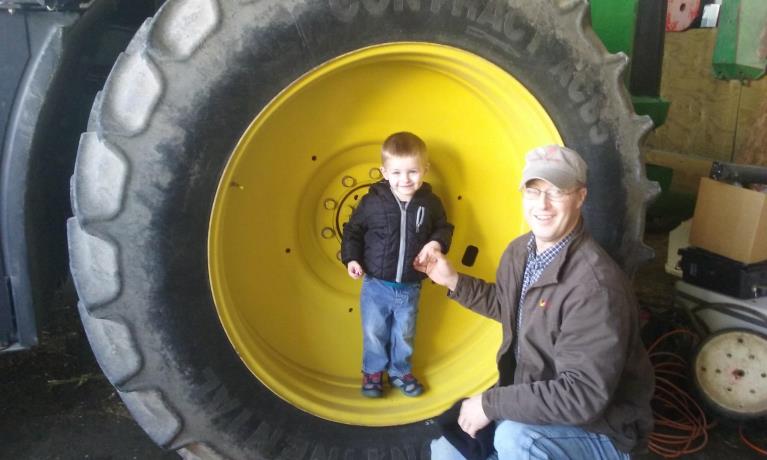
Jed Welder is the owner and operator of Trinity Farms in Greenville, Michigan, where he raises corn and soybeans on 800 acres, along with several acres of hops. Before he embarked on a career as a farmer, Jed served as an officer in the United States Army for more than 10 years, with tours in Iraq, Afghanistan and Bosnia, serving as an armor officer.
“I served with some of the greatest men and women in the world,” said Jed regarding his time in the military. In 2008, he and his wife made the decision to transition from Army life to farm life. They returned to Michigan to start a family and their farm. “We loved moving to the country and enjoyed the challenges of learning this new profession,” says Jed. As they learned, the Welders quickly realized they would need access to land and capital in order to make their dreams of farming a reality.
Jed knew that local farming communities are like the military – a close-knit group. Jed got to know some farmers in the area, and sought their advice on getting started. Several recommended the local Farm Credit explaining that many of their local banks were unable, for one reason or another, to provide operating loans to farmers. Heeding their guidance, Jed prepared a business plan and made an appointment with a loan officer at his local GreenStone branch. “They understood what I wanted to do and what I needed to run my operation. They made good, solid recommendations, and over time became a trusted partner.”
As Trinity Farms has grown, GreenStone has been a partner along the way. This past summer, he financed the construction of a grain drying and storage system. “My loan officer came out to see the progress and talk with me about it,” said Jed. Besides the personal, individualized service, Jed feels one of the greatest benefits of working with GreenStone is having a partner who understands his business. “Their office is twenty minutes away; they know how the crops in our area look and what the prospects for harvest are because they are in the business of working with farmers.”
With challenging times on the horizon for much of the agricultural industry, Jed recognizes the importance of working with a lender like GreenStone, who not only understands the market cycles, but will be there to support rural communities and agriculture in good years and in challenging years as well. “Right now we are planting corn and soybeans with prices very near break-even. There is an exciting revolution in precision agriculture and technology that will help us be more efficient, but at the same time the cost of farming increases every year,” said Jed. “Having a lender that works with me, that knows my farm and the challenges I face, is more important than ever.”
After years of serving his country in the Army, Jed and his family serve again, this time through the hard work and dedication that is required of the farmers who provide the world with food and fuel.
GreenStone thanks Jed and all veteran farmers like him, for their service to our country and their commitment to our rural communities.
As a GreenStone customer…
1. We promise to offer you personalized service.
2. We promise immediate responses to all your requests.
3. We promise honest, fair and impartial treatment.
4. We promise confidential treatment of all information.
5. We promise to provide you accurate information and advice.
Known as our Customer “Bill of Rights,” these five represent the commitment we make to our cooperative members.
1. Personal service – We understand no two farms, businesses or households are alike, and each deserves personal attention. We will work to develop a mutually beneficial relationship with all members, one based on respect, trust and open communication.
2. Immediate responses to all requests – Our staff embrace our Core Four Values, including putting the customer first by being responsive and building relationship with customers beyond the transaction.
3. Honest, fair and impartial treatment – We treat all customers fairly and honestly while appreciating their individuality and adhering to our thorough and regulated processes. It is our commitment to work with customers to provide the most viable and sustainable solutions for their individual circumstances.
4. Confidential treatment of all information – Our commitment to all customers is to treat member information and affiliation with GreenStone confidentially. All financial institutions, including GreenStone, are obligated by law to record certain information as a matter of public record. Beyond what is required, we will never release the names of our customers or comment on the relationship we have with individuals without prior consent.
5. Accurate information and advice – Our staff are engaged in the industries of their customers and bring their experience and education to the customers they serve. Together, we seek out the best solutions for our customers based on individual service, an unbiased perspective and sound financial metrics.
Confidentiality
GreenStone values our customer relationships, and we want you to feel comfortable and knowledgeable with how GreenStone handles your loans and information. A trusted relationship with our customers requires open and transparent communication. Member privacy – as outlined in #4 of our Customer Bill of Rights – is extremely important and can be questioned with the amount solicitations, spam and phishing attempts on us all each day. We want you to know we hold your financial and personal information in strict confidence.
Though we keep your information confidential, some customers who may have recently conducted business with us have received solicitations in the mail or email impersonating GreenStone and referencing personal and financial information related to their loan with GreenStone. Naturally, this raises questions on the authenticity of the mailer, as well as the confidentiality of our customer’s information.
As explained on page 49 in our Tech Tip, this is one of many types of “spam” targeted at securing your dollars or additional personal information. Using the information required by law to be filed publicly some companies compile public data – primarily register of deeds recordings – and mass mail, or email, solicitations using as much personal information as possible to get you to believe it is legitimate or that you need to take action.
Public Record
Because some information is required by law to be publicly filed, we want to make sure you are aware. All financial institutions, including GreenStone, are obligated to record with the Register of Deeds certain information as a matter of public record when a mortgage loan is written. These public records typically identify the borrower’s name, the lender, and possibly the original loan amount. In addition, public property records can also include:
- Ownership history
- Property maps
- Record of sales listings
- Historical tax assessments
- Assessed property value
- Property square footage and the number of rooms in a dwelling
You can be absolutely confident if you receive a solicitation from another lender to refinance your GreenStone mortgage, the lender who sent it did not receive any information from GreenStone about you or your loan.
Our commitment to your right of privacy is part of our Customer Bill of Rights as is our commitment to customer satisfaction. As a member of this organization, the protection of your privacy and the security of your personal information are vital to our continued ability to serve your ongoing credit needs.
Rest assured, we protect you and your information!
To view the article in the online 2021 Spring Partners Magazine, click here.
In 1966, Jim and Germaine Matsche started their Birnamwood, Wisconsin, farm with just two milk cows. While raising six children, they slowly grew the operation. By 2000 they were at about 300 milking cows when they added a double 24-parallel parlor and began an extensive expansion.
By 2014 they were milking 2,200 cows three times a day, around the clock taking a toll on equipment. The family knew it would need to make some significant decisions for the future.
The second generation, Scott and Carrie Matsche, are the current owners of the farm and now their sons Chris and Ryan as well as Chris’ wife Heather, two nephews, Tyler and Brandon, and a niece, Nicole, are involved with the operation. Everyone is well-rounded and has their place on the farm, Heather says, from shop work and working in the fields, to tending cows and working in the office.
“The old parlor was getting a lot of wear and tear,” explains Heather, who wears many hats but is mainly involved in the farm’s accounting, human resources and public relations.
They investigated new technologies, including robotics, and also the idea of revamping the old parlor. Ultimately, with input from their team of experts, including their financial partner, GreenStone, they decided on building an 80-cow rotary parlor and a 4,000-cow freestall barn, which was started in 2015 and operational in 2016. The barn was finished in 2017.
Along with the milk cows, they raise all of their calves and heifers, as well as forages on 6,000 acres.
GreenStone has been their lender since 2000. As the operation grew, Carrie says, “We went with GreenStone because our bank wasn’t big enough and GreenStone was more knowledgeable about farming.”
Tax, accounting and payroll services
With the new expansion and their accountant wanting to retire, the Matsches also decided to benefit from GreenStone’s tax, accounting and payroll services. “This allows us to have everything with one company, and it streamlines operations and allows us to easily understand our current position and projections for the future,” explains Carrie, who is gradually transitioning her accounting duties to Heather.
Data is entered in Quickbooks and a monthly backup is sent to Eric Vandivier, senior tax accountant out of GreenStone’s Little Chute, Wisconsin branch. “I categorize expenses and Eric reviews them to make sure everything is in the right category,” Heather says. “If there’s something wrong, it gets fixed, and sent back to us.”
Vandivier says, “I look at their records and break it down into reports,” he says. “And I work with our lending department to supply a lot of information to fulfill their requirements, whether it be balance sheets, or profit or loss statements or if it’s capital asset schedules or tax returns.”
While both departments are under the same GreenStone umbrella, Vandivier says the information is kept confidential and customers must sign disclosure forms for information to be shared. Once that’s done, a lot of information can flow back and forth, he says. Using GreenStone’s tax and accounting services allows farm owners to move quickly on financing if necessary.
In addition to monthly meetings, there also is an inclusive, team meeting quarterly. “We bring in all our vendors, from the person who’s going to service our dairy equipment, to our agronomist, to our nutritionist and those involved in our breeding program,” Heather says. “GreenStone and our dairy consultant help run the meeting to report on how things are running and to tackle any issues.”
Even though it’s a large dairy, it’s still family owned and oriented – that means there’s always food at these meetings, including Carrie’s famous clam chowder.
To help in decision making, GreenStone also offers some benchmarking through its credit department. As an example, we can anonymously group 500- to 1000-cow dairies and show you how you compare to the rest of that peer group. Is your production lower than normal or is that higher? Maybe a farmer needs to look into lowering his cost of production, or maybe his feed expenses are too high.
Looking ahead
For the future, Heather says the farm is looking into manure digesters. “We are committed to reducing our carbon footprint and being environmentally sound. We’re getting insights from the staff at GreenStone and seeking advice.”
Carrie adds, “We value the opinion of our lenders. Eric has been great to work with. It’s not always just about business; they’ve become like family. I’ve recommended GreenStone to other farmers.”
Scott says he enjoys working with knowledgeable people that understand the farm, everything from buildings and land to equipment.
Most recently, GreenStone assisted with the national Paycheck Protection Program, which helped the farm pay employees when milk prices plummeted during the onslaught of COVID. And, as the farm began transitioning to the next generation two years ago, GreenStone offered resources to help with the process.
While the operation, with about 50 fulltime and 30 seasonal employees, has continued to advance and grow, the Matsche family is most proud to be farming as a family, in which they include their employees.
Scott and Carrie now have 11 grandchildren. “My grandkids get off the bus here, and they’ll come right to the office,” says Carrie, who calls it a blessing to be a part of their lives. The Matsche’s think there’s a pretty good chance their dairy legacy will continue.
To view the article in the online 2021 Spring Partners Magazine, click here.
The previous few months have been busy for cybersecurity professionals. We have seen two large scale alleged national-state cyber-attacks that have impacted tens of thousands of organizations throughout the globe across every industry. 2020 ended with a supply-chain attack against SolarWinds, that impacted over 18,000 organizations that used their network monitoring software. This attacked allowed the cyber-criminals the ability to spy on state and federal computer networks.
Then in March, Microsoft was impacted by 4 zero-day vulnerabilities that have left over 30,000 on-premises Exchange servers compromised. An Exchange server is used by organizations for email communication, among other things. A single Exchange server can host hundreds of individual email accounts. This means that the number of individual email accounts compromised will be unknown for months if not years to come.
Fortunately, GreenStone was not impacted by either of these recent cyber-attacks. We followed the prescribed guidance from CyberSecurity & Infrastructure Security Agency (CISA), Department of Homeland Security (DHS) and the vendors.
The sheer number of newly compromised email accounts mean consumers everywhere could begin to see a tsunami of phishing emails from legitimate email accounts. These phishing emails could contain very specific or sensitive information that normally only the sender would know. This might include loan information or other sensitive conversation information. According to a report released by NTT Communications “59% of phishing attacks in the Americas relate to finance” (NTTSecurity, 2018). The reason the cybercriminals keep doing this is because of the endless potential for financial gain.
Why is this important?
This influx of newly exposed data and personal information provides scammers the perfect foundation to build communication that is tailored towards you. On top of that, they already have access to a treasure trove of public records, including information like your principal mortgage amount and the institution that hold the mortgage note. These details are public information and is not only used by cybercriminals but also by companies trying to solicit you with all types of goods and services.
There is a handful of ways that companies can obtain that information. One potential way is they purchase that information from the financial service provider – GreenStone does NOT sell any of your personal or financial information. Another way is they obtain that information from creditors after you met a certain credit criterion, this is often referred to as a “prescreened” offer.
How do you protect yourself from falling victim to these attacks?
With any email message – trust but verify, never open email attachments or click on URLs from senders you do not know or from emails you were not expecting. It only takes one wrong click, and you could end up with a computer that has now caught a virus or ended up providing your username and password into a “look alike” login page for your email account – all without even knowing it.
With any mortgage mailer that comes in “snail mail,” knowing how they got the information goes a long way. Most of these mailers catch us by surprise because we are unaware that the information that is on the letter is public information.
When I received my first mortgage mailer, I was shocked that this company – which I did not have a business relationship with – knew what I thought was sensitive information like my mortgage principle. In reality, I now know this information is regulated to be reported and becomes public information.
The Federal Trade Commission highlights on their web page two steps individuals can take to help reduce the number or unsolicited mailers:
- Call 1-888-5-OPTOUT (1-888-567-8688) or visit www.optoutprescreen.com to opt out of prescreen offers.
- Put your phone number on the federal government’s National Do Not Call Registry to reduce the telemarketing calls you get at home. To register your phone number or to get information about the registry, visit www.donotcall.gov, or call 888-382-1222 from the phone number you want to register.
There is no magic bullet that will completely or entirely eliminate all risk nor solve all the issues. To help, look for the clues that the mail is junk mail. An example is irregular text – like all “CAPITALS” within sections of the mailer your name, mortgage amount or lender; or the mailer not visually reflecting the same logo or design as most mailers you might get from your lender – these can be giveaways that your information came off a purchased list. Regardless how “real” it looks, you can always call your local lender to verify its authenticity!
Enjoy the beautiful spring weather and save a tree or two by opting out of these junk mailers.
Sources:
NTTSecurity. (2018). 2018 Global Threat Inteligence Report. Retrieved from Phishing Box:
To view the article in the online 2021 Spring Partners Magazine, click here.
There’s only so many ways to say “a year of firsts,” “unprecedented events,” “committed now more than ever,” and yet, here we go again – but we think this one might be the most fitting yet.
PATRONAGE WEEK – March 8-12, 2021 – Join us virtually
Our members are at the core of every decision your cooperative makes. And when it comes to finding ways to benefit our members, we’ve been moving full steam ahead for 105 years. So it’s quite fitting that our members will be receiving $105 million in patronage dividends this year!
What’s that mean to you? It’s 16 years of your partnership paying back $605 million to our members.
This is another record return, a record in a year of tremendous uncertainty, hardship and challenges for our members, our employees and our industry.
Those challenges haven’t ended, the uncertainty remains, and things continue to change. Patronage 2021 won’t look the same as it has – there will be no check pick-up or in-branch celebration – instead we invite you to join us online for a virtual celebration the week of March 8-12, 2021 when all checks will be mailed to members.
While you’re with us online that week, help us again identify the community organizations for our $20,000 Member Grown Outreach support. Place your vote for your chance to win your branch’s gift basket of hand selected local goodies valued at $105.
In February, members will receive individual notification of their portion of the $105 million being returned, while the check itself will arrive to you through the mail the week of March 8.
Patronage has been a celebration we cherish each year. You can’t beat the atmosphere of a day passing out checks and visiting with members. But your safety is far more important, and the checks will come no matter what…because your partnership with GreenStone pays! Like many things these days, we miss our members – our friends – and are disappointed we aren’t able to open our doors and celebrate in person with you this year. We’re looking eagerly to a time we hope isn’t too far into the future when we’ll be able to visit freely without concern.
CONVERSIONS:
2020 showed its hand full of wild cards, and thousands of GreenStone members benefited when the record-low interest rates card got played. Over the course of the year, GreenStone reached out to customers and converted over 12,000 loans to a lower interest rate. Conversions averaged a 1.02% interest rate deduction and will save those members over $32 million in reduced interest payments in the first year alone!
On top of the dollars saved, GreenStone’s loan conversion process is simple without the complexity of a typical loan refinance – resulting in a quick and headache-free experience. There are no appraisals, new financials or supporting documents, application nor a loan closing to convert the GreenStone loan. In the matter of a day and a secure exchange of documents and an online signature, customers reduced the interest rate on their existing loan and began saving.
Not only does a conversion with GreenStone allow you to change the interest rate, you can adjust your loan terms to reduce the lifespan of your loan – giving members the flexibility to both reduce interest paid and the number of payments if they wish.
GreenStone has offered this conversion option for more than a decade, but the broad and extended dip in interest rates in 2020 offered an excellent opportunity to help our members save money.
Conclusion
Profit returns, competitive interest rates, and a customer focused team providing personalized solutions are a trio of benefits unique to only your cooperative. The dollars offer an important tactical value, and our partnership will continue to pay in more ways than any one!
To view the article in the online 2021 Winter Partners Magazine, click here.
Before retiring as a financial services officer from GreenStone, Cynthia Cole helped customers finance their dreams of owning recreational property for 35 years. Whether the land is used to hunt, fish, hike or enjoy in another way, everyone has their own wants and needs when looking for vacant land. No matter the reason, these are the three key questions Cynthia had buyers ask themselves before embarking on the great hunt for the perfect plot of land.
1. What is Your Financial Situation?
Before starting to shop for the perfect piece of land, it is a good idea to assess your current financial situation. Deciding how much land you can afford is a crucial first step. Buying raw land can be very different than purchasing an existing home, but GreenStone is experienced in the process and will guide you through it.
In addition to the credit application, borrowers should expect to share information on your current assets and liabilities, including annual income, investments, mortgages and auto loans. This information will be used to determine a budget, the required down payment and interest rate. It is also important to realize that some lenders may require shorter amortization of land loans, such as 10 to 15 years. GreenStone offers more flexibility with terms up to 30 years and low down payments.
2. How Much Land Is Needed?
Once a budget has been determined, the next question is how much land is desired. That will depend on how you plan to use the land. For example, if you plan to deer hunt, you may want to make sure there is have enough room for food plots or a pond. Hunters should also consider how many people will be hunting on the land at any given time. Too many hunters in a small space is not only dangerous, it will also scare away the game.
3. What Are Your Long Term Plans?
Perhaps your immediate plan for the land includes camping, hiking or hunting… but what about five to 10 years down the road? If there is even a possibility you might someday want to build a home on the land, there are a few things you should consider before signing on the line:
Does the raw lot have adequate space to build? How much would it cost to clear and develop the land before building a home? Some sites may have issues, such as poor drainage, that could complicate construction down the road. Before buying, it is best to consult a qualified builder, and also check with local zoning boards to know if construction is an option.
Does the site have access to utility hook ups, such as water, sewer and electric? If the plan is to eventually live on the property, buyers will want to make sure these amenities are available, or can be at some point in the future.
How accessible is the land? Whether you build or not, survey the lot and make sure there is legal access to the property. If the property relies on an easement, you may want to consult with an attorney before going through with the purchase.
It is true, there is a lot to think about before buying vacant land. Once you have determined what your needs are, GreenStone’s service and loan flexibility, like the vacant land and recreational land loans, make it convenient to finance the acreage you desire with a payment plan you can afford.
Cynthia Cole is a retired senior financial services officer from GreenStone’s Ionia branch.