




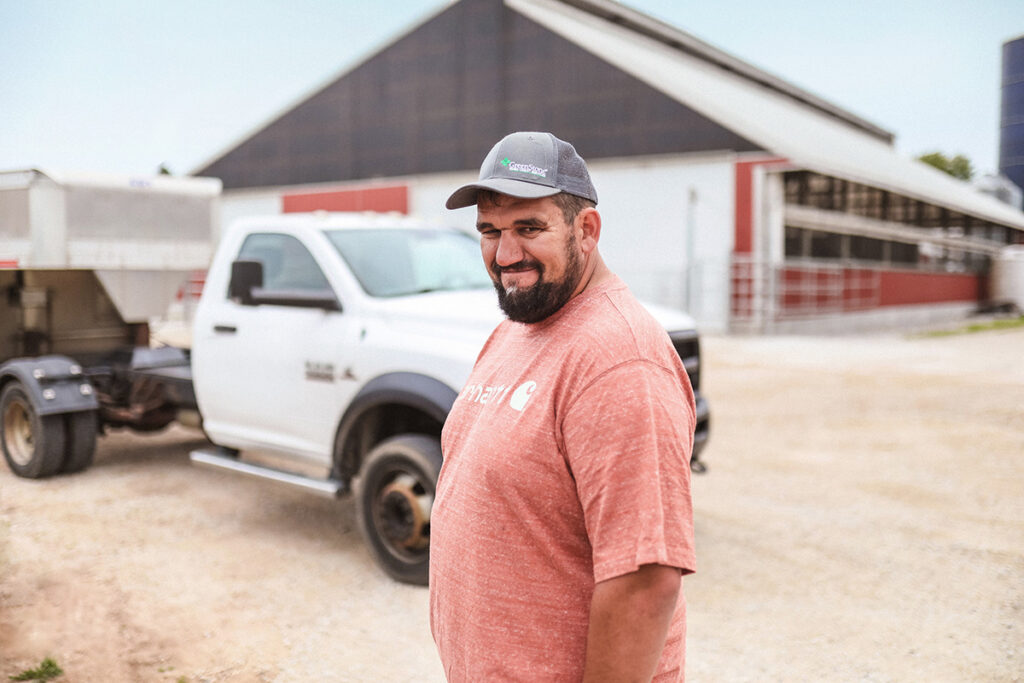

GreenStone recently spoke with Scott Welden, AgDirect Territory Manager, to discuss how members can manage machinery and equipment costs.
Owning every tractor and implement used to farm may be the conventional approach to managing a farm’s machinery lineup. However, that may not be the most economical, and can sometimes have lasting impacts on the bottom line. Leasing, renting or custom hiring work could be a more viable, cost-efficient alternative to outright ownership. In general, both strategies have pros and cons – which one works best for you depends on a few key variables. AgDirect makes it very convenient and easy to purchase, lease and refinance equipment.
“It’s very easy to justify both sides of the decision,” says Scott Welden, AgDirect Territory Manager based in Jonesville, Michigan. “Equipment today is becoming very specialized. It is a balancing act to optimize the use of your resources, capital, labor and time. Those factors all contribute towards determining whether somebody should own or lease equipment or hire custom-work.”
Comparing Costs
A cost comparison is typically the first basis farmers calculate when determining whether to buy, lease, or rent a piece of machinery or finding someone who will do the job for a fee. But, that comparison needs to account for more than just the sticker price and how much capital it requires to get the unit. Hidden costs, that may not be apparent at first glance, often play an important part in the consideration—costs like cash flow, trade-in value variables and soft-costs for associated equipment. These factors should all be accounted for in determining when buying, leasing, or custom hiring is right for your farm’s financial health, according to Welden.
There’s a ripple effect: Some equipment is dependent on other equipment, which may also require additional labor that is added to the overall consideration. The owner of a manure tanker or dragline system, for example, might at first overlook the additional needs required for the equipment and set-up to support the manure application system. Does the existing tractor have the ability to efficiently operate the manure application equipment? Are there other pumps, motors, etc. needed? Likewise, does the dairy farmer have the time and labor needed to get the job done and still manage the rest of the day-to-day farm duties?
“The farmer will have to spend additional capital on that infrastructure and labor to efficiently handle his own manure,” Welden says. For that reason, milk producers may choose to custom-hire a manure handling service.
Helpful tools, like the newest version of AgDirect Mobile, are available for Apple™ and Android™ devices to help with such a task. AgDirect added a new functionality calculating “Cost Per Acre” on a purchase or lease. If you do not have the AgDirect Mobile app downloaded, now is the time to do it.
Cash Flow Considerations
In other cases, cash flow—which can fluctuate for some operations depending on the time of the year—could be a major deciding factor. For example, a custom fieldwork operation may occur during a time of year when capital is limited or being used to plant the crop. In this scenario, the cost of paying a custom operator during the growing season may be more financially burdensome than paying the same amount or more to purchase the equipment and defer payment to a later date. The implications to financing at a later time when cash flow is stronger may outweigh any potential increase in total cost.
“You may have the money to buy inputs, but hiring somebody to custom spray and pay for it in July might not work with today’s cash flow. But, you could buy a sprayer and defer the payments to December,” Welden says. “That allows you to use the equipment during a time of cash flow tightness and delay payment versus paying at the time of service. Cash flow is a big factor and sometimes can be very critical. With AgDirect, our flexibility with payment options and annual installments is very helpful.”
Look ‘Underneath The Financial Statement’
Examples like these underscore the need to closely examine your machinery needs and the costs before you make a decision whether to buy or use custom work. Welden recommends to look “underneath the cost analysis” to throw light on the factors that can impact your operation’s financial health in both cases.
For example, consider the milk producer who handles and applies his own manure vs. the dairy farmer who custom-hires their manure handling. Growers recognize the increased depreciation this task has on their fleet of equipment. “Should the re-sale and trade-in value of the farmer’s line of tractors be considered in the cost analysis… absolutely!” says Welden. Gains or losses associated with trade-in values contribute to the overall cost.
So, what is the best choice between buy, lease or custom hire? It really depends on each operation and its best use to generate the highest return on investment, Welden says. “It is all about asset utilization and using it to its fullest extent—optimizing resources, money, time and human capital.”
When buying or leasing is right for you, be sure to ask your local equipment dealer about AgDirect financing or stop in a branch near you to learn more about GreenStone’s farm equipment loans.
There are many reasons for business owners to develop estate and succession plans. A good plan will allow for competent asset management if the business owner should become incapacitated or die by outlining the manner and timing of asset distributions, this will provide a smooth transfer of assets, manage income and estate taxes, educate the business owner’s beneficiaries, and much more.
It is natural to take life for granted without taking time to think about the possibility of death or becoming incapacitated. Nevertheless, you owe it to yourself and your family to plan how your property will be used after your death.
A good plan will answer the following six questions:
- Who will care for your minor children or aging parents?
- Will the family business continue?
- If you own real estate, does your family wish to keep it and will they have the financial resources to do so?
- Will your spouse be able to live comfortably after your death?
- Will estate taxes consume your family’s security?
- Are there other federal, state, or local taxes, or other expenses, that should concern you?
Estate and succession planning is a set of steps for effective management, enjoyment, and disposition of your property at the least possible cost, both in life and at death. Making a will is a crucial part, but the planning doesn’t stop there. It involves a review of your property ownership, insurance needs and your family business structure.
The planning task can be simplified into five basic steps:
- Begin the dialogue with your beneficiaries
- Develop your objectives
- Compile information
- Seek professional advice necessary to implement a plan
- Update documents as situations change
During this process, it is common to worry that professional advice will be too costly. However, by taking initiative on the first three steps in this process prior to the first meeting with your chosen professionals, you can reduce the expense. Time is valuable for attorneys, tax professionals, and other experts needed to develop a successful plan. Conduct family discussions, set clear objectives, and compile information these professionals will need before employing them.
Many estate and succession plans never get written because death is a sensitive subject. Another problem involves the dynamics of family businesses. Nurturing family values often conflict with the hard decisions necessary to operate a successful business, such as selecting which child will be the future financial manager of the business. Using a third-party consultant to identify and document the skills of each child can mitigate this issue. A good way to start dialogue is to have the entire family attend a community estate and succession planning seminar.
An estate and succession plan should evaluate the need to form a living trust, which will avoid probate court and keep the transfer of assets a private matter since probate estates are public information. The type of entities used to operate the business is also an important issue. The attributes of partnerships, LLC’s, corporations and trusts need to be evaluated to determine the best entities to accomplish your objectives. Selling and/or gifting strategies also need to be considered to ensure the senior generation has a comfortable retirement and the new generation has the resources necessary to continue operating a successful business.
Many people understand the importance of a good estate and succession plan. Getting started is the hardest, yet most important step, so do not procrastinate. Do yourself a favor and get started now! For more help or estate planning resources, contact your local GreenStone branch.
July 17, 1916.
That is the date in history when President Woodrow Wilson signed legislation creating the Federal Land Bank System, what we now know as the Farm Credit System.
One hundred years later, as we reflect on our past and consider the future, it is easy to see how times have changed. We have seen advances in technology, from medicine to cars, computers and more. Our homes and social lives have changed… moving at a faster pace, continually doing more with less. With so many transformations, it is nice to reflect on ‘simpler times,’ remembering American life that now seems so quaint. In fact, it is almost humorous to think that following President Wilson signing the Federal Farm Loan Act, the very first loan made was for just $4,691.66.
What seems like a small amount in today’s economy was enough back then to help a family farm, and lay the ground work for a system that now serves approximately 500,000 borrower-owners across the United States. Members who today, plant and nurture seeds, set country roots and raise families, toil land and maintenance equipment, raise and care for livestock, build barns and milking parlors, and expand storage, packing and processing facilities, all with the help of Farm Credit.
What location is right for us?
Determining the right location begins with an honest discussion about what’s important to you and your family and the lifestyle you lead. Some questions to ask yourself include:
- Is the commute to work manageable?
- Is the school district one that is right for your family?
- What non-work activities are important and are they close by to this location?
- What’s the minimum lot size needed for your family?
- Do you want a rural location or to be closer to town?
These and other similar questions are ones you need to formulate and then prioritize before you begin your search.
Is this home site the right one for us?
Once you have the location figured out, the next step is to identify home site options in the area that are best for you. Not every site is conducive to building your dream home. You will need to determine which is more important, the lot/location or the style of home you wish to build. Your builder can help you in this decision, as you will need to make sure that the home you want to build is possible on the lot or lots you are considering. For example, if the property is flat and you want to build a home with a walkout basement, it may not be possible or it may be at a much higher cost.
Is our dream home affordable on this location?
There are many reasons why a particular location may make your dream home unaffordable by adding costs that would not be factors at another location. This is where you will need to do your homework with the local governing bodies. Questions to ask include:
- Are there zoning restrictions on the type/size/style of home you want to build? Check with the township/sellers to determine if there are potential issues.
- Are there access issues to the property or to the house location on the property that you are considering? Again, the township can help provide an answer.
- Are there restrictions due to environmental concerns, such as water on the property that may result in additional cost/restrictions?
- What site improvements will be needed?
Are proper utilities accessible if we build here?
With the help of your real estate professional or builder, you will need to determine what needs to be done to bring utilities to the property to live the lifestyle you want to lead. Things to consider are:
- What will it take to get electrical power to the property?
- What heat source do you want and what will be required get it, such as natural gas, propane, electric, heat pump or another system?
- Where is the water table in the area and what depth of well will be needed if a public water system is not available?
- What type of septic system will be needed if a public system is not at the location?
Did you consider the homes/properties around you?
Most buyers fully consider the area in which their homesite is located at the present time, but often do not consider the adjoining properties and the future development options of those property owners. For example, if you are considering a location that has undeveloped property around it, could the property be developed into a multi-home complex and would you be OK with that?
Make sure you create your list of questions to ask the seller, the real estate agent, and the township officials. It is also important to look at the property several times and at different times of the day or week. Once you have done your homework, found the right property, and are ready to make an offer, be sure to work with your lender to make sure your dreams are attainable and within your budget!