


At GreenStone, everything we do boils down to our commitment to you — the people and rural communities we serve. As a member-owned cooperative, GreenStone’s success is directly tied to the success of its customers. For us, commitment to our members means standing alongside you year after year, through strong markets and challenging cycles alike. We strive to provide education, resources, and partnerships to help you plan, adapt, and achieve your goals. In 2025, we continued to invest in outreach and engagement efforts focused on supporting and strengthening rural communities, the agriculture and forestry industries, and the people who call Michigan and northeastern Wisconsin home for their families and farms.
CultivateGrowth: Investing in Our Future
Supporting and developing the next generation of operators is critical to securing a strong future for the agriculture and timber industries. We continued to prioritize investment in young, beginning, and small farmers (YBSF) through GreenStone’s own CultivateGrowth program. We remain committed to helping customers at all stages build strong foundations and navigate the challenges inherent in agriculture.
In 2025, GreenStone continued strengthening its partnership with Michigan Farm Bureau and Wisconsin Farm Bureau’s young farmer programming, providing education, leadership development, and networking opportunities that help producers grow through each stage of their operation.
We also maintained strong partnerships with Michigan State University Extension and the United States Department of Agriculture, among many others, sponsoring and helping launch new YBSF resources. These programs reflect our proactive efforts to equip farmers with trusted resources including practical tools and relevant education.
Among the CultivateGrowth program offerings was the launch of the next mentorship cohort, pairing experienced producers with emerging farmers to encourage knowledge sharing and long-term success, and GreenStone’s CultivateGrowth conference where attendees experienced the benefits of networking, education, and laughter together.
Directly supporting students pursuing agriculture education is another way GreenStone continues to support the future of the agriculture industry. In 2025, we awarded nearly $60,000 in scholarships to students pursuing careers in agriculture. This brings our total scholarship contributions since 2010 to more than $550,000.
Strengthening Rural Communities Through All Cycles
Strong rural communities are essential to the success of our members, particularly during periods of change and challenging economic cycles. GreenStone’s commitment to rural resilience extends to every community where our members live, work, and play through education, engagement, and investment.
In 2025, GreenStone invested $1.5 million and provided more than 12,800 service hours with nearly 1,000 organizations that directly impact our members, from local fairs and festivals to producer education and professional development initiatives. Through support of efforts like Michigan’s Sportsmen Against Hunger, we reinforced our commitment to serving the food insecurity in our communities while supporting environmental conservation. In Wisconsin, through support of organizations like the Coleman Police Department and the Clintonville Fire Department, we help ensure first responders are prepared to serve our members.
Hosting construction seminars throughout our territory further provides rural residents, and those looking to relocate to the country, with an opportunity to learn about the construction loan process from our local GreenStone experts. Expanding the opportunity to both the spring and fall seasons in 2025 offered more opportunities for participation at times most appropriate to our members’ needs.
Continued Commitment to the Timber Industry
Like many other agricultural commodities, the timber industry’s distinct challenges, from shifting market demand to regulatory and environmental pressures and input cost disparities, emphasize the importance of our ongoing commitment. Supporting timber producers navigating the economic cycles comes in many facets, from investing in education, to collaboration and industry partnerships that promote long-term success.
In 2025, GreenStone’s annual timber forums provided attendees with industry and mill updates, equipment financing, transition and estate planning, audit preparation, and legislative updates.
We also strengthened partnerships with industry organizations like the Michigan Association of Timbermen, the Forest Resources Association, and the Great Lakes Timber Producers Association. Our commitment to the future of the industry is further reflected through sponsorship of timber scholarships and active participation and sponsor at the Great Lakes Logging Expo.
A Long-Term Commitment to Resilience
GreenStone is a cooperative of more than 29,000 resilient member-owners. By remaining committed through every cycle, proactively investing in education and outreach, and supporting members with the tools they need to succeed, we continue to strengthen the communities we serve – the places we all call home.
After buying their first house in Hancock, Mich., in 2010, Dan and Michelle Seguin vowed their next move would be their last. After a decade and a half filled with lots of life, planning, and hard work, that dream is close to becoming a reality.
Dan and Michelle met as students at Michigan Tech University. They fell in love with the area and knew it was where they wanted to put down roots. They set their hearts on one day building their forever home amid the rugged beauty of the Keweenaw Peninsula.
After an extended season completing degrees in their respective fields – Dan in engineering and Michelle in medicine, the Seguins started their careers years after many of their peers, and with more student loan debt.
Finding a Perfect Property
A few years after buying their first home, Dan and Michelle came across a beautiful piece of property near Houghton. It was exactly what they were looking for, and it was for sale. But it was completely out of their price range. While unable to make an offer, the Seguins kept their eye on the property. It never sold and eventually went off the market. After a few years, they assumed that was that.
But it wasn’t.
“By complete happenstance, I was working with a colleague of mine, and we were just talking about future plans—wanting to get some property, wanting to build a house,” said Dan. “He said, ‘You should talk to my friend Marty.’ And it turns out Marty was the person selling this place we had looked at five or six years earlier.”
The next weekend Michelle came up from Marquette, where she was working at the time, so the couple could see the property together. The 120-acre tract included a bustling trout stream, rustic cabin, and endless potential.
“It was absolutely perfect,” said Dan.
Dan and Michelle knew they didn’t want to let the property slip away for a second time.
“By not going through a realtor, we saved some money, and by us being in a better financial position, we were able to work directly with Marty and with GreenStone to close on the property,” said Dan.
Working for a Dream
In spring of 2024, Dan reached out to GreenStone again, this time to discuss a construction loan. Amber Hanson, Dan and Michelle’s financial services officer, helped them put their goals into perspective and make a plan for achieving them.
Approval didn’t happen overnight. It started with early, transparent conversations about where the Seguins were financially—and where they needed to be. Initial construction loan conversations revealed a gap between the home they envisioned and what their finances could support.
“We looked at it right then as a snapshot—this is where you are, this is what your debt is, this is what your income is, and this is what we can do,” said Amber. “At that point, the loan amount was not going to get them to where they wanted to be.”
For more than a year, Amber worked with Dan and Michelle as they focused on paying off debt in pursuit of qualifying for a construction loan at an amount that would allow them to build the home they wanted.
“We started looking at things line item by line item. … He (Dan) would call and say, ‘Hey, just so you know, we paid off this and this and this.’ And I’d say, ‘OK, here’s where you’re at now—debt-to-income wise, it’s moving in the right direction,’” said Amber.
Using the equity from their recreational land loan and knowing the Seguins would be selling their home in town after construction was completed, they were approved. Soon after, the biggest hurdle in the Seguin’s journey nearly derailed it all together.
The first appraisal for the construction loan came back dramatically lower than was expected. The news took an emotional toll on the Seguins.
Amber pushed for a second appraisal. This time, the property was broken into a 40-acre tract where the home would be built and a separate 80-acre tract. By separating the land into two tracts the appraisal came back where it needed to be for Dan and Michelle to move forward.
“When the second appraisal came back, it was like Christmas Day,” said Amber as she recalled the Seguins’ excitement.
“We had quite a few little adjustments along the way and small little hiccups like you always do with such a project,” said Dan. “She (Amber) was awesome to work with through the entire process, and I give her great credit for working with us and being patient with us and helping us along the way.”
Building a Forever Home
Construction on the Seguins’ forever home began in September of 2025 and is expected to be completed by early summer of 2026. After the long journey to get to this point, Dan and Michelle were thrilled with how quickly the home has taken form – especially in the often-unforgiving fall and winter seasons of Michigan’s upper peninsula.
“To think that on September 1 it was just a hole in the ground—and now it’s fully sealed in—is pretty amazing,” said Dan. “You can stand in the skeleton of the house right now and see where life is going to happen.”
“Every time I get a text message with a picture (of the progress), I’m just so happy for them,” said Amber. “I’m really so, so, so happy that it worked out for them… and just really thankful that I have them as my customers.”
The Christmas season is uniquely meaningful to Dan and Michelle. They were engaged around Christmas in 2008. Nearly two decades later, they celebrated their last Christmas at their home in town and got a taste of their new life in the country. With the porch of their new home completed, they had the opportunity to sit in lawn chairs over the 2025 Christmas and watch their son Oliver sled down the driveway like he will do for years to come.
“This is what it is going to be like,” Dan recalled thinking in that moment. “Every Christmas is going to be like this.”
Courtney Walsh is partnered with her brother, Calob Crumbaugh, and the rest of her family with C&W Farm Services. The farm operation raises corn, soybeans, and wheat. They formed the LLC with the long-term goal of expanding their services, like incorporating drone application technology into their farming practices. Their focus is improving efficiency and crop yields through innovation, while continuing to build on the foundation of their family farm.
As their operations grew, they started thinking more seriously about expanding into drone services. Initially, the certification process felt overwhelming because of all the required paperwork and licensing. However, in 2025 they committed to completing all the necessary certifications and legal requirements so they could move forward confidently and legally with drone applications.
Working with GreenStone since 2019, it wasn’t until Walsh attended GreenStone’s CultivateGrowth conference where she was encouraged to apply for the CultivateGrowth grant. She found it to be a straightforward application process. “The first time I submitted it, there was a technical issue and it didn’t go through, but the team was incredibly helpful and forgiving. Courtney Ross [CultivateGrowth program manager] assisted me through the process, and it ended up being very smooth.”
Building skills to fly forward
She used the grant money towards commercial pesticide licensing, including study materials and books, drone certification coursework, and other remote pilot licensing requirements. To legally operate the drone for agricultural spraying, you must complete both pesticide certification and drone pilot certification. The funding helped them make that process financially manageable.
Some portions of the training were in-person, while others were self-paced. “I learned a lot of self-motivation and discipline with the online courses because there were no harsh deadlines so it was up to me to keep myself accountable if I wanted to complete it the best I could,” Walsh added.
She gained a much deeper understanding of the drone industry from doing these courses. The certifications were essential for them to begin applying fungicide to their wheat using a drone. Traditionally, when using a ground sprayer, the tires run over portions of the wheat crop, which can reduce yields. With a drone, there is no crop damage from equipment running through the field, which promotes higher yields. “The drone also allows us to spray fields that are harder to navigate with traditional equipment,” she noted.
Their goal is to eventually complete all their fungicide applications using the drone. They are still in the early stages, but they expect to see more measurable yield improvements over the next growing seasons as they fully integrate the technology.
Walsh says she wants to encourage others to attend the conferences and seminars and put themselves out there.
“This grant came from a simple networking opportunity, and it has been incredibly valuable to us. We truly appreciate GreenStone and their continued support for our farm and business growth,” Walsh said.
If you are interested in seeing what growth opportunities are available to you, click here to learn more about the CultivateGrowth grant.
Earlier this month, we wrapped up our spring construction seminars. These in-person and online sessions allow our team of experts to share their knowledge and insights into the home construction process. Our goal is to help you make informed decisions as you navigate the journey of building your dream home! If you didn’t get the chance to attend one of our seminars, here are some of the most frequently asked questions we received and our answers.
Timelines for Pre-Approval & Construction
Q: How long is my pre-approval for a home construction loan valid for?
A: Credit reports and pre-qualification are valid for 90 days. After loan approval, borrowers generally have another 90 days to close. The total timeline from application to closing may be up to 180 days depending on the timing.
Q: How soon should I start the loan approval process?
A: Ideally, borrowers will begin taking steps before closing on their loan – about 60-90 days before construction begins. This will give your financial services officer time to help you estimate the affordability of the project and plan construction costs.
Q: What is the timeline for completing the construction of my home with a loan from GreenStone?
A: Construction loans with GreenStone are structured within a 12-month build period.
Q: What happens if the construction of my home takes longer than 12 months?
A: Principal and interest payments begin at the 12-month mark. If construction goes past 12 months, borrowers can request a 90-day construction agreement extension. Extensions allow you to continue requesting draws during construction and typically have a fee of 0.25% of your loan amount.
Q: When is the construction of my home considered complete?
A: Construction of your home is considered complete once you have a Certificate of Occupancy and GreenStone has completed the final inspection.
Construction Costs
Q: Why does GreenStone recommend a $180 per square foot minimum for my DIY construction project?
A: The $180 per square foot minimum for DIY construction is intended to ensure there are enough funds set aside to build the home. Similarly, the recommended minimum when building a contracted home is $200 per square foot.
Q: How do I calculate the value of my construction project’s square footage?
A: To calculate your project’s square foot value, divide the total contracted amount price listed on your sworn statement by your build’s total number of square feet.
Q: Does the square foot value of my project include the value of the land, garage, or basement?
A: No, the value only applies to the livable square footage of your project, not the land value. Unfinished spaces, such as garages and basements, are generally not factored into the per-square-foot calculation.
Construction Loan Draw Process
Q: What is a construction loan draw?
A: A draw is a request you or your general contractor will make to GreenStone to release the funds needed to complete the next step in the construction process.
Q: How are draws scheduled?
A: Draw requests will be submitted using a sworn statement outlining the expenses. If you are acting as your own general contractor, you will work with your GreenStone construction disbursement specialist to request the funds for each line item listed on your sworn statement.
Q: How do I request a draw myself for a DIY construction loan?
A: To request a draw, you will need to submit your updated sworn statement form as well as any lien waivers from previous draws. This documentation verifies work that has already been completed so GreenStone can release the funds for the next step in the construction process. Watch this informative video on how to request a draw!
Using Equity, Land, and Other Assets
Q: Can equity from another property be used for my down payment on my construction loan?
A: Yes, you can use additional real estate as collateral to help meet down payment requirements.
Q: Is land included in my appraisal of the construction project?
A: Yes, land value is included in your appraisal and loan-to-value calculation.
Q: Can a land loan from another lender be rolled into the construction loan?
A: Yes, existing land loans from other institutions usually must be rolled into the construction loan at closing.
Paying Interest and Rate Conversions
Q: Will I pay interest on my full loan amount during construction?
A: No, you will only pay interest on the funds that have been already drawn for the construction project. If no funds have been used yet, little to no interest is owed. If land loans or initial draws are included at closing, interest would begin on those amounts immediately.
Q: How will my down payment affect interest charges?
A: Down payments are used first before loan funds, meaning borrowers do not pay interest on their own money.
Q: Does GreenStone offer interest rate conversions?
A: Yes, an interest rate conversion is available for qualified borrowers. The fee for an interest rate conversion, is generally about 0.25% of the loan balance, and your financial services officer will help evaluate whether a conversion provides enough rate savings to justify a fee.
Loan Management After Construction
Q: Are there any prepayment penalties?
A: No, there is no prepayment penalty.
Q: Can I make a large payment on my construction loan after selling a previous home?
A: Yes, borrowers commonly sell their previous home after construction and apply the proceeds towards the construction loan.
Q: Can my construction loan be re-amortized?
A: Yes, loans can be re-amortized to reduce monthly payments after a major principal payment. This process typically does not include any additional fees.
Patronage and Member Benefits of Working with GreenStone
Q: What is Patronage?
A: Patronage is the return of a significant portion of our profits back to our members in the form of Patronage dividend checks. Learn more here!
Q: What amount can I expect to get back in Patronage each year?
A: Your Patronage payment is based on the net interest income earned on your loan by GreenStone. Return amounts vary, but often effectively reduce a borrower’s interest rate by about 0.5-0.75%.
Q: How will I be supported by GreenStone through the home construction process?
A: We have decades of experience in home construction financing to help bring your plans to life. As your trusted financial partner, GreenStone will never sell your loan. Our dedicated team of experts are here for you every step of the way from loan application to final payment! Click here to contact your local GreenStone branch.
The journey of turning your dream home into reality can be both exhilarating and overwhelming. Whether you’re just beginning to explore the home building process, or you’ve already laid out your plans, navigating the numerous choices can be a daunting task. We are here to help you each step of the way!
Be on the lookout for future construction seminars near you.
Did you know an Enhanced Coverage Option (ECO) as a part of your existing crop insurance policy can provide stability against falling commodity prices and a higher revenue floor? ECO is a cost-effective risk management tool that offers additional Revenue or Yield Protection.
ECO crop insurance coverage explained
ECO is an area-based band of coverage that attaches to your existing eligible crop insurance policy. ECO crop insurance coverage provides two coverage levels to choose from: 86-90% or 86-95% depending on your specific needs. It is typically taken at 95% coverage level, meaning even a small drop in revenue, price and/or yield would trigger an indemnity payment. The ECO endorsement matches your underlying policy and is typically measured by the levels in your county. For example, if a producer chooses Revenue Protection, then the indemnity is county revenue based. If a producer chooses Yield Protection, then ECO indemnity is county yield based.
How ECO works
This supplemental coverage option works especially well in a situation where county revenues dip, but not enough to trigger a Revenue Protection claim. Producers without ECO can sustain considerable damage in their production area before their individual policy indemnifies. With ECO however, producers can receive a payment when the area has more than a 5% (depending on elected coverage level) decrease in expected revenue, even if they are individually experiencing a bumper crop that year.
Similarly, if grain prices dip lower than the revenue floor established by a producer, they can wait to market the grain as the insurance is offsetting losses. Because ECO is revenue based, it also can generate an indemnity if county yields dip causing revenue to fall. Producers who typically track count yields should especially consider ECO as it provides an indemnity from falling county-based revenue.
Why to consider ECO
The ECO subsidy is increasing from 44% in 2024, 65% in 2025, to 80% subsidy in 2026, making this an even more cost-effective strategy to mitigate risk and provide coverage to your crops.
Take a look at the table below to see how ECO will be an even more affordable option for providing additional coverage in 2026.
| Example at 95% Coverage Level | 2024 | 2025 | 2026 |
| Coverage | $70 | $70 | $70 |
| Subsidy | $16.81 | $20.89 | $25.71 |
| Estimated farmer premium | $21.39 | $11.25 | $6.43 |
The estimated premium for 2026 has declined by a large amount due to large increases in government subsidy. This is primarily a result of the increased subsidy as well as the change in corn prices. For those who have considered ECO in the past but have been hesitant due to cost, now is a great opportunity to see how this additional coverage can benefit your operation in the coming year.
How can ECO be purchased?
If you are interested in obtaining ECO coverage, the first step is to reach out to your GreenStone crop insurance specialist to evaluate what coverage would benefit your operation most. To obtain an ECO policy, you will need an underlying buy-up policy for corn or soybeans. Our team of dedicated crop insurance specialists can help you understand your area’s historical analysis by looking at your county’s ECO performance over the past years.
Our exclusive quoting tool can also help give you the information you need to make data driven decisions that will positively impact your business.
If you have questions on ECO crop insurance options and whether it would be a good fit for your farm, don’t hesitate to reach out to your local branch!
For Adam Weinrich, growth means more than expanding production. It means building a business with intention. With support from the CultivateGrowth Grant, he invested in business education that is now shaping the future of his livestock operation.
Founded in 2020, Adam’s farm is a pasture-based, multi-species livestock farm focused on direct-to-consumer sales. He raises pigs, cattle, and other livestock while prioritizing outdoor systems and responsible land stewardship. Rather than selling through traditional distributors, he manages his own distribution system serving both retail and wholesale customers.
Although Adam grew up in rural areas and spent time on a small homestead in Big Rapids, Mich. he did not have extensive agricultural experience before launching the farm with his wife. Like many beginning farmers, he has relied on learning opportunities to strengthen his business foundation.
Always seeking for ways to improve, Adam discovered the CultivateGrowth Grant online and has applied the past three years.
“We’re always looking for ways to fund and grow our business,” Adam said. “We’ve applied for many grants, and this one is one of the easiest out there.”
With the grant, Adam attended a multi-day Food Sales and Leadership training at Zingerman’s in Ann Arbor, Mich. The nationally recognized food business is known for achieving something rare in the industry, which is maintaining high quality at high volume without franchising.
The training introduced Adam to the tools, systems, and philosophies behind that success. A key takeaway was Zingerman’s “12 Natural Laws of Business,” which emphasize sustainable growth, realistic planning, and strong leadership.
One principle stood out to Adam in particular. “If you want your employees to provide great service, you have to provide great service to your employees first,” Adam shared.
The seminar also challenged him to create a written vision for the future of his farm. This included clearly defining what the business should look like physically, operationally, and culturally. That exercise has helped him build a more focused and actionable plan while strengthening employee training systems that support long-term success.
“We want to grow the same way Zingerman’s have. With intention and without losing what makes our business special,” Adam said. “Programs like the CultivateGrowth Grant make that possible.”
Adam’s experience highlights exactly what the CultivateGrowth Grant is designed to do, which is to equip farmers with practical tools, leadership training, and business strategies that create lasting growth.
Ready to invest in your operation? Learn how GreenStone’s CultivateGrowth Grant can help you take the next step by clicking here.
If you’re considering acting as your own general contractor for your home construction project, chances are you’ve already started to familiarize yourself with the documentation that will be required along the way. One of those documents is the sworn statement form, which is used throughout the duration of the home construction process. Whether you’re contracting out the project or doing the work yourself, understanding the sworn statement will benefit you throughout the entirety of your home construction.
What is the sworn statement?
The sworn statement is a detailed, itemized breakdown of each step in the construction process. It tracks everything from the architectural services to foundation work, building materials, appliances, furnishes, and fixtures installed.
Its main purpose is to ensure all subcontractors and suppliers have received payment for the services provided in the construction of your home. It also protects the property owner from unexpected mechanics liens, so you don’t pay for the same service twice!
When is the sworn statement used?
The sworn statement is not a one-time form. It will initially be introduced at the beginning of your construction project and will be updated and resubmitted each time you make a draw request. A draw is a request to your lender to release the funds needed to complete the next step in the construction process. Click here to learn how to request a draw.
What will your sworn statement track?
The sworn statement will track:
- Funds disbursed
- Your remaining loan balance
- Payments made to subcontractors
It also tells the title company which lien waivers are required at each stage.
Who completes your sworn statement?
If you are acting as your own general contractor, you will be responsible for completing the sworn statement yourself. For contracted builds, the builder will complete and submit the sworn statement.
If you are considering acting as your own general contractor, make sure you are comfortable taking on the responsibility of managing the construction process, including submitting the sworn statement. While it is entirely possible to manage your own construction project, ask yourself how organized, detail-oriented, and confident you are using applications like Microsoft Excel, which is required when using the sworn statement form provided by GreenStone.
Using the sworn statement form provided by your lender is not mandatory but can help make the process smoother by ensuring consistency. Your title company and construction disbursement specialists will already be familiar with the lender’s format, which can help avoid confusion.
How to complete and submit your sworn statement
1. When applying for your home construction loan with GreenStone, you will need to provide an accurate estimate of the costs of each service. First, you will obtain quotes from any contractors or subcontractors. List any contractors you plan to use in the Subcontractor and Supplier column of the form.
2. The material and labor costs will be listed in the Total Contract Price column. While vendors and materials may change later throughout the project, the initial estimates must be realistic and completed prior to your first draw.
3. Once your loan paperwork has been signed and you have received your first draw, you will make a manual entry into the Amount Currently Owing column for the amount you are requesting for each part of your project. This will total at the bottom each time the form is edited. You will then sign the form with a notary, and provide the form to your team at GreenStone, and the title company.
3. After receiving the funds for your draw, and paying subcontractors or suppliers, you will move the amount you received over to the Amount Already Paid column, keeping accurate record of the amount paid with lien waiver forms and receipts. This paperwork is a crucial part of your loan process and will need to be provided to GreenStone and your title company before you take another draw.
4. If the actual cost of a service differs from what was estimated in your initial quote, an adjustment can be made in the Adjustment Change Order column. The Current Contract Price column will automatically adjust with these updates.
5. Finally, the Balance to Complete column will keep a running total of the remaining costs to complete your project. The total balance in this column should never exceed the funds you have available with GreenStone.
Watch a step-by-step example of completing a sworn statement below:
GreenStone provides different sworn statement versions for:
- Site-built homes
- Pole barns
- Modular homes
Sworn statement forms from GreenStone vary by state for Michigan and Wisconsin.
Your GreenStone team is here to help
Whether you’re considering acting as your own general contractor or not, the home construction process can seem daunting, but it is also a very rewarding experience. If you have questions about the sworn statement or other construction documents, your team at GreenStone is here to help! Reach out to your construction disbursement specialist at any time or contact your local branch to get started with the home construction process.
On July 4, 2025, the One Big Beautiful Bill (“OBBB”) was signed into law to extend, enhance and, in some cases, make permanent some of TCJA’s tax law changes. At the federal level, a couple of significant provisions for farmers were:
- Bonus depreciation was reinstated to 100% and made permanent for now. Be sure to note this is for qualified capital expenditures acquired and placed in service after January 19, 2025. Qualified property purchased prior to January 20, 2025, are only eligible for a maximum of 40% bonus depreciation, even if not placed into service until after January 19, 2025.
- Section 179 allowed expense was permanently increased to $2.5 million for eligible property purchased and placed into service during tax years beginning after December 31, 2024. The investment purchase phaseout threshold was increased to $4 million for property placed in service in years beginning after 2024, with the allowed section 179 expense decreasing dollar-for-dollar as the investment amount during the tax year approaches $6.5 million, the level of being fully phased out.
These are two of the most significant levers farmers use to manage taxable income due to the capital-intensive nature of farming.
So why am I writing about this again? Well – there are state issues to consider. On October 7, 2025, Michigan’s Governor Gretchen Whitmer signed House Bill 4961 into law, enacting significant changes to the state’s tax code. This legislation formally decouples Michigan from several key business provisions of the OBBB – this article will focus on the decoupling around depreciation.
What does “decoupling” mean?
State “decoupling” occurs when a state chooses not to follow certain provisions of the federal Internal Revenue Code (IRC). Many states conform to the IRC on a rolling basis as it is enacted to simplify tax compliance. Decoupling allows states to diverge on specific federal laws for state tax purposes. This affects the calculation of income tax at the state level and generally does not change a taxpayer’s federal tax obligations. Federal taxable income remains determined by federal law; however, additional planning may be needed at the state level.
Michigan has historically been a rolling conformity state meaning it typically follows the IRC when federal law changes occur. This decoupling from certain OBBB provisions is a tremendous change. You will want to make sure you understand the impact of the change for state income tax purposes. Michigan farmers cannot complain too much though; our neighbors in Wisconsin have been working through no state tax bonus depreciation for years.
Effect of Michigan decoupling related to depreciation methodologies
For our farming customers, Michigan’s decoupling results in them no longer having the leverage of the following OBBB federal provisions for calculating their state taxable income for tax years beginning after December 31, 2024:
- Bonus Depreciation: Taxpayers can no longer fully deduct 100 percent of eligible equipment costs in the first year for state tax purposes. Michigan does allow bonus depreciation for all taxpayers other than C-Corporations of 40% for the year ending December 31, 2025, which was the pre-OBBB rule in place.
- Section 179 Expensing: Michigan retains pre-OBBB expensing limits, such as the lower cap of $1.25 million, even if federal limits are higher. The same effect occurs with the investment phaseout threshold retained at the pre-OBBB amount starting at $3.13 million and fully phasing out the Section 179 available amount once eligible investment purchases exceed $4.38 million.
The below example illustrates a farming sole proprietorship entity; however, the decoupling provisions apply to all business taxpayers who benefit from the OBBB provisions.
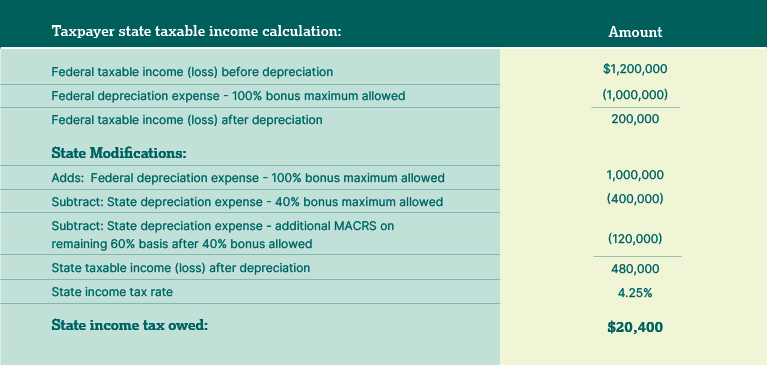
Example – Michigan Decoupling from OBBB’s Federal Bonus Depreciation
Scenario: Taxpayer is a Michigan 1040 Schedule F taxpayer that purchased and placed in service new five-year MACRS property, after January 19, 2025, totaling $1,000,000. This simplified example assumes there is no carryover depreciation available on fixed assets in service prior to December 31, 2024.
Federal Tax Effect: The OBBB will allow 100 percent bonus depreciation for qualified property acquired and placed in service after January 19, 2025.
- Taxpayer claims 100 percent depreciation on the $1,000,000 in assets in 2025.
- Federal depreciation deduction for 2025: $1,000,000
- Federal taxable income impact: Full $1,000,000 is deducted in 2025.
Michigan Tax Effect: Michigan has decoupled from IRC Section 168(k) 100% bonus depreciation as enhanced by the OBBB and reverts to the original 40% phased-down amount for the 2025 period due to following the provisions in effect as of December 31, 2024. Thus, when the individual calculates their Michigan individual income tax, federal taxable income will be adjusted by the unallowed increase of federal bonus depreciation at the state level.
Navigating uncertainty surrounding a State’s OBBB decoupling
Your situation is likely not as cut and dry as the one presented, but it gives a basic example of how the depreciation decoupling would work. As you can see in the above example, while Michigan decouples from federal depreciation methodologies in the OBBB, you can still take state bonus depreciation of 40% on assets placed in service in 2025 – which was the pre-OBBB tax law. Additionally, Michigan taxpayers can also utilize Section 179 expense, limited to $1.25 million in 2025. In this scenario, if the taxpayer wanted their Michigan taxable income to closely match their federal taxable income, their tax preparer could utilize Section 179 expense on the remaining basis and try to get them aligned.
Limitations with Section 179 include the $1,250,000 maximum expense and that Section 179 depreciation cannot take a business activity into a taxable loss situation.
With Michigan decoupling from several significant provisions of the OBBB, it is critical that proactive planning and additional time spent preparing your tax returns is taken to avoid unnecessary tax liabilities. Make sure you are an advocate for yourself this tax filing season – talk to your tax preparer and ensure that all methodologies available are considered to get you to where you want to be from an income tax standpoint this year and into future years.
This article was originally published in Michigan Farm News.
Mary and Doug Campbell of Campbell Crossing Farm are proof that the CultivateGrowth Grant can transform a farm’s future. With support from GreenStone, they invested in education and resources that will help them expand their community supported agriculture (CSA) program and improve efficiency for years to come.
Campbell Crossing Farm was founded in the summer of 2022. In 2022, Mary quit her corporate job to become a full-time farmer and stay at home mom. The farm is a fruit and vegetable farm that focuses on soil health regenerative agriculture practices and supporting local food access through non-profit partnerships and supplying high quality fresh food to local establishments.
While Mary and Doug’s passion for farming started in 2022, it was the CultivateGrowth Grant that gave them the tools and education to take their farm to the next level. In 2025, they launched their farm share program, also known as CSA, supplying 20 local families with fresh fruit and vegetables all summer.
Mary and Doug were introduced to the CultivateGrowth Grant as new farmers building their farm. More recently they utilized the grant funds to help pay for an all-day conference in Traverse City with Jean Martin Fortier, a leader in organic market gardening, along with other educational resources. With support from the grant, the Campbells immersed themselves in this hands-on learning opportunity.
“We were able to tour a working vegetable farm and see their operation and listen to JM Fortier share great advice on how to become a better farmer,” Mary said. “He supplied us with some resources which then led us to the final use of the grant for me, The Market Gardener masterclass that JM Fortier created. The final funds from my husband’s grant were used for some Cornell Small Farms study courses and the farm financial book, ‘The Farmer’s Office’ to help us grow the business.”
To build both production and business capacity, they turned to the Cornell Small Farms program, which offers courses spanning agricultural business, start-up essentials, and production practices. They chose accounting with QuickBooks, vegetable production for integrated disease management, and high tunnel production to extend their season.
The Market Gardening masterclass became a comprehensive guide for what comes next. “It goes in depth on how to extend our season, build out our own tools for better efficiencies, or even how to build your own buildings on the farm, such as a wash and pack station. It truly covers every aspect on how to successfully operate your market garden,” said Mary.
Looking ahead, the couple is energized by what they learned. “The seminar filled us with hope that with some time management and simple practice changes we will become more efficient on our farm,” Mary reflected. “It all comes down to time, so we decided to invest our time in learning this year and implementing those learnings. Without the help of GreenStone, this wouldn’t be possible.”
Mary shared, “We know knowledge is power and we are so thankful we were able to get funds from Greenstone’s CultivateGrowth program to participate in the seminar, masterclass, and take other courses online. We will have access to these resources for years to come.”
Mary and Doug’s story show what is possible with the CultivateGrowth Grant. Ready to grow your farm? Click here to learn more about your possibilities with GreenStone.
Visit GreenStone’s Facebook page from January 29 to February 5, 2026, for your chance to win two tickets to the 2026 Spartan Stampede Rodeo!
Participation in the giveaway is simple: visit GreenStone’s Facebook page from January 29, 2026, to February 5, 2026, and comment the name of who you would take to the rodeo on our designated Facebook post. After you submit your comment, you will automatically be entered in a random drawing to win the pair of tickets! Two (2) winners will be selected, and each winner will receive two (2) tickets to the 2026 Spartan Stampede Rodeo from February 13-15, 2026.
Here’s what you need to know:
- The contest begins with a social media post on January 29, 2026, and will conclude on February 5, 2026, at 9 AM EST.
- Two (2) tickets will be given away to two (2) lucky, random participants.
- Participants do not need to make any purchases to enter.
- Participants must be 18 years or older to participate.
- Participants must live in Michigan or Wisconsin to be eligible to win.
- In order to receive the prize, winners must contact GreenStone via Facebook private message by February 12, 2026, and provide their contact information.
[More details in the official rules below]
GreenStone Farm Credit Services is a proud sponsor of the MSU Rodeo Club. Learn more about the upcoming event: Spartan Stampede – MSU Rodeo Club
Join us on Facebook to enter!
_______________________________________________________________________________________________
Official GreenStone 2026 Spartan Stampede Rodeo Sweepstakes Rules:
NO PURCHASE IS NECESSARY TO ENTER OR WIN. A PURCHASE DOES NOT INCREASE THE CHANCES OF WINNING. The promotion is in no way sponsored, endorsed, administered by, or associated with Facebook.
- Eligibility: This Sweepstake is open only to those who participate by commenting on the GreenStone Farm Credit Service’s Facebook page (@GreenStoneFCS) under the specific Sweepstake post during the specified time frame and who are 18 years of age or older as of the date of entry. The Sweepstake is only open to legal residents of Michigan and Wisconsin and is void where prohibited by law. Once a participant of a GreenStone contest has been selected as a winner, participants are prohibited from winning all future GreenStone contests. Employees of GreenStone Farm Credit Services, its affiliates, subsidiaries, advertising and promotion agencies, and suppliers, (collectively the “Employees”), and immediate family members and those living in the same household of Employees are not eligible to participate in the Sweepstake. The Sweepstake is subject to all applicable federal, state, and local laws and regulations. Void where prohibited.
- Agreement to Rules: By participating, the Sweepstake participant (“You”) agree to be fully and unconditionally bound by these Rules, and You represent and warrant that You meet the eligibility requirements. In addition, You agree to accept as final and binding the decisions made by GreenStone Farm Credit Services as it relates to the terms and conditions of this Sweepstake.
- Sweepstake Period: Entries will be accepted online starting with the Facebook Sweepstake post on January 29, 2026. Entries can be submitted until February 5, 2026, at 8:59 AM EST. The randomly selected winner will be drawn and notified on February 5, 2026.
- How to Enter: The Sweepstake must be entered by commenting on the designated post as directed on the GreenStone Farm Credit Services Facebook page at https://www.facebook.com/GreenStoneFCS. Comments that are incomplete or do not adhere to the rules or specifications may be disqualified at the sole discretion of GreenStone Farm Credit Services. You must provide the information requested. You may enter one comment/entry per post per the life of the contest. Multiple comments will not increase your odds of winning, as GreenStone Farm Credit Services will base its selection on the first comment You made. If you use fraudulent methods or otherwise attempt to circumvent the rules, your submission may be removed from eligibility at the sole discretion of GreenStone Farm Credit Services.
- Prizes: Two (2) Winners will be chosen by random from the comments and each Winner will receive two (2) tickets to the MSU Rodeo Club’s 2026 Spartan Stampede. Actual/appraised value may differ at the time of prize award. Greenstone Farm Credit Services shall solely determine the specifics of the prize. No cash or other prize substitution shall be permitted except at GreenStone Farm Credit Services’ sole discretion. The prize is nontransferable. Any and all prize-related expenses, including without limitation any and all federal, state, and/or local taxes, shall be the sole responsibility of Winner. No substitution of prize or transfer/assignment of prize to others or request for the cash equivalent by Winner is permitted. Acceptance of prize by Winner constitutes Winner’s permission granted to GreenStone Farm Credit Services to use Winner’s name, likeness, and entry for purposes of advertising and trade without further compensation, unless prohibited by law.
- Odds: The odds of winning depend on the number of eligible entries received.
- Winner Selection and Notification: Two (2) Winners from the Sweepstake post will be chosen at random by GreenStone Farm Credit Services. Two (2) Winners will be notified in the comments of the Facebook post on February 5, 2026, at 9 AM EST; Sweepstake comments will be eligible for the life of the contest. GreenStone Farm Credit Services shall have no liability for Winners’ failure to receive notices due to Facebook notifications, spam, junk email or other security settings or for Winners’ provision of incorrect or otherwise non-functioning contact information. If the Winners cannot be contacted, are ineligible, or fail to claim the prize by February 12, 2026, the prize may be forfeited. The Winners must contact GreenStone Farm Credit Services via Facebook private message with their name, email, and phone number by February 12, 2026, to receive the details of redeeming their tickets. Receipt by Winners of the prizes offered in this Sweepstake is conditioned upon compliance with any and all federal, state, and local laws and regulations. ANY VIOLATION OF THESE OFFICIAL RULES BY A WINNER, AT GREENSTONE FARM CREDIT SERVICES’ SOLE DISCRETION, WILL RESULT IN WINNER’S DISQUALIFICATION AS WINNER OF THE SWEEPSTAKE, AND ALL PRIVILEGES AS WINNER WILL BE IMMEDIATELY TERMINATED.
- Rights Granted by You: By entering this Sweepstake, You understand and agree that GreenStone Farm Credit Services, anyone authorized to act on behalf of GreenStone Farm Credit Service, and GreenStone Farm Credit Services’ licensees, successors, agents, and assigns, shall have the right, where permitted by law, to print, publish, broadcast, distribute, and use in any media now known or hereafter developed, in perpetuity and throughout the world, without limitation, your entry, name, portrait, picture, voice, likeness, image, statements about the Sweepstake, and biographical information for news, publicity, information, trade, advertising, public relations, and promotional purposes, without any further compensation, notice, review, or consent.
- By entering this Sweepstake, You represent and warrant that your Facebook Sweepstake comment is your original comment and does not violate any third party’s proprietary or intellectual property rights. If your Facebook comment infringes upon the proprietary or intellectual property right of another, You will be disqualified at the sole discretion of GreenStone Farm Credit Services. If the content of your Facebook comment is claimed to constitute infringement of any proprietary or intellectual proprietary rights of any third party, You shall, at your sole expense, defend or settle against such claims. You shall indemnify, defend, and hold harmless GreenStone Farm Credit Services from and against any suit, proceeding, claims, liability, loss, damage, costs or expense, which GreenStone Farm Credit Services may incur, suffer, or be required to pay arising out of such infringement or suspected infringement of any third party’s right.
- Terms & Conditions: GreenStone Farm Credit Services reserves the right, in its sole discretion, to cancel, terminate, modify or suspend the Sweepstake should any virus, bug, non-authorized human intervention, fraud, or other source beyond GreenStone Farm Credit Services’ control, corrupt or affect the administration, security, fairness, or proper administration of the Sweepstake. In such case, GreenStone Farm Credit Services may select the Winner from all eligible Facebook comments received prior to and/or after (if appropriate) the action taken by GreenStone Farm Credit Services. GreenStone Farm Credit Services reserves the right, in its sole discretion, to disqualify any individual who tampers with or attempts to tamper with the entry process, administration or operation of the Sweepstake, or website, or violates these Terms and Conditions. GreenStone Farm Credit Services has the right, in its sole discretion, to maintain the integrity of the Sweepstake, to void Facebook comments for any reason, including, but not limited to: multiple Facebook comments on same post from the same user from different IP addresses; multiple Facebook comments from the same computer in excess of that allowed by Sweepstake rules; or the use of bots, macros, scripts, or other technical means for entering. Any attempt by an entrant to deliberately damage any website for the purpose of undermining the legitimate operation and administration of the Sweepstake may be in violation of criminal and civil laws. Should such attempt be made, GreenStone Farm Credit Services reserves the right to seek damages to the fullest extent permitted by law.
- Limitation of Liability: By commenting on a Sweepstake post, You agree to release and hold harmless GreenStone Farm Credit Services and its subsidiaries, affiliates, advertising and promotion agencies, partners, representatives, agents, successors, assigns, employees, officers, and directors from any liability, illness, injury, death, loss, litigation, claim, or damage that may occur, directly or indirectly, whether caused by negligence or not, from: (i) such entrant’s participation in the Sweepstake and/or his/her acceptance, possession, use, or misuse of any prize or any portion thereof; (ii) technical failures of any kind, including but not limited to the malfunction of any computer, cable, network, server, hardware or software, Facebook page, or other mechanical equipment; (iii) the unavailability or inaccessibility of any transmissions, telephone, or Internet service; (iv) unauthorized human intervention in any part of the entry process or the Sweepstake; (v) electronic or human error in the administration of the Sweepstake or the processing of comments.
- Disputes: THIS SWEEPSTAKE IS GOVERNED BY THE LAWS OF THE UNITED STATES OF AMERICA AND THE STATE OF MICHIGAN, WITHOUT RESPECT TO CONFLICT OF LAW. AS A CONDITION OF PARTICIPATING IN THIS SWEEPSTAKE, PARTICIPANT AGREES THAT ALL DISPUTES THAT CANNOT BE RESOLVED BETWEEN THE PARTIES AND CAUSES OF ACTION ARISING OUT OF OR CONNECTED WITH THIS SWEEPSTAKE, SHALL BE RESOLVED INDIVIDUALLY, WITHOUT RESORT TO ANY FORM OF CLASS ACTION, EXCLUSIVELY BEFORE AN APPROPRIATE COURT HAVING JURISDICTION WITHIN THE STATE OF MICHIGAN. FURTHER, IN ANY SUCH DISPUTE, UNDER NO CIRCUMSTANCES SHALL PARTICIPANT BE PERMITTED TO OBTAIN AWARDS FOR, AND HEREBY WAIVES ALL RIGHTS TO, PUNITIVE, INCIDENTAL, OR CONSEQUENTIAL DAMAGES, INCLUDING REASONABLE ATTORNEY’S FEES, OTHER THAN PARTICIPANT’S ACTUAL OUT-OF-POCKET EXPENSES (I.E. COSTS ASSOCIATED WITH ENTERING THIS SWEEPSTAKE). PARTICIPANT FURTHER WAIVES ALL RIGHTS TO HAVE DAMAGES MULTIPLIED OR INCREASED.
- Privacy Policy: Information submitted with an entry is subject to the Privacy Policy stated on the GreenStone Farm Credit Services website. View the Privacy Policy here.
- Winners List: To obtain a copy of the Winners’ names or a copy of these Official Rules, mail your request along with a stamped, self-addressed envelope to: GreenStone Farm Credit Services, Attn: Marketing and Public Relations Department, 3515 West Road, East Lansing, Michigan 48823. Requests must be received no later than February 12, 2026. These Official Rules may not be available online after the expiration of this Sweepstake. Copies of these Official Rule may be requested as noted in this paragraph, subject to GreenStone Farm Credit Services document retention policy.
- Sponsor: The Sponsor of the Sweepstake is GreenStone Farm Credit Services, 3515 West Road, East Lansing, Michigan 48823, USA.
- The Sweepstake hosted by GreenStone Farm Credit Services is in no way sponsored, endorsed, administered by, or associated with Facebook.