



The holiday season brings warmth, connection, and celebration, but for many of us the weeks that follow can come with a wide mix of emotions. Once the decorations are packed away and routines resume, it’s common to feel a bit disheartened, overwhelmed, or simply worn out. That’s why taking intentional steps to care for your mental health is just as important as planning for the holidays. Whether you’re navigating the winter blues, managing stress, or supporting loved ones, resources and strategies exist to help you feel connected and hopeful as you move into this year.
Understanding the Feelings
The shift from constant activity to quieter days can feel jarring. It’s normal to experience a sense of sadness or loneliness as the hustle winds down. Practicing mindfulness, such as deep breathing, short walks, or even journaling can help you stay present and calm as you adjust. Try scheduling breaks, prioritizing rest, and minimizing screen time before bedtime to help support your emotional balance.
Tips To Help Year-Round
1. Maintain a routine. Getting into a schedule for meals, sleep, and exercise can give your days structure and help stabilize your mood.
2. Say “No” when needed. Resist the urge to overschedule and overcommit. Setting boundaries for invitations or even household tasks helps to protect your time and energy.
3. Stay connected. Loneliness can easily linger. Scheduling coffee dates, phone calls, or even a group activity provides you with social support.
4. Practice self-care. Moments of mindfulness, little wins, and rest can make a big difference in promoting emotional recovery, whether it’s a warm bath, short walk, or quick nap.
Connecting with Supportive Resources
If stress or emotional strain feels heavy, you’re not alone, and help is available. Farm Credit is one of many resources aiming to help their communities feel supported. Farm Credit has partnered with organizations across the country to provide a range of free accessible support services for rural families and farmers.
These resources include Together all, a 24/7 anonymous peer-to-peer mental health support community where individuals can connect with others, share experiences, and work through self-help courses on topics like anxiety and sleep, all while being supported by licensed clinicians.
Rural Resilience Training is another option of support – a no-cost online course developed to teach stress recognition, coping skills, and effective communication strategies.
Visit the Farm Credit website to learn more about these resources, as well as the support in place for families, youth, and women.
Look Ahead with Hope
As winter unfolds, remember that improving your mental health is a process, one that benefits from support, routine, and self-compassion. Whether you’re using formal resources, local community programs, or simply connecting with your loved ones, it all contributes to a healthier and more balanced year ahead. Taking care of your mind isn’t a one-time event; it’s a lifelong practice, and it starts with recognizing that you deserve happiness!
To view the rest of the 2026 winter Partners articles please click here.
Time just seems to fly by for me. Today I attended a luncheon to celebrate the retirement of a teammate that I have worked with for nearly 32 years, both at GreenStone and our previous employer. I just get amazed when I think about how fast my children have grown, my grandchildren are growing, and how quickly years go by in my career. I’m sure you all feel the same on some days. With our time continuing to fly by, I hope you were able to take time to relax and spend time with your family this last month, and had a Merry Christmas and happy holidays.
Association Update
Your association continues to perform very well financially. GreenStone exceeded its targeted net income for 2025 with approximately $265 million of net income. As a result, during our Board of Directors meeting in early December, the Board approved a $5 million increase to our Patronage to be paid in March of 2026. The payment will be a record dividend payment of $125 million! Our total cash Patronage paid over the last 21 years is now over $1.2 billion. The average amount paid back to our members as a percentage of your loan balance will be slightly more than 1%. What other financial institutions are able to do that for their customers? Our Patronage program continues to be an outstanding benefit our cooperative provides to its member-owners.
Industry Update
As with all years, our members’ profitability will depend on many factors. In 2026, the commodities being raised will be a very big factor and as always, so will the cash prices received at the time of sale. For example, while wheat prices continue to be very challenged, corn and soybean prices have seen somewhat of an uptick from early November to early December. The soybean increase may have come a little late for 2025 but the small win in corn was timed better. In either case, both increases should help with 2026 marketing.
Your association’s diversification continues to allow us to be a dependable and competitive source of credit during all phases of an agriculture cycle. If your financial projections show your cash flow getting tight, please make sure you are talking to your GreenStone financial services officer sooner rather than later. We have been through these cycles before and given adequate time and transparent communication, we can help you with strategies to navigate the financial challenges you are facing.
Nominating Committee
I recently was able to spend a little time with Nominating Committee members from regions one, two, three, six and seven before they worked on their nominee list for next year’s Committee. Committee members from regions four and five met in late August and early October to finalize their nominations for the GreenStone Board elections taking place after our Annual Meeting in 2026. The governance of your cooperative does not work without members willing to spend time on our Nominating Committee and Board of Directors. Thank you to all our members that are currently serving or previously served on the Nominating Committee or board.
Cheryl Motz, senior executive assistant to the CEO, does an outstanding job leading our governance process. If you are interested in serving on the Nominating Committee or Board of Directors, please contact Cheryl at [email protected] or (517) 332-9557.
Leadership Update
In October we announced that Brett Dutcher would be taking over for Steve Junglas as our new executive vice president and chief information officer. Brett will play a crucial role in shaping and implementing our information technology strategy, ensuring it aligns with GreenStone’s overall business plan and organizational direction. His focus areas will include information services infrastructure, cybersecurity, digital transformation, data management, AI and innovation, our technology collaborations and the overall technology experience for our employees and customers. Brett will oversee all information technology operations and strategic initiatives, ensuring continued support and advancement for GreenStone. Brett has been with GreenStone for more than 11 years and most recently served as GreenStone’s Senior VP of Application Services.
We are lucky to have Steve remain on the executive team as a strategic advisor until his retirement on February 3rd. Brett is going to do a great job for us and Steve will certainly be missed. Please join me in congratulating both Brett and Steve.
As always, thank you for feeding me, my family, our country, and the world, and thank you for your membership and commitment to GreenStone!
Please reach out to me any time I can be of assistance.
To view the rest of the 2026 winter Partners articles please click here.
Premium Accounting & Billing Update
Late fees will be charged on any unpaid premium beginning on October 1st. After that time, payments are applied as follows: A. any unpaid finance or interest charge, B. unpaid administrative fees, and C. unpaid premiums. Please keep in mind that accrued interest on uncollected premium is attached, according with the terms of the Standard Reinsurance Agreement, and cannot be waived by the agent or AIP. Payment is due regardless of whether or not you have an outstanding claim. If you cannot pay your premium before the March 15th Debt Termination Date, contact the AIP directly to set up a payment plan. Otherwise, you will not be eligible for crop insurance or any other federally subsidized programs.
Receive a Free Review of Your Crop Insurance Policy at Great Lakes Crop Summit
The past few years has seen many new options offered that can be added to your multi-peril policy. Supplemental Coverage Option (SCO) and Enhanced Coverage Option (ECO) can be added to your policy to increase your total coverage levels and acre income guarantees. Sometimes at a premium cost that is less than buying up your regular policy coverage level. Your GreenStone crop insurance specialist has the tools to show you what options are available to evaluate the best options to maximize your coverage at a cost that fits your budget. Give them a call to set up an appointment.
Early/Late Plant Dates
Early and late plant dates may have changed and vary by location within the State. Be sure to contact your GreenStone crop insurance specialist to get the specific dates for your area. It is important to note that crop acreage planted before the early plant date is not eligible for replant payments but will still be eligible for insurance coverage. The insurance guarantee is not impacted if producers follow good farming practices. Crops planted after the late plant date during the late plant period will also have reduced coverage.
Organic Crops
As a reminder, the USDA Risk Management Agency now requires all insured organic certified producers to provide a copy of their organic crop plan and organic certificate to their agent before the acreage reporting date.
New Multiple Peril Policy Options
Over the past few years many new options have become available that can be added to your multi-peril policy. Supplemental Coverage Option (SCO) and Enhanced Coverage Option (ECO) can be added to your policy to increase your total coverage levels and acre income guarantees, sometimes at a premium cost less than buying up your regular policy coverage level. Your crop insurance specialist has the tools to show you what options are available and the best options to maximize your coverage at a cost that fits your budget. Give them a call to set up an appointment.
Contract Price Addendum
The Risk Management Agency offers a contract price addendum that would allow a producer who receives a contract price for their crop to receive a crop insurance guarantee that is more reflective of the actual value of the crop. Under the addendum, insured producers would have the ability (where available and by choice) to use their personal contract price as their price election, or to use the existing crop insurance price election. If you grow specialty crops under contract and are interested in using your contract price to set your crop insurance guarantee, make sure to ask your crop insurance specialist about the new contract price addendum.
USDA Announces $12 Billion in Farmer Bridge Payments
On December 8, 2025, the USDA announced the scheduled release of $12 billion in one-time bridge payments for producers experiencing economic losses caused by high input costs, persistent inflation, and market distortions from foreign competitors. February 28, 2026 is the target for FBA payments to be released, with additional details expected to be forthcoming.
Key FBA elements:
- Payment rates will be commodity-specific, and payments will be made on planted acres
- Acres prevented from planting will not be included
- Acreage report required for eligibility
- AGI of less than $900,000
- Payment limit of $155,000 per person or legal entity
- Purchasing crop insurance in 2026 is not required
If you have any questions, please don’t hesitate to reach out to your crop insurance specialist!
Power of Attorney (POA) and Signatures
Crop insurance documents requiring a signature must be signed by an authorized person. The Crop Insurance Handbook says for a spouse or others to sign for the insured, they must be authorized by a POA or other legally sufficient document. Even if the person is listed as an Substantial Beneficial Interest (SBI) on the application. Signature statements on the Application or Policy Change Form can serve as a legally sufficient document. For specific details, please consult your crop insurance specialist.
Person Types & Identification Numbers
To better accommodate data reconciliation between the Farm Service Agency and Risk Management Agency, there have been some changes made to the social security number and employer identification reporting requirements for individuals, estates, and trusts. If you have recently made a change in how an entity has been set up, let your crop insurance specialist know and they will make sure your policy is renewed using the correct identifying numbers. These records need to be updated before the March 15th deadline.
Dry Bean Prevented Planting (PP) Coverage Level Changes
PP Coverage levels for dry beans has been reduced from 60% coverage down to 50%. Prevented planting coverage levels have changed for many other crops in recent years. See your agent for the most current levels and options for PP coverage.
To view the rest of the 2026 winter Partners articles please click here.
During the winter, getting cozy with your family and enjoying a warm meal together is a must! Thanks to Michigan Pork Producers Association for sharing this comforting pork shoulder recipe with us. They say it’s, “Slow-cooked in the oven until melt-in-your-mouth tender. The pork absorbs the warm, spiced flavors of apple cider, garlic, and herbs, creating a rich and comforting dish. Serve it with creamy mashed potatoes or roasted vegetables for the ultimate feast.” Check out their website for more pork recipes and resources!
Ingredients
- 2 lbs boneless pork shoulder, cut into ½ inch cubes
- 1 tbsp olive oil
- 1 tsp salt
- ½ tsp black pepper
- 1 yellow onion, thinly sliced
- 2 cloves garlic, minced
- 2 cups apple cider
- 1 cup chicken broth
- 1 tsp dried thyme
- 2 Granny Smith apples (peeled, cored, and sliced)
Directions
- Preheat the oven to 325 degrees Fahrenheit.
- Season pork with salt and pepper.
- Add oil to a Dutch oven or any coverable, oven-ready pot. Heat on high.
- Sear the pork until all sides are browned. Remove pork to a plate.
- Add onions and garlic to the pot and cook for 2 minutes.
- Add apple cider, chicken stock, and thyme. Stir well and bring to a boil.
- Remove from the heat and add the pork back into the pot. Cover with sliced apples.
- Place the lid on the pot and cook in the oven for 2 ½ hours or until tender (175 degrees).
- Remove from the oven and allow the pork to rest in the braising liquid for 10-15 minutes before serving.
* Whole muscle pork cuts are safe to eat when cooked to 145 degrees and allowed to rest 3 minutes.
To view the rest of the 2026 winter Partners articles please click here.
When 35 acres of land became available for lease through a family friend, Zach Birenbaum jumped at the chance to start farming on his own. Zach had remained connected to agriculture working at a manure hauling company for the past ten years, as well as on his family’s farm. Now, it was his chance to start his own operation and pursue his passions.
“Living in Manitowoc County, Wisc., farmland like that is pretty hard to come by,” explained Zach. “There’s a lot of competition, so when the land became available, I jumped at the chance.”
Taking the Leap
Zach grew up on his parent’s dairy farm, Condale Acres. “My parents’ both grew up on farms, and when they met each other they both wanted to continue farming. They’re both from southeast Wisconsin and decided to head north until they found a farm they could make their own,” Zach said.
Growing up, Zach and his three siblings helped on the farm, and that’s really where his love of agriculture began. “I knew from a young age I wanted to farm, so when the chance came for me to go out on my own and start cash cropping, I knew I had to take the leap.”
At first when he started farming, Zach maintained his job at the manure hauling company. He quickly became busy, however, and was able to move into full-time farming after only a year. Zach was able to rent the equipment he needed to get started from his parents until he was ready to finance his own. He started reaching out to local lenders for assistance, but they were hesitant to give him the financing he needed. Then he reached out to GreenStone for support.
“I needed financing for equipment as well as an operating loan to help maintain my day-to-day operations,” explained Zach. “That’s when I started working with GreenStone and was able to finance my first combine with them.” After purchasing his own equipment, Zach took the next step and started doing custom combine work for other local farmers in the area in addition to farming his own land.
Mitigating Risk as a Beginning Farmer
As Zach’s operation grew, he began to take on more land and started diversifying his crops. “I started growing wheat to support the needs of the dairy farm and then took on more corn and soybeans as well.” Through working with GreenStone, he was introduced to the benefit of mitigating risk to his crops through crop insurance.
“I had already had such a positive experience. Everyone at GreenStone was very honest, and they provided me with a lot of guidance when I was just getting started. As I started growing and renting more land to farm, they mentioned how beneficial having crop insurance could be for me as a beginning farmer.”
Zach began working with crop insurance specialist Erin Kenneke, who helped him secure the right policy level for his specific needs. “I’ve known Erin just growing up in this area, but getting to work with her is just another reason I really like working with GreenStone. The local relationships and connection to the community they have is really nice.”
Zach was able to receive a higher subsidy rate for his crop insurance policy because of the Risk Management Agency’s (RMA) Beginning Farmers and Ranchers program. “What I didn’t realize was that because I was a young and beginning farmer, there was even more benefit to me seeking crop insurance coverage. I was able to receive extra premium subsidies and waived administrative fees which made the policy more affordable,” said Zach. The USDA has also recently extended the program to benefit young farmers in their first ten years of farming.
“When I started working with Zach, I wanted to make sure we found the right policy level for Zach based on his specific risk,” explained Erin. “We wanted to cover his input costs and protect against the volatility of markets and weather. We added ECO (Enhanced Coverage Option) to his policy, which is an additional crop insurance option that provides coverage to your underlying crop insurance policy deductible. We placed a protection on 95% of the crop insurance commodity price on Zach’s policy, so if market prices decline, that extra coverage per acre will make all the difference in Zach’s bottom line.”
“Having that added peace of mind from having the crop insurance coverage has been key for me,” commented Zach. “Even though it does cost a little bit more money, I think it’s worth it. When you have so much going on, it’s just one less thing you have to worry about.”
“I especially enjoy that Erin stays on top of everything and is able to send me over everything I need to look at or sign right on my phone. It’s really convenient for me as I continue to get busier,” added Zach.
The Ultimate Reward
Zach stays busy farming over 150 acres of corn, soybeans, and winter wheat, which he markets to local co-ops and processors, which roast and press soybeans used in cooking oil. Since farming full-time, he’s also been able to continue his custom combine work for 800 acres of neighboring farmers’ land and has even started doing custom pesticide spraying. He still helps on his parents’ dairy and is responsible for all of the combine work for them as well.
“My goal is to continue growing at a steady rate,” Zach said. “For me though, I’m really motived by the enjoyment of farming and not just by ownership or scale. Not many people can say they get to work with their family either, and for me getting to work with them and do what I love is the ultimate reward.”
To view the rest of the 2026 winter Partners articles please click here.
While winter can be a quieter period for some operations, cyber risks don’t take time off — and many now arrive through the trusted partners and services we rely on every day.
$9 million. That’s the estimated loss some US farms have faced when cyber incidents forced them to pause operations. At a recent FBI agriculture security symposium, farmers, processors, and industry partners heard a consistent message: as agriculture becomes more connected and technology-driven, it is also becoming a more attractive target for cybercriminals. The risk is real, and it continues to grow (Protecting Critical Infrastructure, 2024).
Many cyber incidents don’t start with a direct attack on a farm or business. Instead, they begin through trusted third parties — vendors or platforms that already have access to systems and information.
Third-Party Risk, Explained in Plain Terms
A third party is any outside company your organization relies on to operate. This can include software providers, online marketplaces, payment processors, logistics platforms, or customer management tools.
Third-party cyber risk means your organization can be affected by a cyber incident at one of those companies — even if your own systems were never directly attacked.
A recent national incident illustrates this clearly. In 2025, a widely used business integration tool that connected customer chat services with customer relationship management systems was compromised.
Attackers gained access through the vendor’s system and were able to extract customer data from hundreds of organizations that used the service (Kost, 2025).
Those organizations were not breached directly. They were impacted because a trusted external service had access to their data. This is a clear example of how third-party risk works in practice.
What This Looks Like for Agriculture
Cyber incidents don’t always involve sophisticated hacking or national headlines. In many cases, the damage starts quietly, through everyday digital tools that are trusted and widely used.
Agricultural businesses have reported real financial losses tied to online ordering and payment scams. In these situations, criminals placed legitimate-looking orders using fraudulent or manipulated payment information. The products were delivered, the payment initially appeared valid, and then the transaction was later reversed — leaving the business without both the product and the funds (Galloway, 2025).
There was no breach of the business’s internal computer systems. Instead, the loss stemmed from reliance on third-party online ordering and payment platforms, showing how cyber risk can surface through trusted external services rather than direct attacks.
In addition, Michigan State University has surveyed agricultural operators across the state and found that unauthorized access attempts, computer intrusions, and digital disruptions are already occurring. Many of these incidents go unreported, either because operations recover quickly or because it is unclear who to notify (Galloway, 2025).
The takeaway is straightforward: cyber risk already exists in the agricultural community, and third-party tools and services are part of that reality.
Why This Matters to Businesses and Their Customers
Third-party cyber risk is not just an information technology issue. It is a business risk.
When a vendor or service provider experiences a cyber incident, the impact can ripple outward:
- Payments may be delayed or reversed
- Orders or services may be disrupted
- Sensitive business or customer information may
be exposed
For organizations that support agriculture, including service providers and technology companies, these disruptions can affect both internal operations and the customers they serve.
Agriculture depends on timing. Even short interruptions tied to third-party issues can result in missed opportunities, financial loss, or strained relationships.
Cyber Threats Aren’t Just Accidents
Federal law enforcement has been clear that cyber threats to food and agriculture aren’t random — some are intentional. At a national agriculture security event, an FBI Special Agent warned that foreign actors, most notably the People’s Republic of China, are actively seeking ways to disrupt the United States’ agriculture industry. These are not hypothetical concerns; they are part of a broader threat landscape that includes attempts to undermine supply chains, steal valuable data, or degrade operations (Protecting Critical Infrastructure, 2024).
In that same briefing, the FBI urged agricultural operators, just like any other business, to adopt good cyber hygiene as part of their regular routine. That term simply refers to basic practices that make systems and data harder for attackers to exploit. Examples include:
- Using multi-factor authentication — adding a second step (like a code sent to your phone) when signing in so that stolen passwords aren’t enough to gain access (Federal Bureau of Investigation).
- Backing up critical data regularly — and storing those backups separately so you can recover quickly if files are lost or held hostage (Federal Bureau of Investigation).
These steps may sound simple, but they dramatically reduce the chances of costly disruptions or data loss — and they’re recommended by both law enforcement and cybersecurity specialists.
Reducing Risk from Third-Party Relationships
While no organization can fully control another company’s security practices, there are practical steps that can reduce exposure to third-party risk. Even when cyber risk feels overwhelming, progress often starts with a few manageable actions.
- Know Who You Rely On
- Maintain an up-to-date list of vendors and service providers that have access to your systems or handle your data.
- Limit Access
- Ensure third parties only have access to the information or systems necessary to perform their role.
- Ask About Security
- Before engaging a vendor, ask how they protect data, how often controls are reviewed, and how incidents are communicated.
- Review Connections Regularly
- Periodically review vendor access and update credentials, especially following reported security events.
- Plan for Disruptions
- Have a clear, practical plan for how your organization would respond if a third-party incident caused delays, outages, or data concerns — even if your own systems were not directly affected.
Looking Ahead
Third-party cyber risk is no longer theoretical. It is present today and affects organizations of all sizes — from local agricultural operations to national service providers.
Understanding this risk, managing vendor relationships thoughtfully, and planning for disruptions are essential steps. Not only to protect systems and data, but to support the stability of customers, partners, and industries that rely on secure, dependable services.
As we move into the new year, strengthening how we approach third-party risk is one of the most practical ways we can protect our organizations and the communities we serve.
To view the rest of the 2026 winter Partners articles please click here.
People choose to build their dream home in the country for many reasons. For Jim and Christine Kesler, their decision wasn’t based on luxury or square footage, it was about dignity, love, and legacy.
The Keslers were close to paying off their home in Trenton, Mich., located about 20 miles southeast of Detroit, when they decided the home would not accommodate their needs any longer.
Accessibility Challenges
The Keslers’ daughter, Victoria, was diagnosed with multiple sclerosis (M.S.) at 19 and her symptoms progressed quickly. What started with dizzy spells and acute eye issues quickly led to Victoria requiring a walker, then a wheelchair.
The tight quarters of their colonial-style home led to Victoria, now in her early 30s, becoming virtually homebound. With no easy way for her to enter and exit the home, her electric wheelchair regularly damaging their hardwood floors, and the only accessible bathroom being located upstairs, the need for an accessible home was urgent.
“We had been going to [a fitness center] and taking her there to do a shower,” said Christine. “With her no longer able to support herself enough to even pivot out of her chair, she’s fully a lift move at this point. So that was no longer an option there either.”
Adding to the Keslers’ urgency was the fact that Jim, while mostly asymptomatic, also has M.S. With Jim nearing retirement, and knowing the disease often progresses with age, the Keslers knew they needed to find a place where their family could truly feel at home, one that would support them for years to come.
Searching for Solutions
Victoria, Jim, and Christine scoured real estate listings. After months of doing their own research and working with a realtor, their countless hours of searching led to a dead end. There were homes available but none met the accessibility requirements of their family.
“There’s honestly nothing that is handicapped accessible. Buying another house and having to renovate it wasn’t going to work either,” said Christine.
Planning a Place to Call Home
The Keslers came to the realization the only way they were going to find the home they were looking for was to build it. They made a list including their specific requirements for property to build on, which included it being somewhere without a home owner’s association (HOA), enough buildable area to construct a ranch home with no physical barriers, within 15 minutes of a hospital, a reasonable distance from Jim’s workplace, close to town and shopping, up to 10 acres, access to water, and the ability to hunt on the property.
It took the Keslers two years to find the land where they would build their home. During that time, they saved enough money to pay for the property with cash. After securing the property, they quickly transitioned to searching for a contractor.
Finding a Trusted Partner in GreenStone
The Keslers eventually identified a construction company that gladly agreed to take on the unique challenges their project presented. After learning of the difficulties they were having with the appraisal they received when seeking financing, the builder recommended the Keslers to reach out to GreenStone.
Upon hearing the Keslers’ story, Stephanie Lundy, senior financial services officer at GreenStone’s Adrian branch got to work. Utilizing the equity in the Keslers’ current home and the property they owned outright, she was able to roll their former mortgage into a new construction loan. Stephanie also worked with a new appraiser to ensure the value of the Keslers’ project was fairly evaluated and accounted for the value of the accessibility upgrades the plan included.
“Stephanie really worked out great for us,” said Christine. “She helped us move along with as few hurdles as possible.”
Stephanie saw the challenges the Keslers presented as an opportunity – not simply to facilitate a loan, but to help a family in desperate need of a new home.
“My father is in a wheelchair. When I first heard their story, I immediately resonated with many of the challenges the Keslers have experienced and wanted to do everything I could to help them,” said Stephanie.
“GreenStone’s lending policies gave me the ability to help this family on their timeline,” she said. “The Keslers’ story is about more than simply wanting a new home, it is about ensuring a good quality of life for their family today and in the future.”
Breaking Ground
After the long journey of deciding they needed to build, finding a location for their new home, and securing the right construction and financial partners to support their vision, the Keslers assumed the construction process would present more of the same – consistent challenges and lots of waiting.
However, their contractor exceeded their expectations by not only accommodating their requests but working diligently to do everything possible to get them in their new home quickly.
“In a three-week period, from the 4th of July to the 25th of July, we had a fully framed house with siding, windows, roof decking, and shingles. That was three guys. That was it. They were amazing. They were there on the holiday, Sunday — they didn’t care. They just got it done,” said Jim.

Building a Legacy
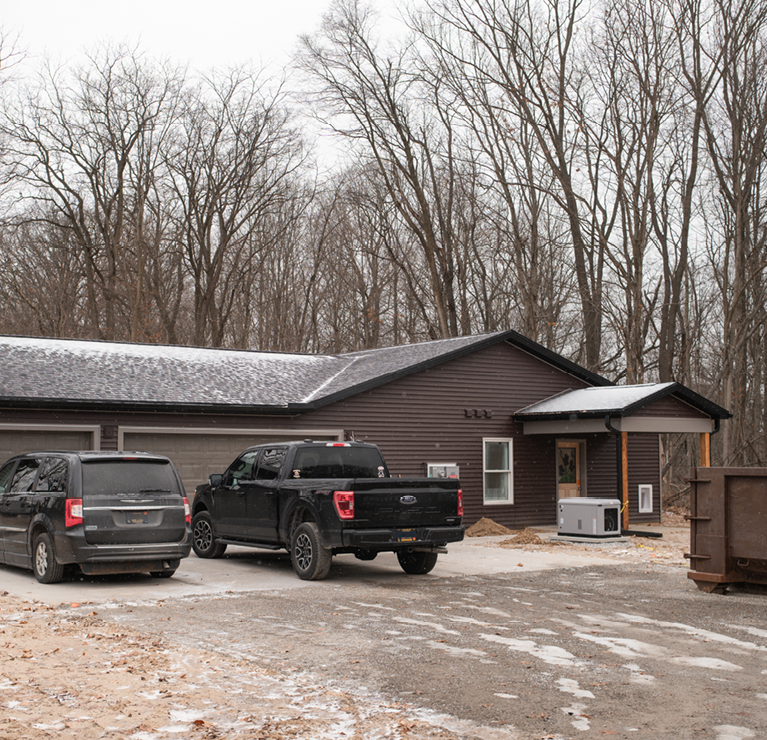
With construction now nearly complete, the Keslers look forward to moving into a home that will accommodate their needs today and for years to come.
For the first time in years, the Keslers’ new home will provide Victoria the ability to live in a way most people take for granted – without barriers. Concrete floors will provide a smooth surface for her wheelchair, a customized garage and lift will help her enter and exit the home safely, and sidewalks outside have been designed to allow her to spend time outdoors. She already has plans for a butterfly garden on the property. In the future, Jim has plans to purchase a side-by-side vehicle to allow himself and Victoria to ride down to the river that touches their property.
The Keslers have plans to host their family, allowing a place for relatives to stay when they visit to hunt on their land. The home will also allow Jim and Christine a place to “age in place” without the worry of needing to relocate in the future. They also intend to pass the home down to Victoria and her brother, James, who also suffers from M.S.
Summing up her feelings about her new home, and the conclusion of the long journey it took her and her family to see it to fruition, Christine concluded, “it’s well beyond my expectations.”
To view the rest of the 2026 winter Partners articles please click here.
GreenStone remains committed to shaping the future of agriculture and natural resources. We’re continuing this mission by offering thousands of dollars in 2026 scholarship funds to students pursuing careers in these fields.
Since 2010, GreenStone has awarded over $500,000 in scholarships to undergraduate students.
Scholarship Opportunities:
- Up to $40,000 in scholarships for incoming freshmen: $2,000 for students attending a four-year program and $1,000 for those in a two-year program.
- The Dave Armstrong Scholarship Program, named after GreenStone’s former CEO, offers $5,000 each to four current college students.
To apply, applicants must live within GreenStone’s service area (Michigan and select counties in northeastern Wisconsin) and plan to study agriculture, timber, or natural resources. Applicants must demonstrate academic success and leadership in school, community, and agricultural activities.
The application deadline is March 1, 2026. For more details and to apply for a 2026 scholarship, visit www.GreenStoneFCS.com/scholarships.
Success in the timber industry depends on careful planning, strong management, and long-term commitment. GreenStone has proudly been a steady and trusted partner in the lumber industry for decades. To support the continued success of timber professionals, GreenStone is pleased to host free, in-person Logging Forums this March.
We invite you to join us at one of the following sessions with lunch to follow:
Monday, March 16
8:00 a.m. to 12:30 p.m. EST
Island Resort and Casino, Harris, MI
Thursday, March 19
8:00 a.m. to 12:30 p.m. EST
Treetops Resort, Gaylord, MI
Earn & Learn
Attendees who pre-register and attend the full forum in person are eligible to earn four SFI points. GreenStone’s timber industry loan specialists will be available to answer questions and discuss financing options. Each timber forum will also feature updates and insights from industry experts on topics such as:
- Industry and mill updates
- Equipment financing
- Transition and estate planning
- Legislative updates
Registration for 2026 timber forums is now closed. Be on the lookout for future forums near you!
To learn more about timber and forestry loans click here.
Are you looking for the first step toward your future? For many college students, that step begins with an internship. At GreenStone Farm Credit Services, instead of the typical internship or summer job, we provide a launching pad for your career filled with endless opportunities for growth.
We understand the desire for hands-on experiences in your summer internship. With volunteer events, customer visits, and career development opportunities, your internship is a journey where you can grow in a supportive dynamic environment and create meaningful memories with fellow students as a part of an intern cohort.
For each experience, you will be joined with the other college students interning at GreenStone, along with having networking opportunities to meet interns with agricultural companies across the state!
We truly believe growth happens when you’re given the chance to make a real impact. From day one, we’ll encourage you to embark on purposeful projects and contribute to work that drives our mission forward – supporting our rural communities through tailored financial services.
You’ll get the chance to job-shadow, even with departments outside your area of expertise, and collaborate with industry professionals while gaining hands-on experience and developing skills to help sculpt your future career.
GreenStone’s internship experience is shaping the next generation of professionals and making a lasting influence on students across the country. We’re proud to offer an experience that goes beyond the basics, one that builds confidence, leadership, and a strong foundation for your success.
If you’re looking to turn your enthusiasm into impact, we’d love you to take your next step with us. GreenStone doesn’t just offer internships; we offer the opportunity to be part of something bigger. Something that will help shape the future, starting with you. To learn more about our internship program and what possibilities there are for you, click here.