


Land Benchmark Results Point to Market Stabilization
Each year, GreenStone’s team of expert appraisers evaluates the same benchmark properties across Michigan and northeastern Wisconsin to track changes in land values over time. A variety of factors influence these values, including commodity prices, economic conditions, government policies, tourism activity, and weather patterns. GreenStone’s benchmarking system is designed to measure the combined impact of these factors and provide a consistent assessment of how land values have changed over the previous year.
This year, land values pointed to an overall trend of stabilization in the market. Land values showed a steep increase following the pandemic. This year’s land benchmark results suggest a more moderate and sustainable pace of growth than the dramatic gains seen in the years following 2020.
What Stands out About Land Values in 2026
Alongside the same fifteen plots of land that were evaluated in 2025, GreenStone appraised two additional recreational plots this year. The new recreational benchmarks are located in northeastern Wisconsin and southern Michigan and are designed to capture recreational land market trends more effectively.
Both agricultural and recreational land continued to appreciate the most across the benchmark regions, but growth slowed substantially compared to the sharp increases seen in prior years. While the run-up in values eased, there is no indication of a widespread decline in land values.
Dairy and Cash Crop Land Values
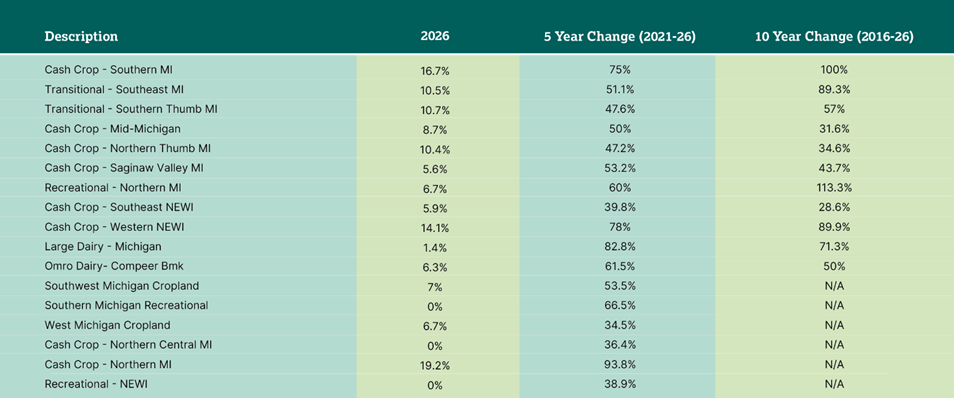
The strongest increase was seen in the cash crop land benchmarks found in northern and Thumb regions of Michigan. Most of these benchmarks increased between 5% – 19%. Cash crop land in northern Michigan experienced the largest increase of all land benchmarks at 19.2%, compared to a 14.5% increase in value of cash crop land in southwest Michigan last year. The increase in cash crop land values in northern Michigan reflects the region’s typical market dynamics, where land value trends have historically followed those observed in southern Michigan.
CAFO (concentrated animal feeding operation) sized dairy farms also grew in value but at a much lower rate than in years past. Large dairies in Michigan increased by just 1.4% compared to a 7.4% increase in 2025, again suggesting stabilization in the market after a period of demand and increase in milk prices following the pandemic.
Recreational and Transitional Land Values
With the addition of the two new recreational benchmarks, the total number of recreational land benchmarks appraised now comes to three, with the existing benchmark located in northern Michigan. Recreational land in northern Michigan did experience a 6.7% increase in value, only a slight drop from a 7.1% increase in 2025. This trend suggests that demand for recreational land remains strong, although competitive pressures appear to have moderated compared with previous years.
Transitional land is defined as agricultural land expected to be developed into another use, such as residential. Both of GreenStone’s transitional benchmarks have increased by more than 10% and have increased in value by more than 50% over the past five years. A strong residential housing market and growing interest in hobby farming and small acreage ownership can be attributed to the continued increase in value for transitional land.
Land Values Across the Region Continue to Stabilize
This year’s land value benchmark analysis points to a market that is continuing to grow, but at a more measured and sustainable pace in contrast with rapid increases seen in the years following the pandemic. While demand for farmland, recreational properties, and small-acreage ownership remains strong, the slower rate of growth across most benchmarks suggests the land market is stabilizing rather than accelerating, with no signs of widespread value declines across Michigan and northeast Wisconsin.
Whether you’re looking to invest in recreational property or considering expanding your farming operations through the purchase of additional farmland, GreenStone’s team of lending experts are here to help you find a solution that’s tailored to you. Click here to learn more about the financial solutions GreenStone provides when it comes to purchasing land.
This article was originally published in Michigan Farm News.
We’re here to help.
With locations across Michigan and northeast Wisconsin, we’re here when you’re ready to talk.